

UNAIR NEWS – Universitas Airlangga (UNAIR) reinforced its
commitment to building campus integrity through collaboration with Indonesia’s Corruption Eradication Commission (KPK). During the postgraduate inauguration ceremony for the 2025/2026 odd semester, the KPK was represented by Abdul Aziz Suhendra, Head of the Gratification and Public Services Task Force, who delivered a
presentation on corruption and gratuities within the higher education environment.
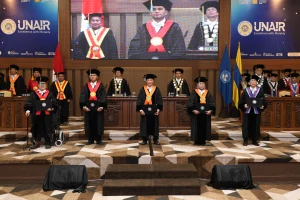
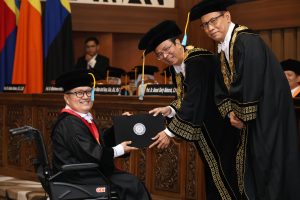
The event, held on Thursday, August 8, 2025, at the Airlangga Convention Center (ACC), served as a platform to promote anti-corruption awareness among academics.
Education: the third pillar of KPK strategy
In his presentation, Suhendra emphasized that although the KPK is widely known for its enforcement role, work is based on three main pillars: enforcement, prevention, and education.
“Universities hold a crucial role in shaping the character of future leaders. Therefore, anti-corruption education is a key strategy that we continue to advance,” he stated.
He also highlighted that Indonesia’s Corruption Perception Index remains low, even ranking below several neighboring countries. This condition highlights the importance of strengthening systems, policies, and personal integrity to combat corruption effectively.
Gratuities: legal, illegal, and often misunderstood
A key point of discussion was the concept of gratuities, which is frequently misunderstood. Suhendra explained that not all forms of giving are considered corrupt practices.
“Certain gratuities are permissible, such as wedding gifts within a specified limit or exchanges between colleagues under certain thresholds. However, when a gift is linked to one’s position or authority and is not reported, it becomes problematic,” he said.
The KPK has noted that many gratuity reports are unnecessary, indicating that public understanding of the distinction remains limited.
Universities are not immune to risk
Suhendra outlined several potential risks of gratuities within higher education, including student admissions processes, academic evaluations, and the management of research and institutional assets. In some cases, risks also arise from gifts given to universities following acceptance through independent admission pathways.
“Universities can act as both recipients and sources of gratuities, for instance, when accepting research projects that involve certain obligations. These are risks that require careful attention,” he explained.
Students as agents of change
In closing, Suhendra encouraged students to actively participate in the anti-corruption movement from an early stage. “Corruption is not only about systems, but also about intent, and intent can be shaped through education,” he concluded.
The event underscored that strengthening integrity is not solely the responsibility of government institutions, but also a shared responsibility of the academic community in building a corruption-free Indonesia.
Author: Nafiesa Zahra
Editor: Khefti Al Mawalia