
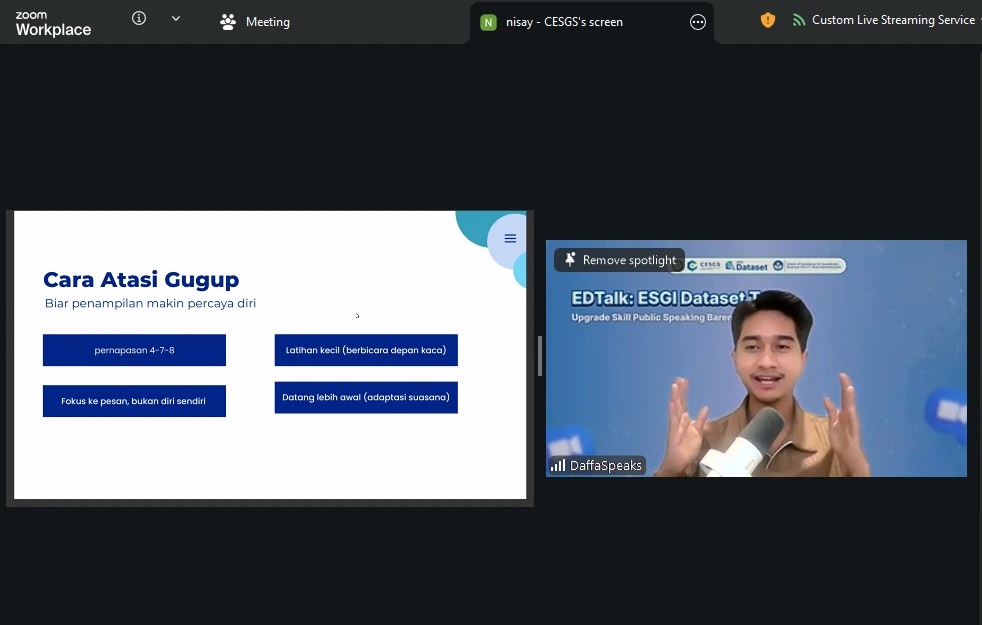
UNAIR NEWS – ESGI Dataset Center for Environmental, Social, and Governance Studies (CESGS) Universitas Airlangga (UNAIR) once again convenedEdTalk: ESGI Dataset Talk with the theme Upgrade Public Speaking Skills with Kak Daffa. The event was conducted online via Zoom Meeting on Saturday, April 11, 2026.
Public speaking coach and content creator Teuku Daffa revealed that around 80 percent of university students experience anxiety when speaking in public. He explained that this fear often stems from a paralysing pursuit of perfection that prevents individuals from speaking before they feel fully prepared. “Students tend to overthink before presenting and feel that they are not good enough to speak,” he said.
Tips for effective public speaking
Furthermore, Daffa explained several techniques to help individuals begin speaking in public. One of them is the 4-7-8 breathing technique, which can help reduce nervousness.
“In fact, adrenaline hormones are triggered when we feel anxious or nervous. Through this technique, you can inhale for four seconds, hold your breath for seven seconds, and exhale for eight seconds,” he explained.
He also shared additional strategies to manage nervousness, including practicing in front of a mirror to become more familiar with facial expressions and delivery style. In addition, focusing on the message being conveyed is essential to prevent attention from being dominated by fear.
Arriving early at the venue to adapt to the environment is also an important factor. “We also need to develop communication skills, both verbal and nonverbal, which are essential in public speaking,” he added.
Building confidence in front of an audience
Daffa also elucidated strategies to build confidence when speaking before an audience. He emphasized the principle of “three times practice, one time confident performance,” which involves practicing in front of a mirror, conducting simulations with peers, and recording one’s voice while speaking. These methods have proven effective in boosting confidence.
“The formula is simple. If you want to perform once, you need to practice three times. For example, if you are going to speak for two hours, you should practice three sessions of two hours each in front of family, friends, and a mirror,” he explained.
In addition, he introduced the STOP technique (Stay Calm, Picture Success), which involves taking a brief pause before starting a presentation and visualizing a smooth delivery. This approach helps build positive mental suggestions.
Lastly, Daffa highlighted the FEED principle (Feedback, Evaluate, Elevate, Do Better), which encourages speakers to seek feedback and conduct evaluations in order to improve future presentations. “A public speaker must continuously seek feedback,” he concluded.
Author: Amelia Farah Putri Iswara
Editor: Yulia Rohmawati