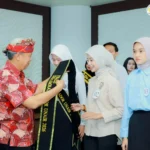
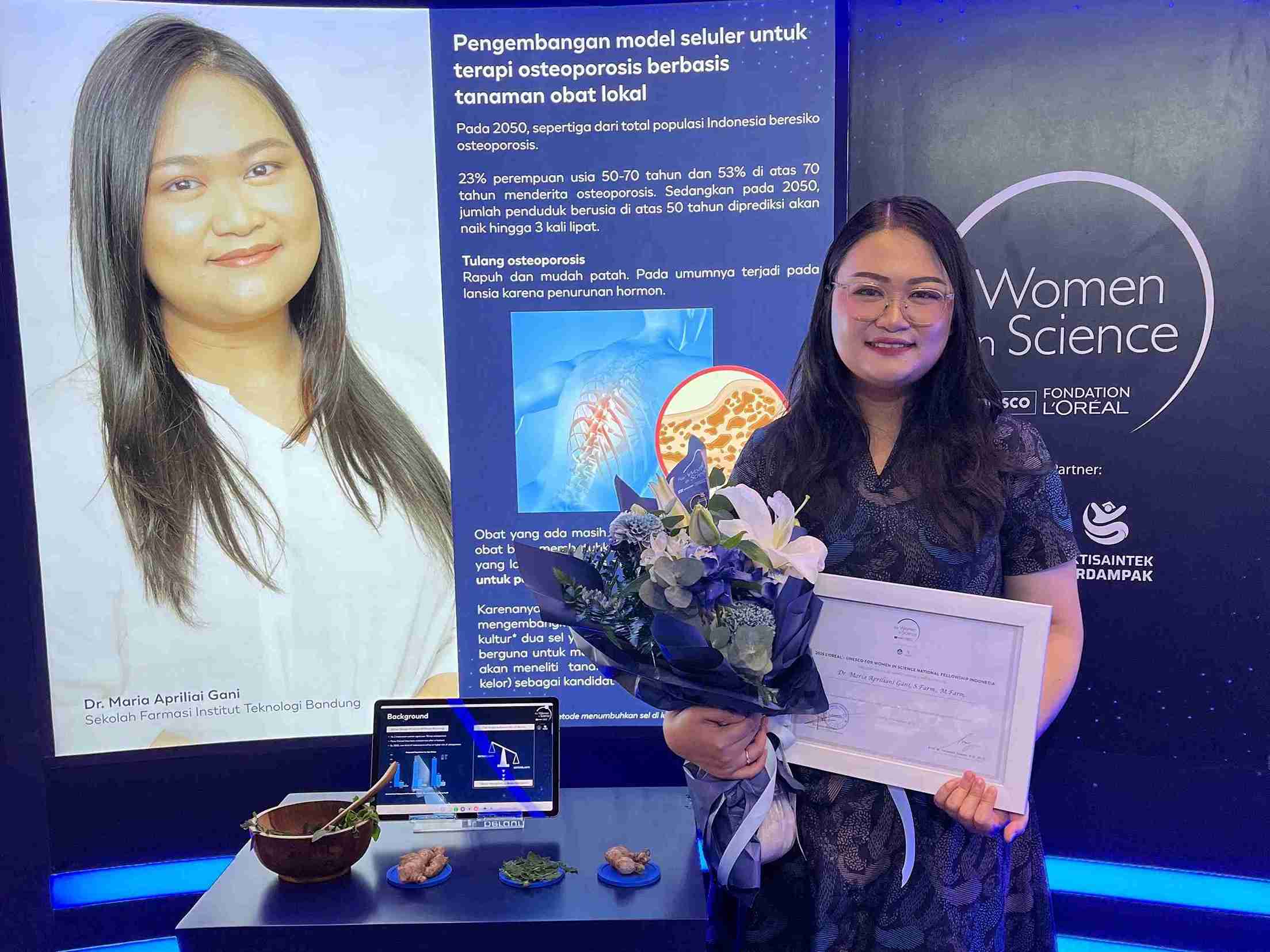
UNAIR NEWS — Osteoporosis remains a major global health issue affecting quality of life, particularly among women. The condition stems from an imbalance between osteoblasts, the cells that build bone, and osteoclasts, the cells that break it down. Current therapies still fall short of fully restoring bone health. Confronted with this challenge, Dr. Maria Apriliani Gani, an alumna of the Master to Doctoral Education Scholarship Programme for Excellent Scholars (PMDSU) program UNAIR’s Faculty of Pharmacy, pursued a rigorous research path that ultimately earned her the 2025 L’Oréal–UNESCO For Women in Science (FWIS) Award.
Research model
The young UNAIR PhD graduate developed a cellular model designed to replicate osteoporotic conditions. Her model provides a more biologically relevant platform for drug screening compared to existing testing methods.
“This model is essentially a dual-cell culture system featuring osteoblasts and osteoclasts. It mirrors the osteoporosis environment found in human bone. We hope it will eventually serve as an alternative to animal testing in osteoporosis research,” Dr. Gani explained.

She also incorporated an integrated in vitro–in silico approach to accelerate the discovery of bioactive metabolites from Indonesian medicinal plants. Based on her initial predictions, several local plants show promising anti-osteoporosis potential.
“In this project, I collaborated with a professor from UI’s Faculty of Pharmacy to characterize bioactive metabolites and strengthen the herbal-medicine component. Using the cellular model I developed, we can assess how candidate plants enhance bone formation while inhibiting osteoclast activity,” she said.
Impact and challenges
Dr. Gani’s research holds meaningful implications for women, particularly those at highest risk of post-menopausal osteoporosis. Her work may help lay the groundwork for safer, plant-based therapies. It also contributes to faster, more effective diagnostic and drug-screening tools, ultimately improving the well-being of older women.
She acknowledged that, despite her youth and limited professional experience, impactful research demands strong teamwork and complementary expertise. “That’s why I must be proactive in collaborating with other researchers and in seeking partners, whether final-year students or research assistants, who are interested in working with me,” she said.
She added that UNAIR provided her with a strong foundation in critical thinking, discipline, and lifelong learning. She also offered a message for UNAIR students and early-career researchers: “Take full advantage of every opportunity you have. Don’t be afraid to dream big, don’t hesitate to try new things, and never stop learning.”
Author: Adinda Octavia Setiowati
Editor: Yulia Rohmawati