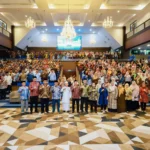
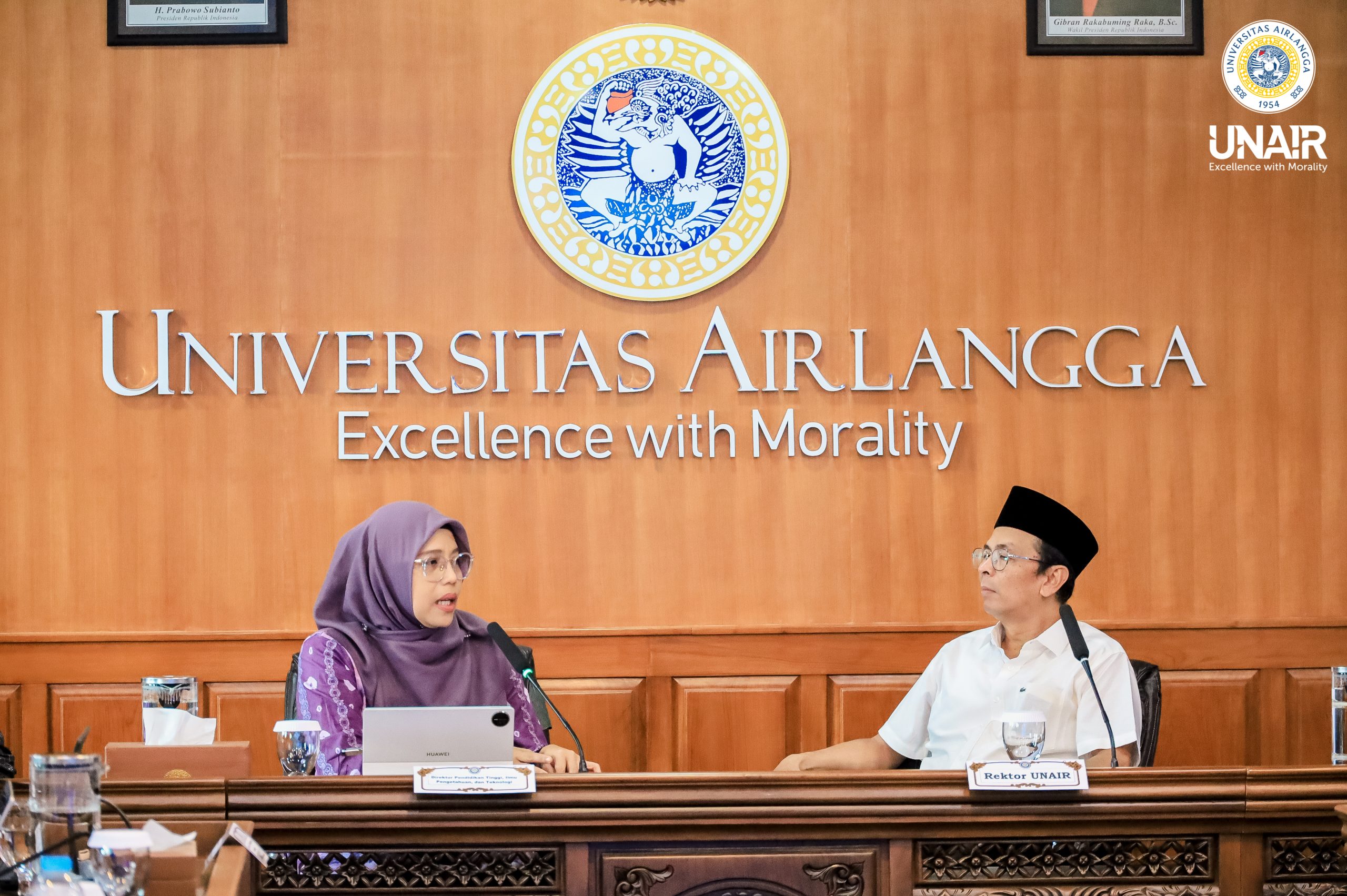
UNAIR NEWS – Universitas Airlangga (UNAIR) welcomed an official delegation from the Directorate of Higher Education and Science & Technology at the National Development Planning Agency (Bappenas) on Friday (Nov 21, 2025). The meeting, held in the Plenary Room of Balai RUA, 4th floor, marked a key moment for UNAIR to deepen its collaboration in advancing higher education, research, and national innovation.
UNAIR Rector Prof Dr Muhammad Madyan SE MSi MFin, together with university leaders, personally received the Bappenas representatives. The visit aligned with the series of events marking UNAIR’s 71st Dies Natalis, providing a timely opportunity to reflect on UNAIR’s role in supporting national development goals.
Focus on developing UNAIR Science and Techno Park
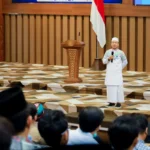
In his welcoming remarks, Prof Madyan emphasized the strategic value of the visit, particularly concerning two major priorities: the establishment of UNAIR’s Science and Techno Park and a Center of Excellence in Inclusive Health.
“UNAIR has substantial research capacity across its 16 faculties and one school. Building a Science and Techno Park is essential to bridging academic discovery with industry needs and public benefit,” he said.
The UNAIR Science and Techno Park is envisioned as a robust innovation hub that will accelerate the commercialization of research in health, life sciences, and digital technology. The initiative is expected to nurture technology-based startups and support a knowledge-driven economy.
Among UNAIR’s flagship strengths is its Faculty of Veterinary Medicine, which has produced numerous patents in veterinary science and food safety. UNAIR has also contributed significantly to national vaccine development, including seed vaccines for H5N1, H1N1, and the Merah Putih COVID-19 vaccine.
“We hope Bappenas’ insights and support will continue to strengthen UNAIR’s research impact, ensuring the Science and Techno Park is fully aligned with national development priorities,” Prof Madyan said.
He added that UNAIR researchers remain committed to delivering advanced biotechnological solutions and supporting vaccine sovereignty for Indonesia. “We look forward to Bappenas’ guidance so that the design and implementation of the Science and Techno Park are in sync with the National Development Master Plan and generate measurable economic benefits,” he continued.
The Science and Techno Park is planned to be built in Madura, with expectations that its development will help stimulate the region’s economic growth.

Development of Center of Excellence for Inclusive Health
Prof Madyan also reaffirmed UNAIR’s commitment to developing a Center of Excellence in Inclusive Health, an initiative aimed at expanding equitable healthcare access, particularly for vulnerable populations and those living in remote 3T (frontier, outermost, least developed) regions.
“The Center of Excellence is designed to become a national and regional leader in addressing disparities in healthcare services. We want UNAIR’s research outputs and services to be accessible to all communities,” he stated. The initiative aims to drive the creation of equitable health policies, diagnostic tools, and service models that uphold fairness and social justice.
UNAIR and Bappenas strengthen synergy
The senior economist and UNAIR professor expressed hope that the visit would produce strategic direction and actionable recommendations for advancing science, technology, and higher education in Indonesia.
“We are ready to collaborate to ensure that UNAIR’s resources, expertise, and capabilities deliver maximum benefit for the nation and help realize a fair, advanced, and sustainable Indonesia,” he said.
Meanwhile, Bappenas Director for Higher Education and Science & Technology, Endang Sulastri, emphasized that the visit was part of ongoing monitoring efforts for both long-term and medium-term development plans. “We are reviewing projects already incorporated into key planning documents. We want to see how they are being executed on the ground,” she explained.
During discussions, Bappenas highlighted two core issues. The first concerned medical education, specifically the debate between hospital-based and university-based specialist training systems.
“We have coordinated with the Presidential Staff Office. We all recognize that the hospital-based system can accelerate the production of medical specialists. Our goal is to ensure that specialists are trained with consistent quality to deliver optimal healthcare services,” Sulastri said.
The second major topic focused on UNAIR’s Science and Techno Park, which is a priority initiative within Indonesia’s long-term science and technology development strategy.
“The Science and Techno Park is one of our priority agendas. It represents an important tool for maximizing the impact of science and technology in national development. We hope UNAIR’s STP becomes a model for other universities,” she noted.
“With UNAIR planning to develop the STP in Madura, our team will examine the existing plans in detail. We may offer recommendations to ensure full alignment and effective coordination,” she added.
The visit concluded with an in-depth discussion between UNAIR and Bappenas officials on long-term planning needs, innovation strengthening, and the practical steps that will guide implementation moving forward.
Author: Khefti Al Mawalia