

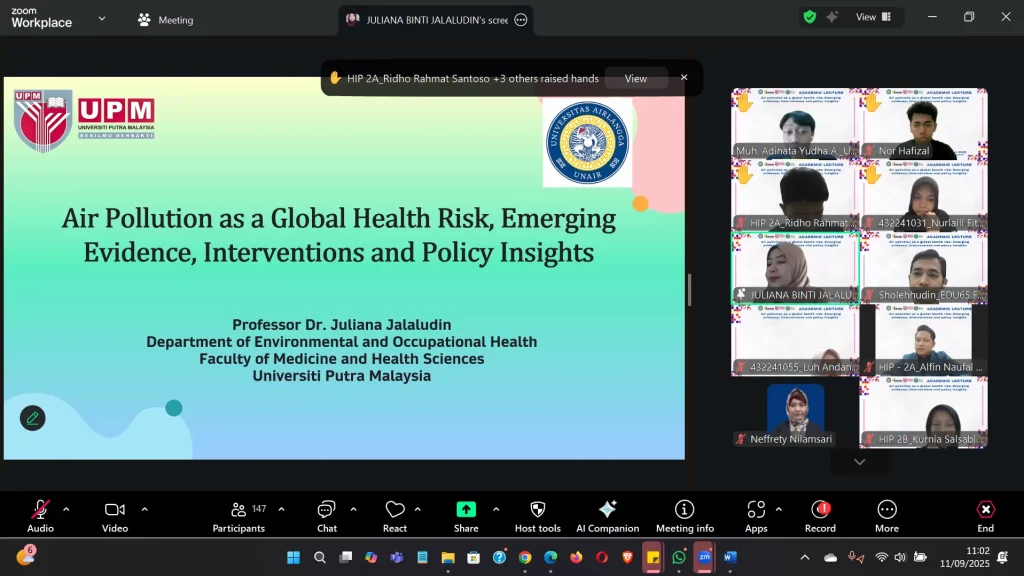
UNAIR NEWS – The Applied Occupational Safety and Health (OSH) Program, Faculty of Vocational Studies (FV), Universitas Airlangga (UNAIR), in collaboration with Universiti Putra Malaysia (UPM), held an International Academic Lecture to commemorate the International Day of Clean Air for blue skies. Held virtually, the event carried the theme “Air Pollution and Potential Health Risk: Emerging Evidence, Interventions, and Policy Insight,” and brought together 168 participants from three different countries.
Global concerns on air pollution
The lecture featured renowned air pollution expert Prof. Juliana Jalaludin from UPM’s Faculty of Medicine and Health Sciences as the keynote speaker. She presented the latest findings on the global health impacts of air pollution, emphasizing its link to respiratory illnesses, cardiovascular diseases, and developmental disorders in children.
“Air pollution has evolved from being an environmental problem into a global health crisis that demands a multidisciplinary response,” Prof. Jalaludin asserted.
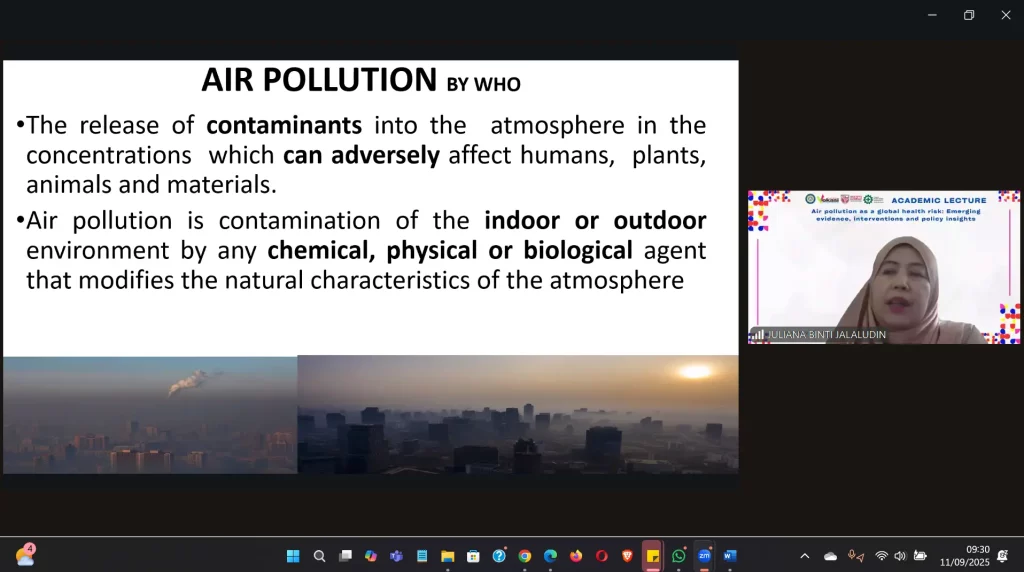
She also outlined a range of effective intervention strategies, including real-time air quality monitoring technologies and evidence-based policy approaches. “In Malaysia, the Air Quality Health Index (AQHI) has proven useful in helping citizens make informed, protective decisions when air conditions worsen,” she explained.
The event attracted participants from Indonesia, Malaysia, and Bangladesh, consisting of academics, OSH professionals, and students. In his remarks, Tofan Agung Eka P., SKep, MKKK, PhD, Coordinator of the Applied OSH Program at UNAIR, highlighted the significance of cross-border collaboration in advancing occupational health and safety studies. “Our partnership with UPM demonstrates our dedication to bringing a global perspective to OSH challenges, particularly those tied to air pollution,” he said.
Moderated by Mochammad Sholehhudin, SKM, MKL, the discussion session was lively and engaging. Participants raised insightful questions about the effectiveness of emission control policies, the role of industries in curbing air pollution, and how air quality issues can be integrated into OSH curricula.
Air pollution poses a major risk to both worker safety and global public health. According to the World Health Organization (WHO), 99% of the world’s population breathes air that exceeds safe standards. “Through discussions like this, we aim to foster evidence-based policymaking and encourage innovation in air pollution control within work environments,” Tofan Agung Eka P stated.
Policy recommendations and future impact
The insights and recommendations from this academic exchange are expected to inform OSH-related policies in both corporate and governmental sectors. Key takeaways include strengthening air quality monitoring systems in industrial areas, incorporating air pollution exposure assessments into OSH management systems, and developing occupational health protocols for industries with high pollution risks.
The event concluded with a virtual group photo symbolizing the shared commitment of both institutions to ongoing cooperation in tackling air pollution challenges. “This marks the beginning of a sustained partnership between UNAIR and UPM to pursue innovative solutions for global environmental and occupational health issues,” the coordinator concluded.
Author: M. Sholehhudin
Editor: Yulia Rohmawati