
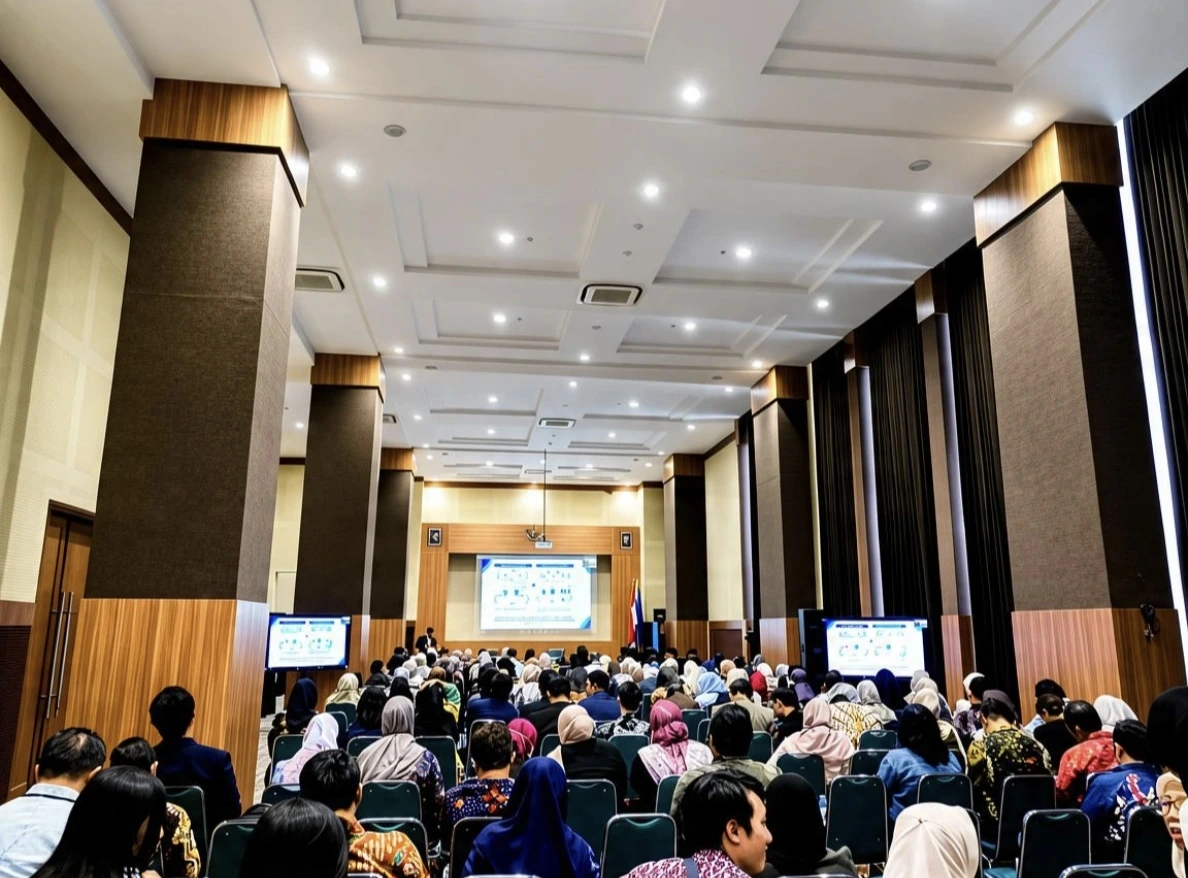
UNAIR NEWS – Two heart attack patients prescribed the exact same medication and dosage may not experience the same results. The smallest genetic difference can determine whether a medication works optimally, or instead carries hidden risks. This was the subject examined by Assoc Prof Doreen Tan Su-Yin from the National University of Singapore (NUS) and the National University Heart Centre Singapore, at the International Graduate Student Conference on Pharmaceutical Sciences (IGSCPS) 2026, held by the Faculty of Pharmacy, Universitas Airlangga (UNAIR), Saturday (September 19, 2026).
The conference brought together master’s students in pharmacy from universities in Indonesia and across ASEAN, featuring a presentation by Prof Tan titled “Implementing Precision Cardiovascular Pharmacotherapy in Southeast Asia: Opportunities and Challenges.”

Why can the same medicine lead to different results?
Prof Tan opened her presentation with the concept of precision health, a treatment approach that no longer applies the same standard to every patient. “Precision health is essentially a healthcare approach that does not apply uniform treatment to every individual. This approach aims to deliver the right therapy to the right individual at the right time,” she explained.
This approach takes into account genomic data, digital and clinical history, lifestyle, and environmental and family factors. She cited several Asian countries, including Singapore through its SG100K initiative, as well as China, South Korea, and Japan, which are actively pushing genomic research into everyday clinical practice.
Beyond the disease, understanding the person
According to Prof Tan , the medical world’s perspective is shifting, from simply treating disease to understanding patients as whole individuals. “We cannot focus only on the disease itself. Psychological, social, family, and cultural factors also need to be considered, because all of these can affect how a patient responds to treatment,” she said.
One concrete example involves a gene called CYP2C19. Some patients with this gene variant do not respond well to Clopidogrel, a blood thinner commonly prescribed after a heart attack. Alternatives such as Ticagrelor or Prasugrel are more effective at reducing the risk of a repeat heart attack, but carry a higher risk of bleeding. Because of this, adjusting the dosage and type of medication based on a patient’s genetic profile becomes crucial.
“This is no longer just theory. In Singapore, gene-based drug adjustment has been part of national practice since 2022, following a long journey that began with the first trial in 2013,” Prof Tan said.
Supporting heart patients after hospital discharge
As a solution to the gap in post-heart attack care, Prof Tan introduced the AMI-HOPE program, a pharmacist-led support program for patients after they return home from the hospital. The program includes self-monitored blood pressure tracking through an app, automatic reminders, routine online consultations, and virtual cardiac rehabilitation, before patients are eventually handed over to the nearest primary healthcare facility.
The presence of world-class experts like Prof Tan at IGSCPS 2026 reaffirms the position of the Faculty of Pharmacy (FF) UNAIR as a hub for regional pharmaceutical scientific discussion, while also opening up opportunities for further research collaboration between UNAIR and ASEAN’s academic network in pharmacotherapy and health.
Author: Farelnanda Ramadhani
Editor: Ragil Kukuh Imanto