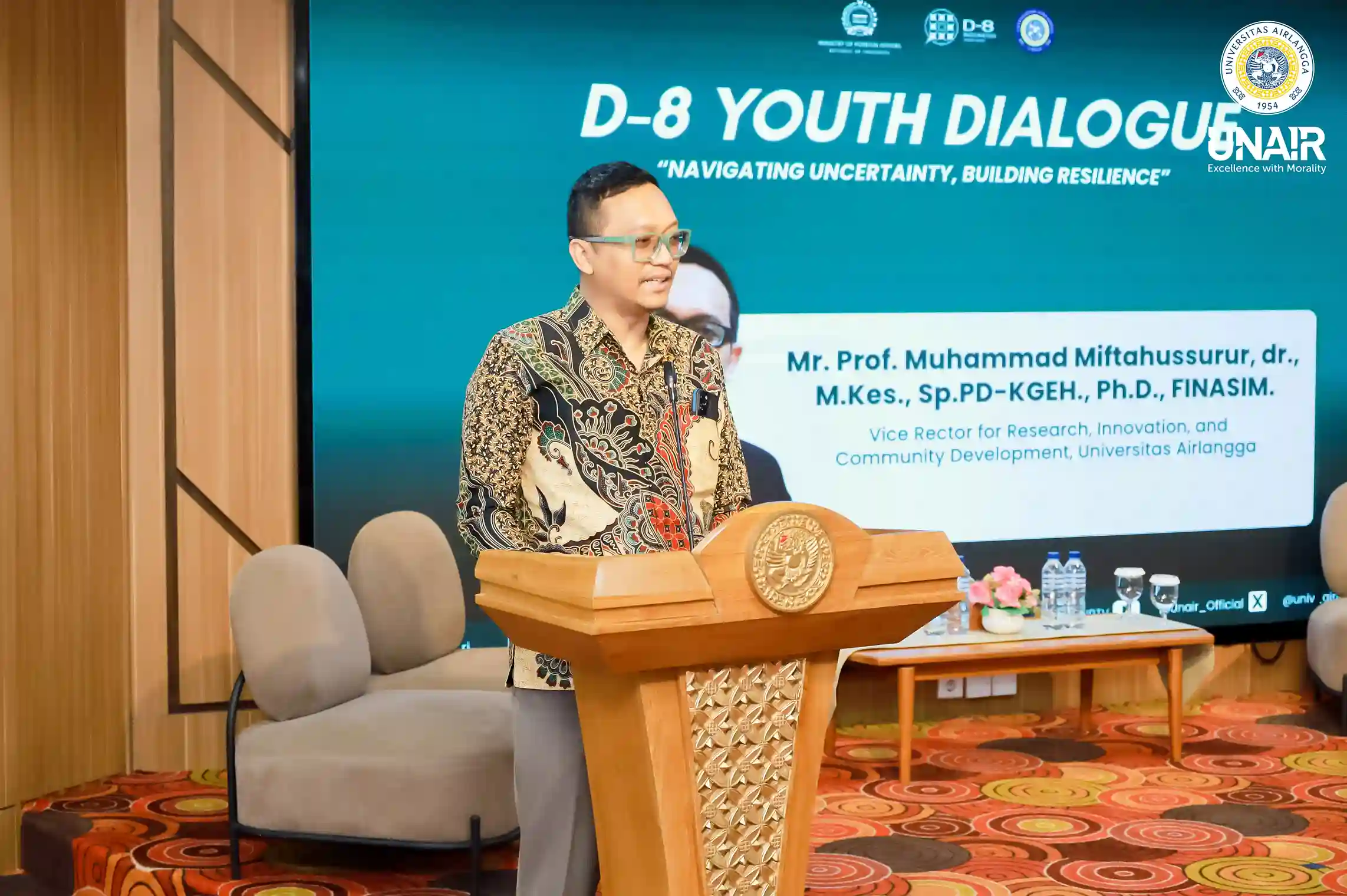
UNAIR NEWS – As part of Indonesia’s chairmanship of the D-8 for the 2026–2027 period, Universitas Airlangga (UNAIR) was appointed by Indonesia’s Ministry of Foreign Affairs to host the Preliminary Discussion of the D-8 Youth Dialogue under the theme “Navigating Uncertainty, Building Resilience.” The event was held on Wednesday (June 3, 2026) at Majapahit Hall on the fifth floor of the ASEEC Building, Dharmawangsa-B Campus, UNAIR.
The dialogue brought together a wide range of stakeholders, including government representatives, academics, members of the diplomatic corps from D-8 member countries, and students from universities across Surabaya. The forum served as a platform for exchanging ideas on global challenges and discussing the role of young people in building resilience across strategic sectors.
Universities’ role in addressing global challenges
In his remarks, UNAIR Vice Rector for Research, Innovation, and Community Development (RICD), Prof. Muhammad Miftahussurur, MD, M.Kes., Sp.PD-KGEH, Ph.D., FINASIM, said the theme was highly relevant to current global conditions. According to him, the world’s increasingly complex challenges require collective responses and strong adaptability, particularly from younger generations.

“Geopolitical uncertainty, food security challenges, and energy resilience require coordinated responses from multiple stakeholders. Young people have a vital role to play in navigating these changes,” he said.
Prof. Miftahussurur explained that universities have a responsibility to facilitate cross-sector dialogue and develop research-based solutions to global issues. He emphasized that collaboration among various stakeholders is essential to addressing future challenges. “UNAIR will continue to promote collaboration among academics, government, industry, and society to tackle the challenges of the future,” he said.
Youth and future of diplomacy
Prof. Miftahussurur also highlighted the importance of energy resilience as a cornerstone of development. According to him, the energy sector is closely linked to social stability, technological advancement, industrial activity, transportation systems, and overall economic well-being.
At the same time, he noted that the youth possess significant potential to drive innovations that support energy resilience and sustainable development. Innovations ranging from artificial intelligence-based solutions and sustainable business models to digital systems continue to emerge through the contributions of young researchers, engineers, startup founders, and entrepreneurs.
Concluding his remarks, he expressed hope that the forum would generate practical solutions from the younger generation. He also said he hoped the dialogue would further strengthen Indonesia’s role in global diplomacy. “I hope this discussion will produce ideas that contribute to enhancing Indonesia’s role, particularly in addressing global food security and energy resilience issues,” he concluded.
Author: Maia Chaerunnisa
Editor: Yulia Rohmawati