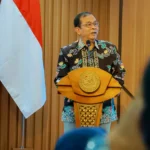

UNAIR NEWS – Digital spaces have created new opportunities for women to express their ideas and participate more actively in public discourse. However, those opportunities have also been accompanied by increasing risks of online harassment and digital violence. Prof. Dra. Myrtati Dyah Artaria, M.A., Ph.D., Chair of Universitas Airlangga’s (UNAIR) Task Force for the Prevention and Handling of Violence in Higher Education (Satgas PPKPT), said the growing presence of women online has coincided with heightened exposure to digital attacks.
Digital spaces offer both opportunity and risk
Prof. Artaria, a professor of bio-anthropology and forensic anthropology at the Faculty of Social and Political Sciences (FISIP) UNAIR, explained that digital spaces provide women with significant opportunities to pursue new forms of participation and engagement. At the same time, she noted, those spaces also introduce new threats.
“On the one hand, digital spaces give women opportunities to work, build networks, voice opinions, and participate in social advocacy. On the other hand, these same platforms also facilitate forms of violence and harassment that are often more difficult to control than those occurring in physical spaces,” she said.
Patriarchal culture continues to influence online behavior
According to Prof. Artaria, women’s vulnerability in digital spaces is closely tied to the persistence of patriarchal culture. “Women are more frequently targeted with negative comments, body shaming, and personal attacks on digital platforms because the internet continues to reflect long-standing gender inequality and patriarchal norms within society. The technology may be modern, but the treatment of women often mirrors what happens in the real world,” she explained.
She noted that women’s identities are frequently associated with personal characteristics such as appearance, emotions, morality, and social relationships. As a result, criticism directed at women in public spaces often shifts away from the substance of their ideas and instead focuses on their personal identity. Consequently, when women participate in public discourse, reactions frequently center not on what they say, but on who they are.
Prof. Artaria emphasized that digital spaces should not be viewed as separate from broader social life. “The digital world is deeply connected to society. Social values, norms, and cultural attitudes are carried into online spaces. That is why the way women are treated online often reflects how they are treated offline,” she said.

Patterns of online attacks and the need for greater support
Digital attacks against women often escalate over time. What begins as degrading comments can develop into threats, the spread of personal data, and technology-facilitated sexual violence.
Prof. Artaria said the impact of such experiences can be far-reaching and multifaceted. “Negative experiences in digital spaces can affect women in many ways, including their mental health, self-identity, social relationships, and even their academic and professional development,” she explained.
She also underscored the importance of improving digital literacy. According to her, many internet users misunderstand freedom of expression as the right to say anything without considering ethical standards in online communication. For that reason, creating healthier digital environments requires change at multiple levels, from individual behavior to broader institutional and policy reforms.
Prof. Artaria encouraged women to remain confident and continue contributing their ideas and work. “Do not let fear cause you to diminish yourself. The digital world needs women’s voices, perspectives, creativity, and presence. At the same time, protecting yourself online is not a sign of weakness, but a form of awareness and self-protection,” she concluded.
Author: Maulya Afifah Zahra
Editor : Khefti Al Mawalia