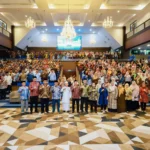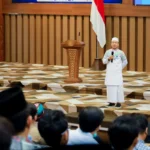
UNAIR NEWS – Research practices in the social sciences and humanities are undergoing a major shift, especially in how data is gathered and how researchers convey their findings. While qualitative work has long centered on interviews and focus groups, scholars are increasingly using creative approaches to capture emotions, experiences, and perspectives that are difficult to express verbally. This evolving landscape was the focus of a guest lecture titled Creative Methods and Non-traditional Research Outputs (NTROs) hosted by the Department of English Language and Literature, Faculty of Humanities, Universitas Airlangga, on Thursday (20/11/2025).
The event featured Aireen Grace Andal, PhD, from the International Institute for Asian Studies and the Airlangga Institute of Indian Ocean Crossroads. Andal underscored that creative methods should not be viewed as secondary tools, but as transformative approaches capable of challenging traditional assumptions about how knowledge is produced.
Creative methods and the limits of conventional qualitative research
Andal noted that creative methods are gaining momentum across social and humanities research. She argued that traditional techniques, particularly those relying heavily on interviews or FGDs, are no longer adequate for capturing the full complexity of human experiences.
“The methodological landscape is shifting in bold new ways. We can’t rely solely on interviews or FGDs anymore,” she said.
She added that Western academic traditions have long shaped what counts as “valid” research, often prioritizing accurate representation above all else. Yet, she emphasized, reality cannot always be captured with precision.
Andal encouraged researchers to embrace alternative pathways for knowledge creation. “There are many ways to produce knowledge beyond the fixation on realistic representation,” she said. She urged students to explore imaginative, creative, and participant-centered approaches that push the boundaries of conventional qualitative methods.
She presented several examples of creative research tools, including drawing, painting, collage, photography, and video, that allow participants to express their stories more authentically.
“When words aren’t enough, visual art becomes essential,” she added, explaining that these methods help researchers navigate sensitive topics without requiring participants to recount traumatic experiences directly.
NTROs as emerging academic outputs
Andal also discussed the rising prominence of Non-traditional Research Outputs (NTROs), especially in the Oceania region. She highlighted that scholarly work is increasingly being presented through formats such as comic-based dissertations, ethnographic films, and animated projects, outputs that are now recognized as legitimate academic contributions.
She stressed that as long as research is grounded in solid analysis, theory, and methodology, it does not need to take the form of a lengthy written thesis. “If your data and analysis are strong, your research can be expressed in many different forms,” she said.
Andal also introduced social fiction as a creative strategy for addressing sensitive topics while protecting participant identities. “Sometimes the most effective way to tell a story is not to tell it directly,” she noted.
She closed her lecture with a reference to the song Naughty from the musical Matilda, which she believes captures the spirit of creative inquiry, reminding researchers that sometimes they must be “a little bit naughty” to challenge outdated rules and reshape academic storytelling.
Author: Tsabita Nuha Zahidah
Editor: Khefti Al Mawalia