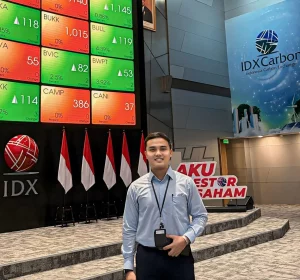


UNAIR NEWS – Mark Jhosua, a student from Faculty of Social and Political Sciences (FISIP), Universitas Airlangga (UNAIR), has been selected to represent Indonesia at the International Conference 249th ECS Meeting 2026. On Thursday, October 30, 2025, he was officially named as Indonesia’s delegate for the event, which will take place in Seattle, United States. Jhosua was selected through Indonesian Student Pathway for Blue Science (JPISB), an initiative by International Blue Carbon Institute. The program screened hundreds of students across Indonesia before selecting eight top participants for an intensive one-week training program in Bali.
From the training, only one participant earned the opportunity to represent Indonesia, and Jhosua emerged as the top candidate. “Alhamdulillah, I was selected to represent Indonesia. This program is fully funded, and I will depart alongside a representative from the Ministry of Marine Affairs and Fisheries,” Jhosua said.
Jhosua said he had long shown strong interest in marine issues. He views the ocean not only as a natural resource but also as a key source of livelihood for many communities in Indonesia. His interest in marine conservation began during junior high school, when he became actively involved in research related to ocean conservation.

“I have long been concerned about the ocean. Many Indonesians depend on it for their livelihoods. My social media algorithms often display content related to marine issues and conservation, which led me to discover events relevant to my research,” he said.
From ritual to blue carbon
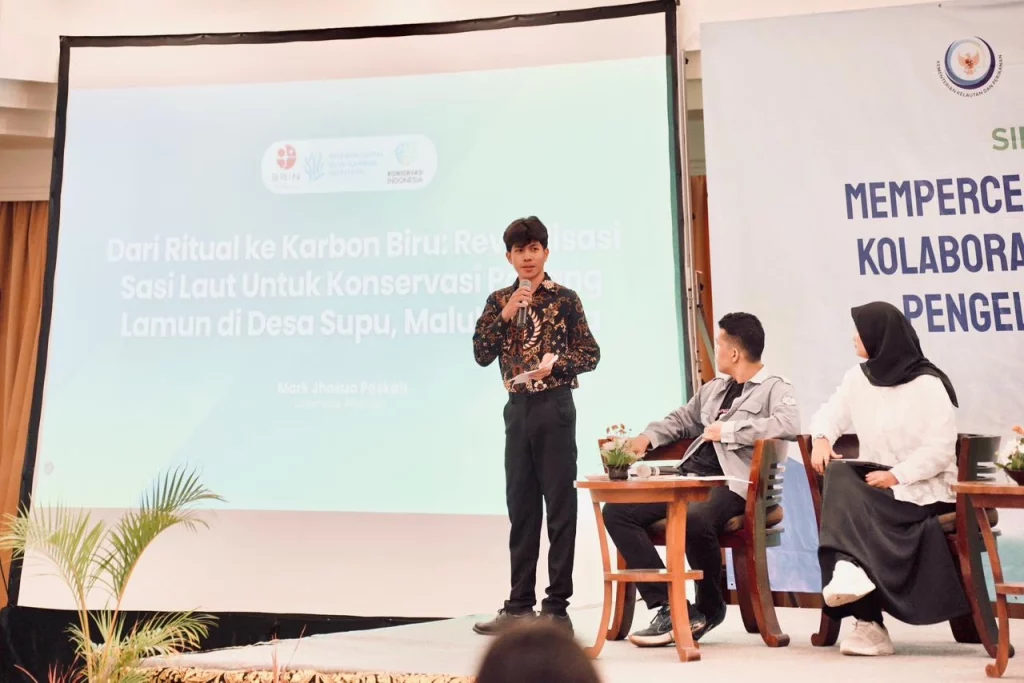
At the upcoming conference in Seattle, Jhosua will present his research titled From Ritual to Blue Carbon Revitalizing Sasi Laut for Seagrass Conservation in Supu Village North Maluku. The study explores integration of Sasi Laut, a local cultural practice, with a blue carbon conservation approach. Sasi Laut is a traditional system in North Maluku that regulates use of marine resources within specific periods to preserve ecosystem sustainability.
“I aim to integrate Sasi Laut as an effective conservation method. Local communities tend to follow customary rules more closely than formal regulations, which shows strong potential for protecting seagrass ecosystems,” Jhosua said.
During his presentation in Bali, Jhosua also explained that seagrass ecosystems contribute about 30 percent of global blue carbon, alongside the significant role of mangroves. However, limited research has examined integration of both ecosystems. Through this study, he hopes collaboration between seagrass and mangroves can lead to greater carbon absorption.
“I hope this research can serve as a concrete step to strengthen marine conservation in Indonesia and reinforce its position in global blue carbon research,” Jhosua said. With his commitment to innovation and passion for marine issues, Jhosua not only represents Universitas Airlangga but also brings Indonesia’s cultural and environmental preservation efforts to the international stage.
Author: Rizma Elyza
Editor: Yulia Rohmawati