

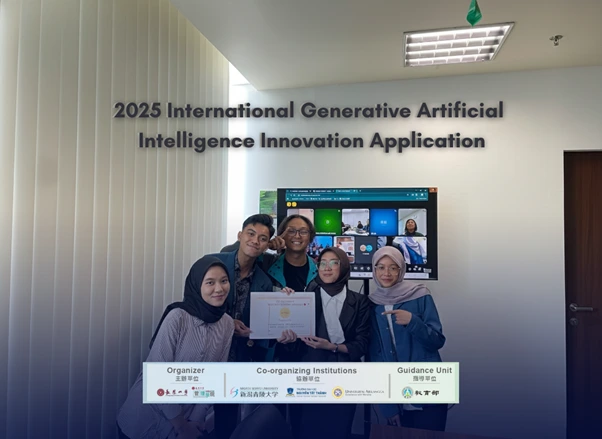
UNAIR NEWS – Universitas Airlangga (UNAIR) students have once again earned international recognition. The Bismillah Winner team claimed first place at Chang Jung Christian University (CJCU) with their innovation, “Generative Medical Intelligence: Integrating CNN-Based Tumor Segmentation with Large Language Models for Automated MRI Interpretation.” The team won in the 2025 International Generative Artificial Intelligence Innovation Application Competition, with the awards ceremony held on Friday, December 19, 2025, in Taiwan.
The innovation presents an AI-based medical system that combines Convolutional Neural Networks (CNN) for tumor segmentation with Large Language Models (LLM) to generate narrative MRI interpretations. The team consists of Venny Pramudita Rahayu from the Faculty of Science and Technology (FST), Afifah Noeralinda Ayu and Nazira Elok Safitri from the Faculty of Public Health (FKM), and Nauval Syahferi and Gravano Alfa from the Faculty of Advanced and Multidisciplinary Technology (FTMM).
Addressing high cancer mortality
Team leader Rahayu explained that the innovation stems from Indonesia’s high cancer mortality rates. This is largely due to limited number of radiology personnel and uneven distribution of MRI facilities, especially outside urban areas.
“Many cancer cases are detected only at advanced stages. MRI has great potential for early detection, if the analysis process is faster and more consistent,” she said.
To address this issue, the team developed Generative Medical Intelligence, a system that uses CNN to detect and segment tumor areas in MRI images visually. The segmented results are then analyzed by LLM to generate structured medical reports in narrative form. The system is designed as a clinical decision support tool to accelerate interpretation without replacing physicians in making final diagnoses.
Easy access through Telegram
By implementing the system as a Telegram chatbot, users can upload MRI images directly from mobile devices. The system then performs CNN-based segmentation, analyzes the visual data using LLM, and produces a narrative medical report consistent with the imaging findings.
This integration uses a vision language alignment approach, which aligns visual pathological information with the generative language module. The team selected Telegram due to its widespread use and ease of bot development via official features such as @BotFather (Telegram’s official bot development features). Alfa explained that this approach allows the technology to reach more users. “We designed the platform to make MRI interpretation faster and more flexible, particularly in areas with limited healthcare facilities,” he said.
The B.E.A.C.O.N. concept
The innovation is structured around the B.E.A.C.O.N. framework, representing six core values of the system. First, Better Accuracy, using CNN to understand tumor visual patterns in depth. Second, Enhanced Explainability, with LLM providing narrative explanations for analytical results. Third, accessibility, achieved through Telegram for easy access without specialized devices. Fourth, Cost-Efficiency, as the system reduces diagnostic workload and patient wait times. Fifth, Operational Consistency, enabling stable and reliable analysis. Sixth, Nationwide Scalability, allowing broad implementation without significant additional costs.
Nauval Syahferi added that the innovation addresses limitations of previous AI medical systems, which were mostly computer- or web-based and lacked integrated language reasoning capabilities. “We aimed to create a system that is not only technically strong but also practical and easy to use in various field conditions,” he said.
Development roadmap
Looking ahead, the Bismillah Winner team plans to develop the system into an adaptive, multimodal AI-based radiology ecosystem. Future iterations will evolve into a Decision Support System (DSS) capable of monitoring tumor progression, estimating disease size and progression, and providing follow-up recommendations based on clinical guidelines. This development could serve as an AI-based second opinion for regional hospitals and primary healthcare facilities with limited radiology services.
Through this achievement, UNAIR students have once again demonstrated their contribution to global health technology innovation. The team hopes their success will inspire further sustainable innovations from the UNAIR academic community.
Author: Venny Pramudita Rahayu
Editor: Yulia Rohmawati