
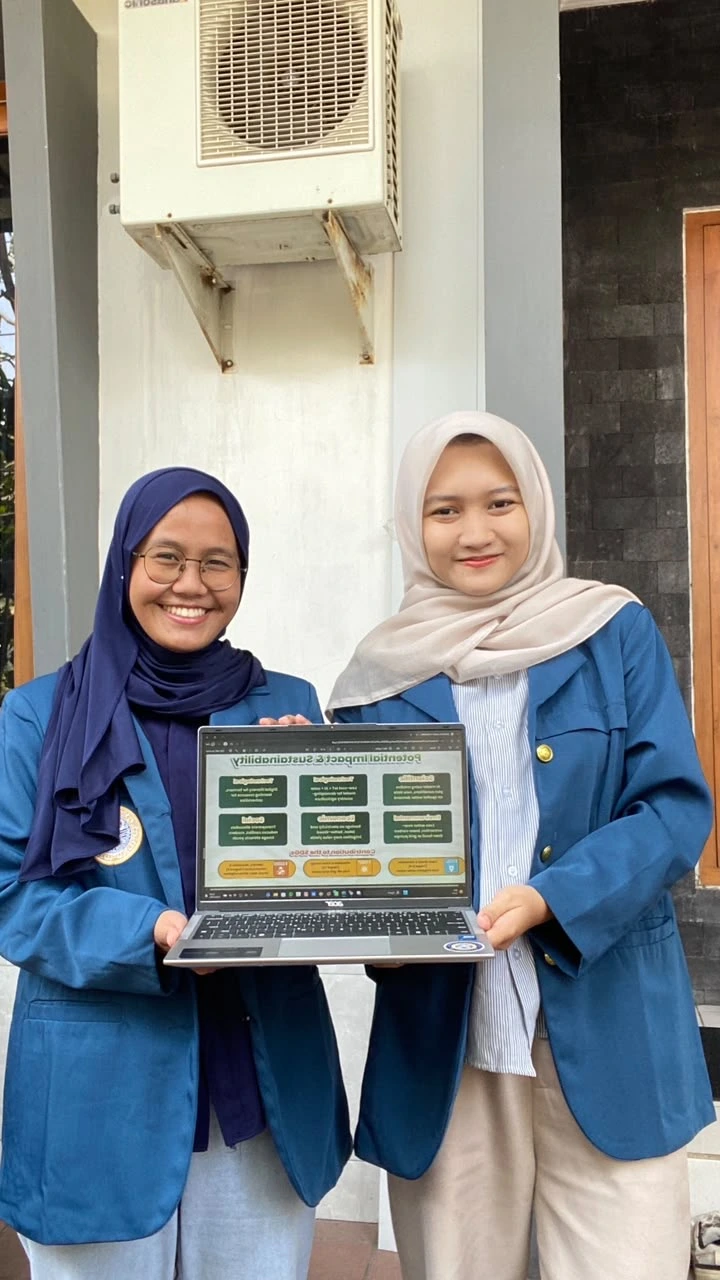
UNAIR NEWS – The GO PH Team won Second Honorable Mention for Analytical Excellence in the International Scientific Essay Competition (ISEC) as part of the Gayatama 5 series at Universitas Negeri Surabaya, on Thursday-Saturday (October 8-10, 2026). This team consists of Khariza Faza Shafiya and Alysa Virnanda Abidin, students from the Faculty of Public Health (FKM) Universitas Airlangga (UNAIR). They developed HYDROVA-AI, a precision irrigation system based on Artificial Intelligence (AI) and Internet of Things (IoT) that utilizes solar energy.
This innovation addressed the issue of inefficiencies in the manual irrigation system, ranging from water waste to potential conflicts among farmers due to unequal water distribution. Through HYDROVA-AI, both of the team members offer a system for monitoring and regulating water distribution that is more precise, transparent, and sustainable.
Addressing agricultural irrigation challenges
HYDROVA-AI innovation stems from the challenges facing Indonesia’s agricultural sector that involved millions of farmers. One of the highlighted issues is the high proportion of farmers over the age of 45, which means that manually monitoring irrigation systems can potentially increase workplace safety risks.
Moreover, the development of irrigation infrastructure has not fully resolved water management issues at the field level. The manual operation of floodgates can lead to uneven water distribution and trigger disputes among farmers.
“The fact that the floodgates are still operated manually can lead to uneven water distribution and trigger disputes among farmers,” said Abidin.
Integrating AI, IoT, and solar energy
HYDROVA-AI integrates soil moisture and water level sensors to monitor the conditions of each rice paddy plot. The Cross-Plot AI system then compares water requirements across plots and prioritizes irrigation for fields with greater water deficits.
This system also uses solar panels so it can operate without relying entirely on the PLN (State Electricity Company) power grid. To increase transparency, information on soil conditions and pump status is sent in real time via Telegram Bot. Farmers can also use the manual control feature when necessary.
During the development process, the team identified weaknesses of the previous system, designed the integration of agronomy and sensor technology, and developed the hardware and software architecture. They also mapped out the implementation phases, from designing and testing to broader-scale development.
Challenges and hopes for implementation
One of the biggest challenges in writing an essay is designing product specifications that can meet a variety of needs while remaining effective and efficient when implemented.
“Going forward, hopefully HYDROVA-AI can be tested in actual rice fields and developed in collaboration with farmers’ groups and relevant institutions,” said Abidin.
This innovation also supports the Sustainable Development Goals (SDGs), particularly SDG 6 (Clean Water and Sanitation), SDG 7 (Affordable and Clean Energy), and SDG 9 (Industry, Innovation, and Infrastructure).
Author: Zahwa Yasmina Fajri
Editor: Yulia Rohmawati