

UNAIR NEWS – Scorching heat amid traditional market activities is not just a matter of comfort. For informal sector sellers, high temperature can affect merchandise quality, visitor interest, and economic turnover. Starting from that issue, Faculty of Social and Political Sciences (FISIP) Universitas Airlangga (UNAIR) students initiated the Green Productive Market (GPM).
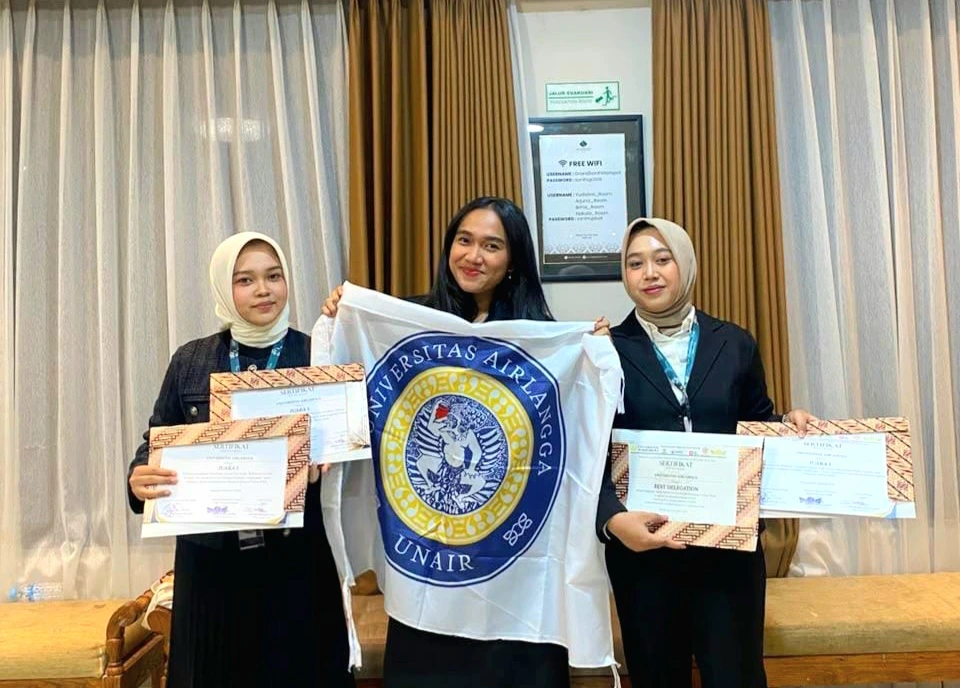
This initiation led the UNAIR team to win 1st place in Policy Brief, 1st place in Research Paper Presentation, and Best Delegate awards at the 2026 Temu Administrator Muda Indonesia (Temu AdMI) that took place at Universitas Warmadewa on Saturday, August 8, 2026.
This team consisted of Vaneza Ika Artamevia as the team leader, along with Mada Ariane Pudjanadi and Amanda Naila Majida. They initiated a research project titled Green Productive Market: Strengthening Green Open Space for Traditional Market Resilience Amid the Urban Heat Island Phenomenon in Surabaya. They addressed how urban heat directly impacts commercial activities.
Combating heat with green roofs and solar energy
Artamevia explained, the team examined four traditional markets in Surabaya, which are Keputran Utara Market, Kayoon Market, Gembong Tebasan Market, and Kapasan Market. The interview results showed that the heat disrupts economic activities. From decreasing visitors’ interest until accelerating the wilting of vegetables and fading clothes color. “The heat also make the vegetables wilt faster and fading clothes color,” she said.
Through GPM, the team initiated a Photovoltaic-Green Roof (PV-Green Roof) system that combined green roofs with solar panels. This concept was designed to help lower market areas temperature while generating renewable energy without requiring new land clearance. “This implementation helps to improve air quality and reduces rain water runoff that could potentially cause flooding,” she explained.
The team also initiated the use of extensive green roofs with lighter structure and growing media that are suitable for market buildings. Aside from helping to reduce the impact of Urban Heat Island, this concept also supports eco-friendly building management with relatively simple maintenance needs.
Broadening impact through market policy
Not stopping with a physical solution, GPM urges the Surabaya City Government to designate traditional markets as a priority zone in heat adaptation policy. According to the team, urban heat impacts are unevenly distributed and felt more acutely in high-vulnerability areas.
“Designating the market as priority zone could help the government target greening and heat mitigation programs more effectively,” she said.
This innovation also offers a collaborative governance model that brings together the government, market managers, sellers, academics, and private sector. This approach can strengthen protections for informal sector sellers, keeping product quality, enhancing visitor comfort, and supporting sustainable environment and local economy.
For the team, GPM serves as an effort to bridge environmental policy with the needs of local communities who face climate change impact directly.
“We hope that the green open space policy will not only address inclusivity in general terms, but also specifically target priority zones that require protection,” she concluded.
Author: Maia Chaerunnisa
Editor: Yulia Rohmawati