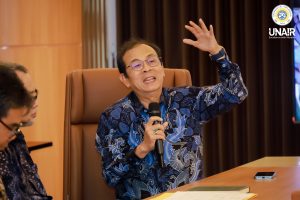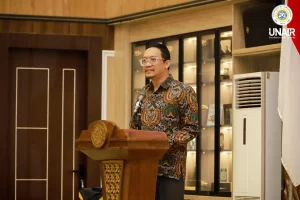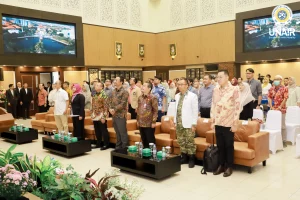


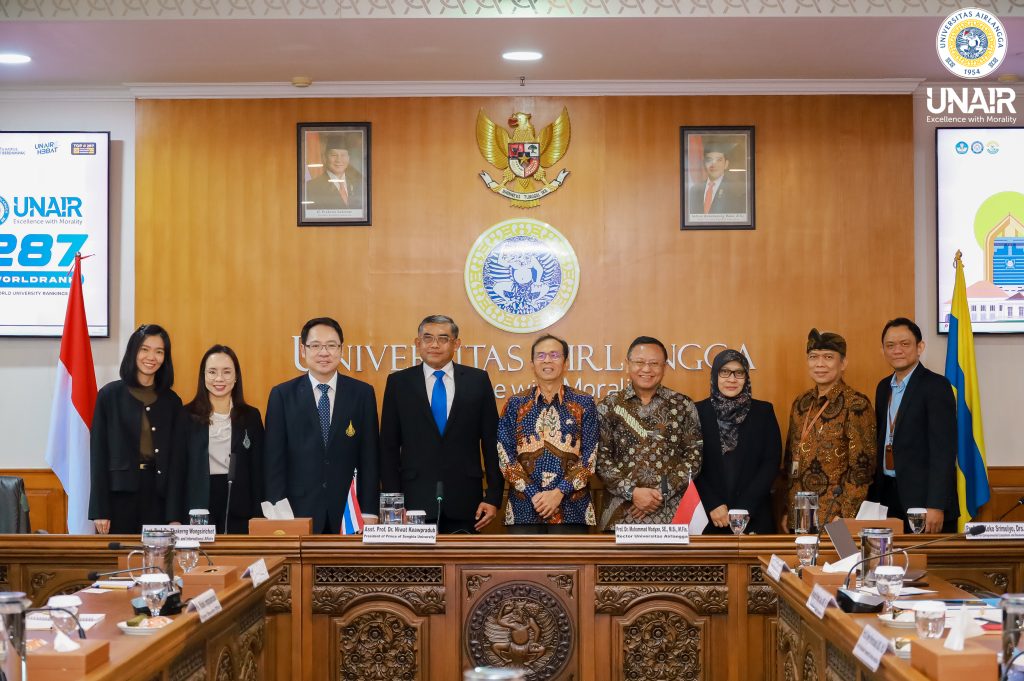
UNAIR NEWS – Universitas Airlangga (UNAIR) welcomed a delegation from Prince of Songkla University (PSU), Thailand, on Thursday (October 30, 2025), at the UNAIR Rectorate Hall. The visit was held as part of a benchmarking initiative to study the implementation of the Sustainable Development Goals (SDGs) at Universitas Airlangga.
UNAIR Rector Prof. Dr. Muhammad Madyan, SE, MSi, MFin extended a warm welcome to the PSU delegation. Prof. Madyan emphasized that fostering strong partnerships with leading global universities, such as Prince of Songkla University, is essential to advancing shared goals in science, innovation, and social impact.
“We look forward to new opportunities for collaboration, through joint research, student and staff exchanges, and community-based initiatives that align with the SDGs. Our doors are always open to strengthening and expanding the friendship between our institutions,” said Prof. Madyan.
Strengthening UNAIR SDGs Center
Head of the Institute for Sustainable Community Engagement (LPMB) UNAIR, Prof. Hery Purnobasuki, MSi, PhD, reaffirmed the university’s ongoing commitment to sustainability. He explained that UNAIR continues to drive progress toward the SDGs through research, education, and community outreach. The university, he added, has evolved from a collection of independent initiatives into an integrated platform that connects academic programs and community activities under a unified SDGs framework.
“Our programs are designed not only to generate academic impact but also to create real, measurable change in society,” said Prof. Purnobasuki.

UNAIR’s SDGs efforts initially began through partnerships with 70 schools. By 2025, the program had grown into a comprehensive system integrating research, education, and community service.
Prof. Purnobasuki also highlighted several of UNAIR’s flagship initiatives, including international training programs and annual community engagement events featuring school visits, book launches, and innovation exhibitions.
Advancing academic and institutional capacity
UNAIR has also leveraged its programs to empower student organizations in addressing local challenges, facilitate international summer courses, and develop formal learning modules centered on the SDGs.
In promoting equity and inclusion, UNAIR provides targeted training for women, childcare facilities, and lactation rooms. The university also offers housing assistance, sexual violence prevention programs, and financial support for low-income students, including scholarships, transportation, and food assistance.
Environmental sustainability remains a top priority at UNAIR, which continues to implement circular economy practices such as composting, recycling, and innovative waste management—particularly addressing shrimp cell waste, a significant local environmental issue.
Prof. Purnobasuki also underscored UNAIR’s collaborations with top universities in Indonesia, Malaysia, Taiwan, and the United Kingdom, stressing that joint research and international training programs play a crucial role in strengthening SDGs-related initiatives.
He noted that Indonesia faces unique sustainability challenges as an archipelagic nation of more than 17,000 islands, requiring close coordination between educational institutions and local communities. To support these efforts, UNAIR regularly publishes annual sustainability reports, guidelines, and best practice benchmarks to guide students, faculty, and the public in effectively advancing sustainability initiatives.
Concluding his remarks, Prof. Purnobasuki expressed optimism about future collaborations.
“We hope to continue expanding our partnerships and aligning our efforts with the global SDGs agenda,” he concluded.
Author: Saffana Raisa Rahmania
Editor: Ragil Kukuh Imanto