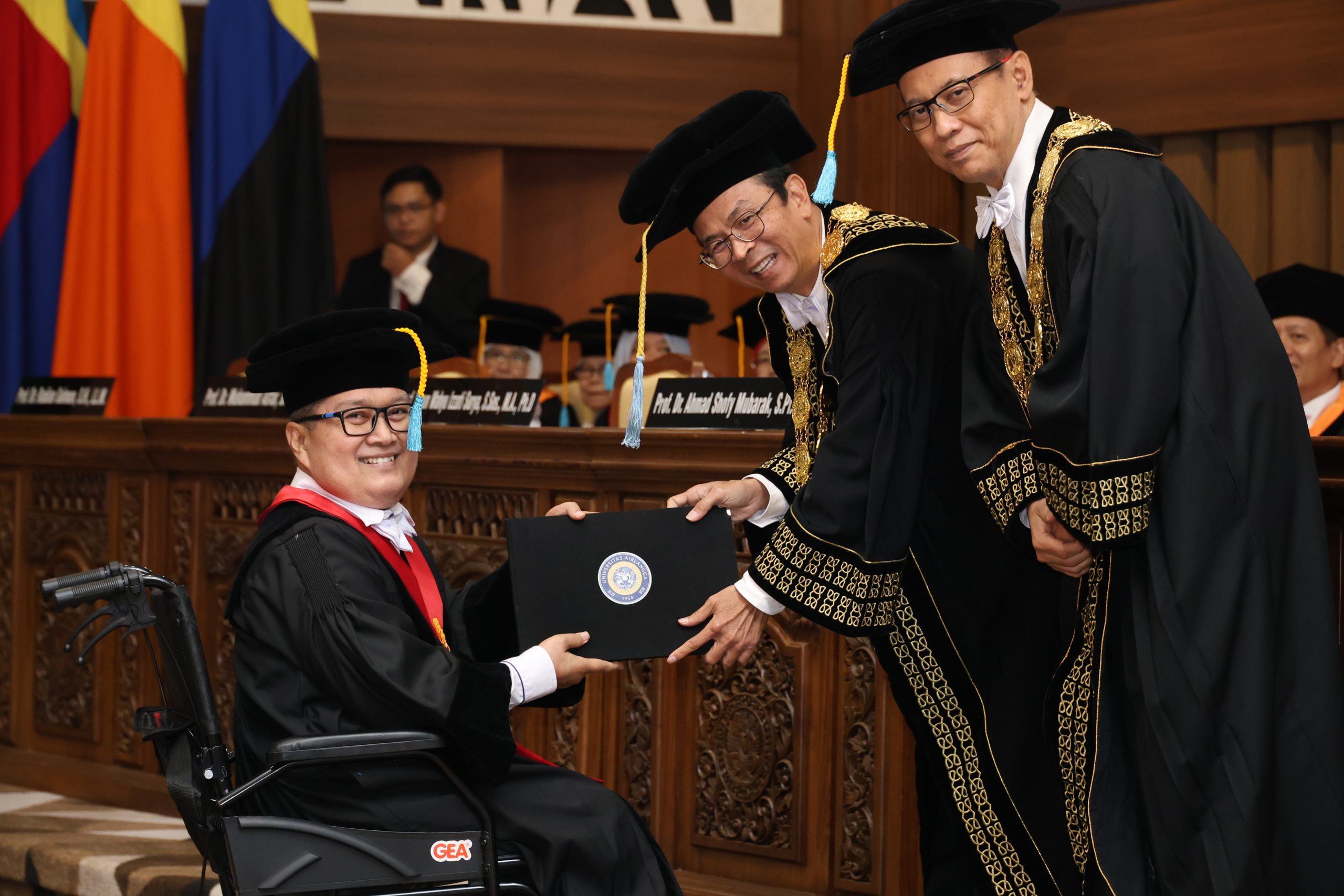
UNAIR NEWS – Consumer protection law plays a pivotal role in shaping informed consumers and sustaining balance within the digital economy. This was conveyed by Prof. Dr. Bambang Sugeng Ariadi Subagyono, S.H., M.H., upon his official inauguration as Professor of Consumer Protection Law.
Delivering his inaugural address at Aula Garuda Mukti, Management Office Building, MERR-C Campus, Universitas Airlangga, on Thursday, April 9, 2026, Prof. Subagyono highlighted that rapid digital transformation requires businesses to strengthen their technological capabilities. However, he emphasized that long term success depends not only on technology, but also on ethical integrity.
“The adoption of digital technology creates broad opportunities for small and medium enterprises, particularly in expanding market reach beyond geographical limits through digital platforms at both national and international levels. It also enhances operational efficiency through digital accounting tools and drives innovation in business models,” he said.
Smart consumer
In his remarks, Prof. Subagyono identified three defining traits of a smart consumer. These include a clear understanding of rights and obligations alongside legal protection mechanisms, the ability to evaluate the credibility of product information supported by digital literacy, and the capacity to make rational and critical decisions based on accurate and verified data.
“In this context, the notion of a smart consumer does not stand independently. It is shaped through the interaction of an effective legal framework, responsive public policy, and sufficient public literacy,” he explained.
Prof. Subagyono also introduced a conceptual framework to guide the evolution of consumer protection law in the digital age. The Smart Consumer Protection model positions consumers within three interconnected dimensions.
“These dimensions include regulatory protection, consumer empowerment, and a just digital ecosystem. Each element reinforces the others. Strong regulation fosters a fairer market environment, consumer empowerment improves decision making, and a responsible digital ecosystem ensures that technological progress does not undermine consumer rights,” he said.
Remaining human in technology driven world
In closing, Prof. Subagyono stressed that consumer protection law in Indonesia must continue to evolve in line with technological change. In doing so, the law serves not only as a regulatory mechanism but also as a moral and intellectual guide for society in navigating rapid transformation.
He further urged both consumers and businesses to remain aware and not be overtaken by technology. In his view, technology enhances human reasoning rather than replacing it.
“The marketplace should be driven by values, not merely by price. We must encourage businesses to grow with integrity and consumers to act with awareness. The future of the digital economy will be shaped not by machines, but by the people who use them,” he concluded.
Author: Putri Andini
Editor: Khefti Al Mawalia