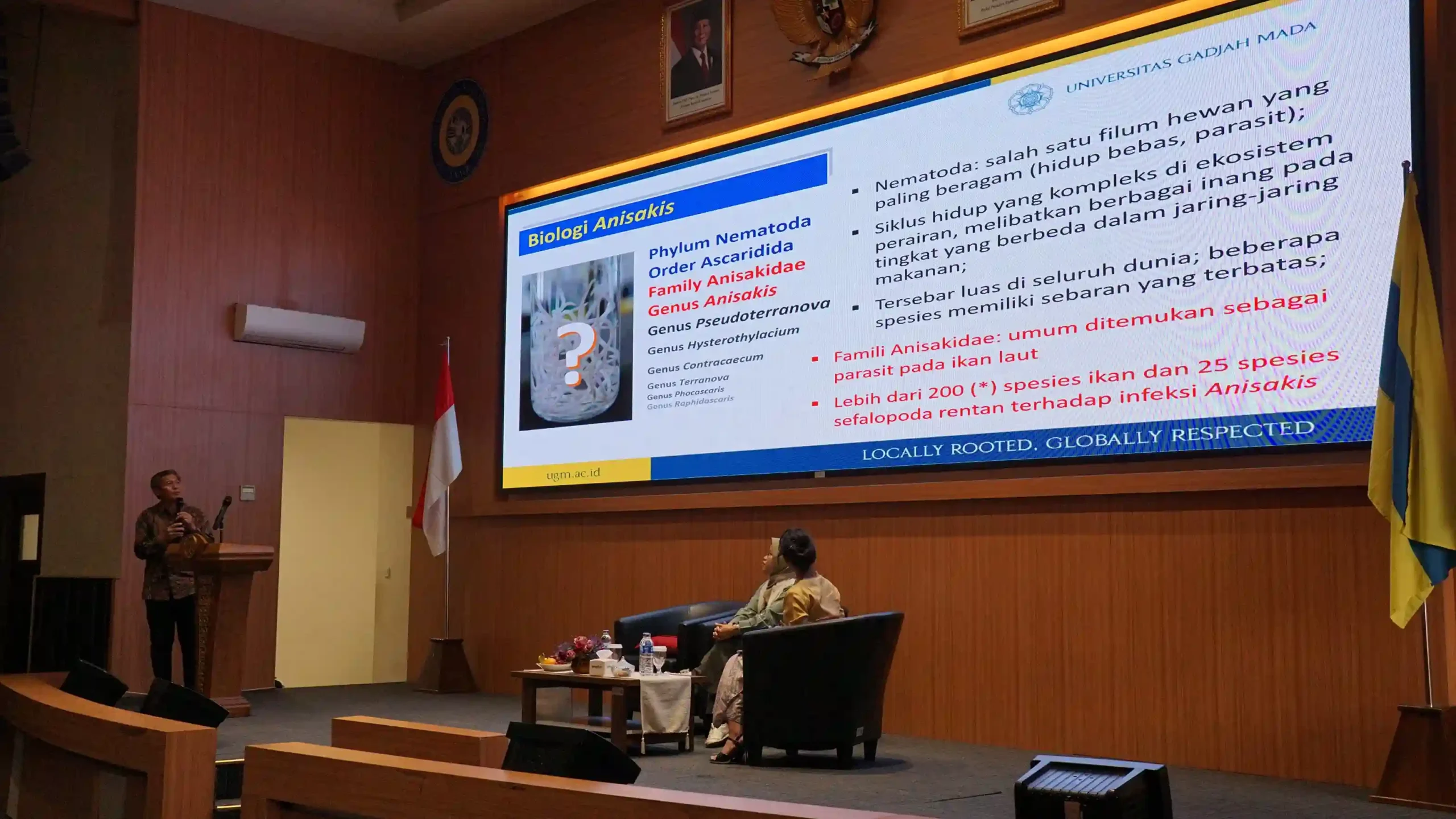
UNAIR NEWS – Airlangga Maritime Week (AMW), Sunday (September 20, 2026), highlighted the potential of marine fish as a fisheries resource, as well as the safety risks posed by the Anisakis parasite. This was presented by one of the speakers, Prof Dr Eko Setyobudi SPi MSi, a professor at the Faculty of Agriculture, Universitas Gadjah Mada, at the Joint Lecture Building (GKB), 9th floor, MERR-C Campus, UNAIR.
Anisakis and marine fish safety risks
At the event, held by the Student Executive Board (BEM) of the Faculty of Fisheries and Marine Sciences (FPK) UNAIR, Prof Setyobudi explained that Anisakis needs attention due to its relevance to human health and the fisheries industry. The parasite’s life cycle involves marine mammals as definitive hosts and can spread through the food chain, meaning that caught marine fish can potentially be infected by the parasite.
Prof Setyobudi also discussed the risks of consuming raw fish and the importance of properly processing fisheries products. The presence of parasite larvae in fish tissue can pose risks to humans if infected fish is consumed. Because of this, the supervision of raw materials and processing methods is a critical part of maintaining food safety.
“Despite these risks, we must keep promoting fish consumption. What matters is ensuring that the fish we consume is safe through food security,” he explained.
Beyond health, Prof Setyobudi highlighted the impact of Anisakis on the fisheries industry. He cited product recalls of canned fish in Japan linked to the presence of the parasite. According to him, inspecting fish starting from the catch stage is necessary to anticipate risks that could affect the processing industry. “We need to pay attention to fish safety, starting from raw materials all the way through the processing stage,” Prof Setyobudi said.
Prevalence and intensity of fish parasite infection
Prof Setyobudi went on to present research on the prevalence and intensity of parasite infection in Indonesian marine fish. Together with his team and students, he collected samples from several regions, including the waters of Banyuwangi and the southern and northern coasts of Java. The research covered hairtail and yellowstripe scad, along with observations of infection patterns and molecular parasite identification.
“We looked at the prevalence and intensity of infection in fish from several regions to understand the pattern of the parasite’s presence,” he said.
The research results showed variation in prevalence and infection intensity depending on fish species and sampling location. Molecular identification was used to determine which types of parasites were found, allowing the research data to support a clearer understanding of Anisakis’s spread.
“Through molecular identification, we can determine the type of parasite found, so its distribution can be studied more clearly,” he added.
Prof Setyobudi added that marine parasitology research in Indonesia still has significant room to grow. The gap between Indonesia’s vast maritime territory and the limited number of researchers is one of the key concerns in developing the field.
“Indonesia’s maritime territory is very vast, while the number of researchers studying marine fish parasitology remains limited. This means there are still many research opportunities to be developed,” he concluded.
Through AMW 2026, UNAIR students gained insight into the potential of marine fish resources, food safety, and parasitology research in support of the safe and sustainable use of fisheries products.
Author: Abraham Chrisanta Putra
Editor: Yulia Rohmawati