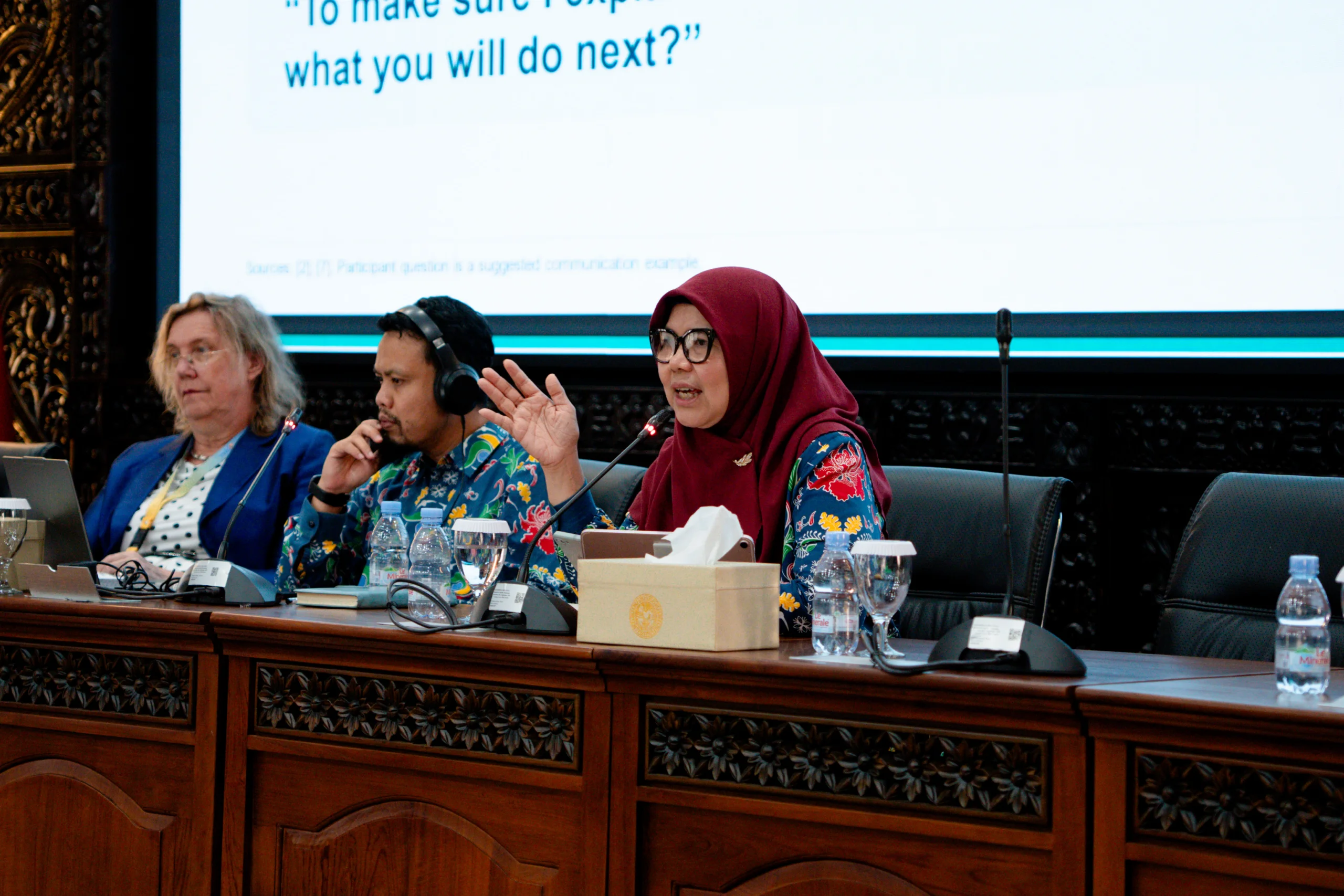
UNAIR NEWS – Strengthening the role of health promotion in achieving the Sustainable Development Goals (SDGs) was one of the agendas in the series of SDGs Connect: AUN-HPN, 11th IAC Meeting & 5th Health Promotion International Conference 2026. On Wednesday (October 14, 2026), Universitas Airlangga (UNAIR) and the Indonesian Association of Public Health Promoters and Educators (PPPKMI) held a satellite conference as part of the first day of the series.
Held at Amerta Hall, 4th floor, Management Office, MERR-C Campus, UNAIR, the conference session featured several speakers on health promotion issues. One of them was Dr Sarah Handayani SKM MKes, Chair of PPPKMI Central. She presented material titled “The Strategic Role of Health Promotion Professionals: Implementing the Free Health Checkup Programme SDGs 3.”
Challenges in services and health promotion workers
Dr Handayani explained the link between free health checkup services, health promotion workers, and the sustainable development goal of good health and well-being. According to her, the free health checkup program strongly supports this goal, but several issues deserve attention.
“The free health checkup program is currently a top priority, but several studies have reported that health workers experience burnout when carrying out the program, from entering data to chasing participant targets,” she said. She added that health promotion workers need to bridge information with understanding, the ability to act, and practical support for patients.
Sustainable health competencies
To address these challenges, Dr Handayani recommended strengthening health workers’ competencies. Reflecting on conditions in the field, she said the problems faced are not merely communication issues, but also other factors such as workload, understanding of the problem, service support, and decision-making based on the results obtained.
Dr Handayani said there are eight competencies that need to be developed, including knowledge of health promotion, service management, program strategy and implementation, as well as communication skills and public education. These competencies should be aligned with continuing professional education for health promotion workers.
She continued that health promotion workers need to develop their competencies so they can adapt to community needs. “We must be confident in these competencies and keep pursuing our professional development,” she added.
Community empowerment
Beyond strengthening competencies, community empowerment is an important aspect of health promotion. Dr Handayani said a program’s success cannot be judged only by the number of people who come for checkups, but also by awareness and the ability to act at the individual, family, and community levels.
She stressed that attendance is not the same as empowerment. Community participation in health programs needs to include better understanding and decision-making skills. Therefore, health promotion workers must ensure that people can understand their own health needs, rather than simply receive services.
Dr Handayani also emphasized that the success of the service is measured not only by how many people undergo checkups. “The success of free health checkups is also measured by how well people understand their checkup results and the follow-up they need, so that they have a real opportunity to live healthier lives,” she said
Author: Damar Anargya Pratama
Editor: Khefti Al Mawalia