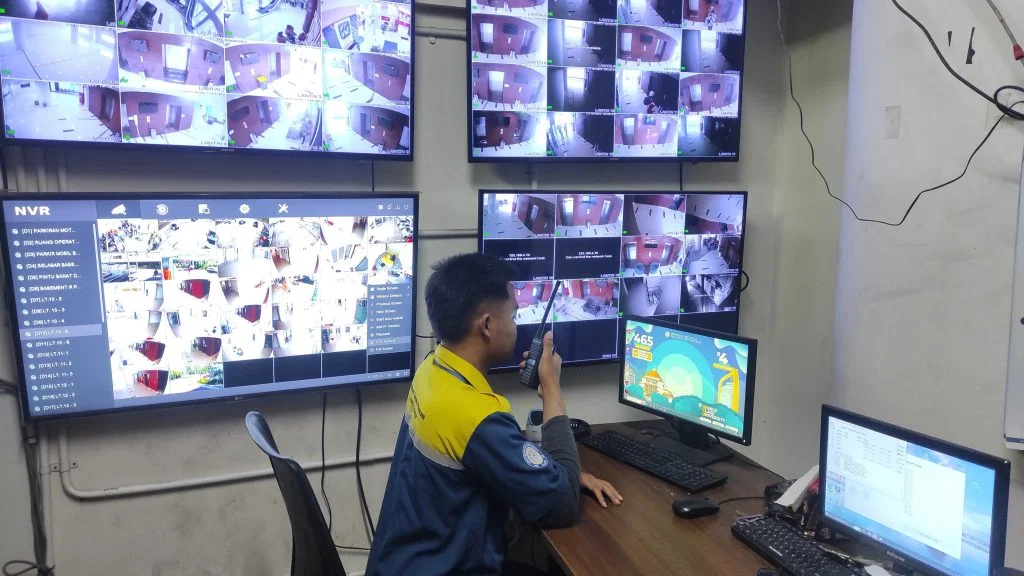
Building Automation System (BAS) is a communication network infrastructure that functions to manage various building services, such as monitoring and controlling the facilities in a building. The purpose of BAS is to simplify control of facilities such as lighting, temperature, and CCTV, which will in turn save energy and maintenance costs for those facilities. BAS uses sensors, hardware, and software to automate building operations, optimize performance, and provide more efficient and accurate control.
As a campus that supports and implements the Green Campus program, Universitas Airlangga (UNAIR) has taken the initiative to integrate BAS into its building systems. Several UNAIR buildings already use BAS, including the Airlangga Sharia Entrepreneurship & Education Center (ASEEC) Tower and Shared Lecture Building (GKB). The use of BAS at GKB has been planned since 2022 and is currently in the development stage. Systems that can be managed with BAS include heating, ventilation, and air conditioning (HVAC); lighting control; fire alarms; and access and security.
Using BAS in several UNAIR buildings offers considerable benefits beyond energy efficiency and control. Comfort in using facilities is another benefit, as the system can regulate factors such as room temperature and lighting. It also makes safety monitoring and management easier, given the large number of facilities that must be controlled and the need to pay close attention to safety levels. Facility maintenance becomes well planned, so facilities can be used for a long time. BAS can monitor equipment performance and provide information that enables more planned and proactive maintenance, which reduces the risk of unexpected operational disruptions. Through energy efficiency, better maintenance, and more efficient management, BAS can also help reduce overall building operating costs, keeping expenses low.
The use of BAS has a positive impact on the environment in several ways, including: 1) reduced energy consumption: BAS minimizes unnecessary energy waste and also helps reduce water usage, as advanced monitoring systems can cut water waste and support the conservation of natural resources; 2) safety management: security and monitoring systems can be integrated with BAS, enabling more efficient oversight and rapid response to emergencies or security threats; 3) planned maintenance: BAS can monitor equipment performance and provide information that enables more planned and proactive maintenance, which reduces the risk of unexpected operational disruptions; 4) reduced operating costs: through energy efficiency, better maintenance, and more efficient management, BAS can help reduce overall building operating costs. In addition, BAS can raise environmental awareness. By providing accurate data and information on energy consumption and other resources to building occupants and managers, BAS helps increase awareness of the importance of environmental conservation.
Given the many positive impacts it offers, the use of BAS is one of the major steps that can benefit the environment. Especially in skyscrapers, it is one way to control every facility. Therefore, UNAIR will continue to pursue the use of BAS in its buildings to support the Green Campus program it champions.
Author: DLKKL UNAIR