UNAIR NEWS – The sharia economy is growing in step with today’s rapid technological advances. In response to this trend, Universitas Airlangga (UNAIR), together with Bank Syariah Indonesia (BSI), presented the Sharia Young Leader Summit (SYLS). The event was held as a platform for in-depth discussion on the sharia economy with speakers who are experts in the field.
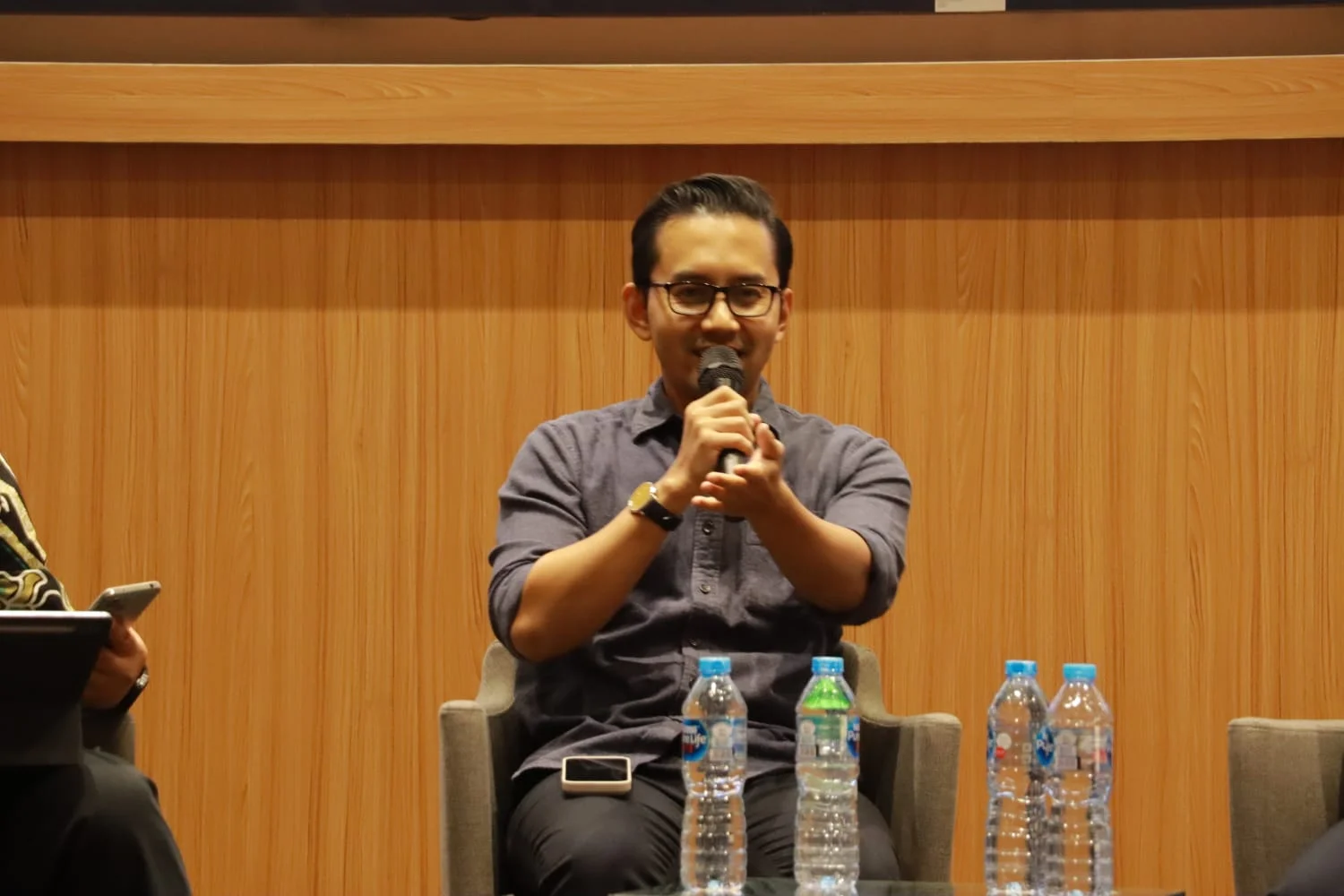
Attending SYLS was Greget Kalla Buana, Vice President of Environmental, Social, Governance Strategy and Portfolio Management at BSI, who is responsible for designing sustainability strategy and managing an environmentally and socially conscious business portfolio. According to him, the sharia economy applies not only to Muslims but also to people of other faiths.
“BSI customers are the largest group of sharia customers in the world, and they come from Indonesia. Alhamdulillah, we are also among the Top 9 Global Islamic Banks by market capitalization. Of those customers, one in seven is non-Muslim. The question is, why are people outside the Islamic faith interested in sharia banks?” he said on Friday, October 16, 2026, at Candradimuka Hall, Shared Lecture Building (GKB), UNAIR MERR-C Campus.
Broad scope of sharia economy
Buana discussed the sharia economy from various perspectives. For example, fashion or beauty products such as Wardah are also part of the sharia economy. She mentioned several fatwas related to the sharia economy, such as Indonesian Ulema Council (MUI) Fatwa No. 30 of 2016. This fatwa forbids activities that worsen the climate crisis, so companies that destroy forests should not be included in sharia indices.
“In addition, the ultra-fast fashion trend also needs to be watched. For example, a hijab bought cheaply but worn only briefly before it falls apart shows unsustainable consumerist behavior. This environmental concern is also part of sharia economic behavior,” he explained.
Buana stressed that those outside the sharia economics major should not hesitate to take part. He recounted that he once received sneers about why studied Islamic finance in the United Kingdom, a majority non-Muslim country. In fact, the largest providers of Islamic finance courses are actually in the UK, surpassing Indonesia and Malaysia.
“Practices such as sharia banking and sukuk exist there and offer a different perspective. Islamic finance is not merely about legally valid or halal transactions but also involves ethics, morality, and accountability, because our transactions involve Allah,” he added.
Golden generation of sharia economy
Furthermore, Buana emphasized that the golden generation must be able to invest, hold egalitarian principles, be multitalented, actively seek scholarship opportunities, and have spiritual values. According to him, learning Islamic finance must not stop at theory but must include skills and experience.
“We lack multitalented human resources. This is greatly needed in the workplace. The great potential of the sharia economy today must indeed be matched by the readiness of qualified human resources,” he said.
Author: Putri Andini
Editor: Yulia Rohmawati