UNAIR NEWS – The Universitas Airlangga History and Culture Museum has been pioneered since 2007 by the History Study Program of Universitas Airlangga together with Dr Haryadi. The museum was pioneered to bridge the need for education on the importance of ancestral cultural heritage, which has recently received little attention from Indonesia’s young generation.
Edy Budi Santoso S.S., M.A., Head of the UNAIR History and Culture Museum, said the museum was built as a learning medium and source of knowledge on museology related to cultural heritage objects. The museum also supports UNAIR’s Sustainable Development Goals (SDGs) in the area of Sustainable Cities and Communities, specifically the indicator Public Access to Museums.
The museum also aims to introduce the importance of ancestral cultural heritage history from the past to the present. According to Santoso, the UNAIR History and Culture Museum has various roles and functions, including in education, research, exhibition and maintenance, and documentation.
In response, the UNAIR History Study Program prepares by offering several relevant courses to support the museum’s development. They include Cultural Heritage and Museology, Ethnography, and Nirleka History.
UNAIR History and Culture Museum collections
Santoso said the UNAIR History and Culture Museum is filled with everything related to ancestral cultural works. To date, the museum has around 200 collection items.
“Although the collection is still small, this museum already has a number of quite rare items,” he explained.
These rare items include ancient objects related to the human life process and the development of society, from traditional human works to modern ones as we see today.
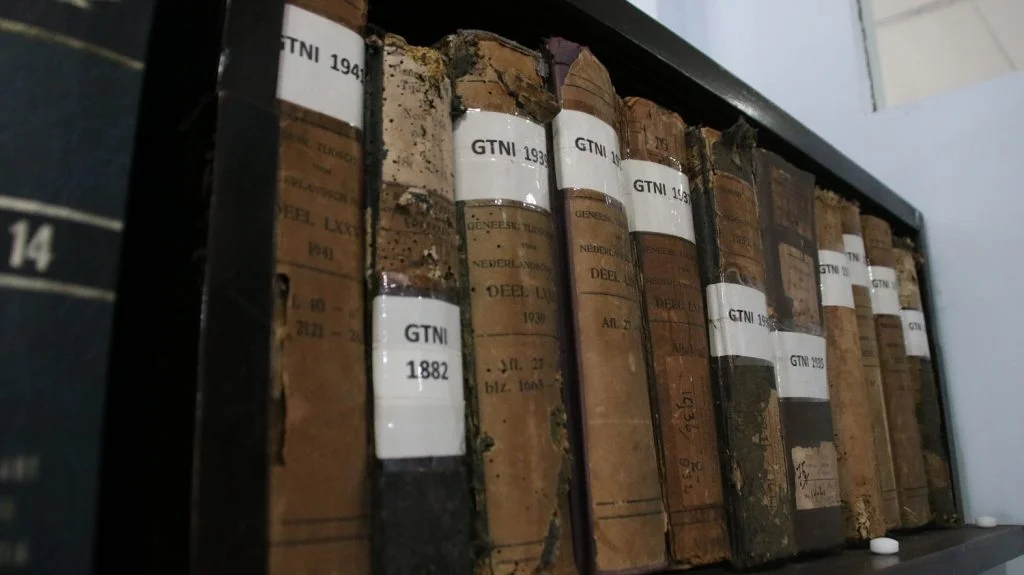
Santoso said that after entering the first room of the museum, visitors can see a variety of ancient books and rare archives neatly arranged.
There is also a collection of traditional music instruments such as angklung, gender, rebab, and classical Kalimantan instruments. In the second room, he continued, the museum stores many valuable items.
“Here, there is a collection of photographs of Surabaya since the Dutch colonial era. A striking cultural heritage item is an ancient photograph of Soekarno, the first president of the Republic of Indonesia, looking lively and energetic,” he said.
Ancient maps and paintings line the second room. Below the photographs are office desks and equipment. There are also glass display cases containing traditional clothing from several regions, numismatic collections, bronze statues, traditional weapons, and a collection of photo cameras.
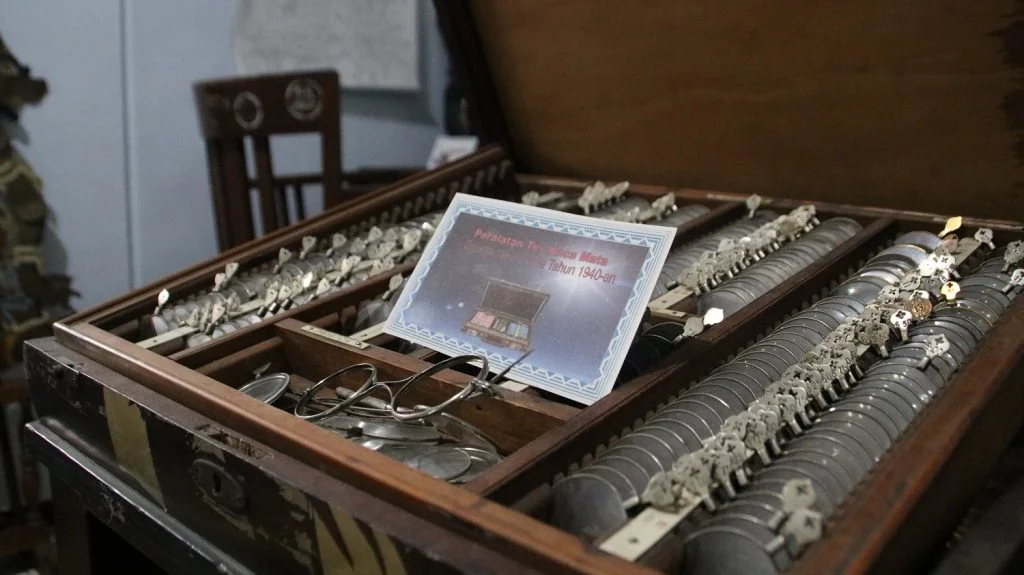
“At the edge of room two, there are several tables with antique objects on top, such as old typewriters. Meanwhile, in the left corner of the room, there are adult mannequins, a mirror, a sewing machine table, optical equipment, wall clocks, projectors, and lighting equipment,” he explained.
Other distinctive objects at the UNAIR History and Culture Museum include lamps from various eras, from cempluk (traditional oil lamps) and petromax to hanging lamps and classic study lamps. At the edge, there is an iron cabinet that stores rare ceramics from the Ming and Qing dynasties, miniature Chinese terracotta, and death masks.
UNAIR also has two other museums open to the public: the Medical Museum, managed by the Faculty of Medicine, and the Ethnography Museum of the Faculty of Social and Political Sciences (FISIP), also known as the death museum.
UNAIR, as one of the best universities in Indonesia, encourages the entire academic community to contribute to society at large.(*)
Author: Sandi Prabowo
Editor : Binti Q. Masruroh