
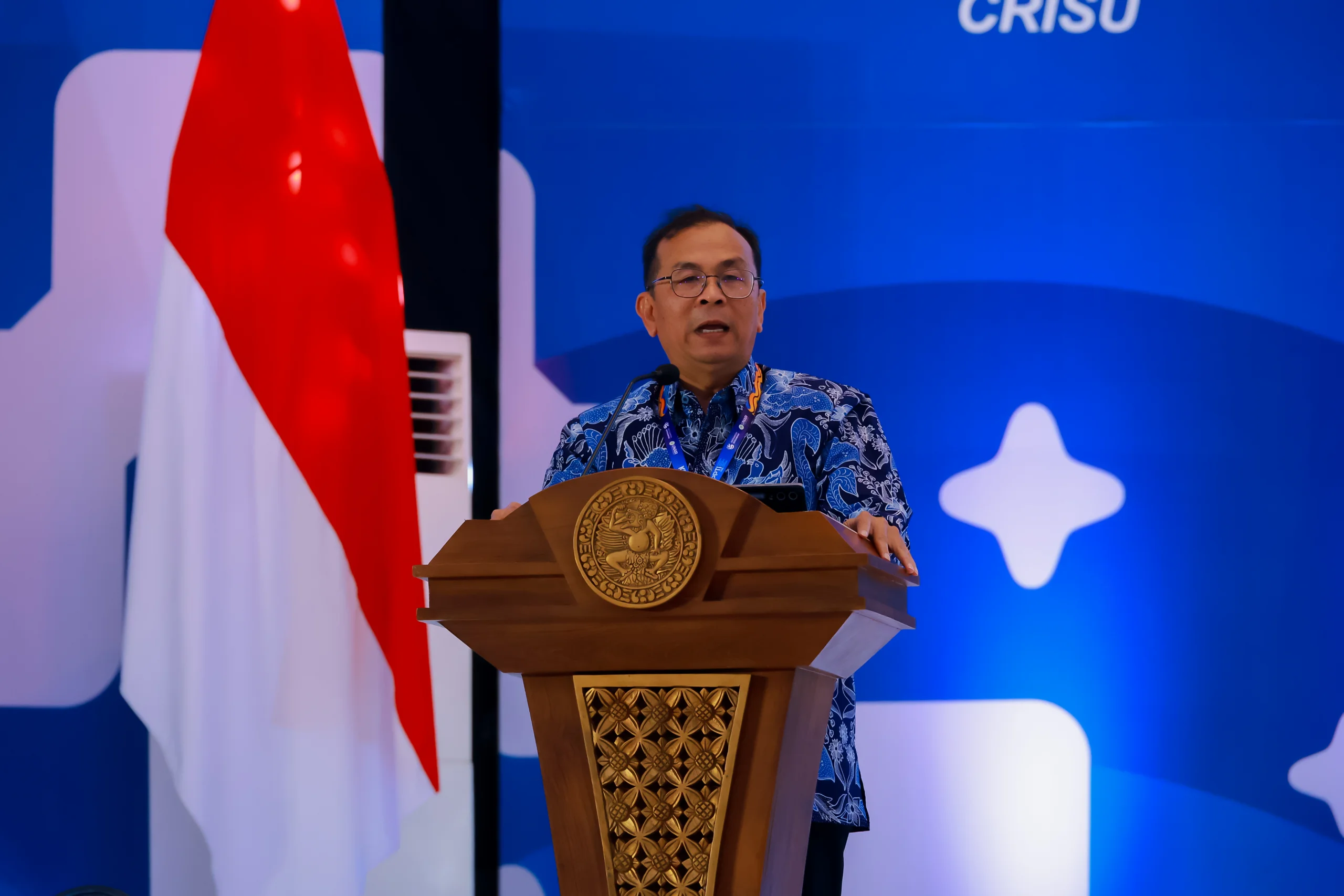
UNAIR NEWS – The success of a university is not only measured by its global rankings but also by the extent to which it provides broader access and delivers tangible benefits to the quality of life for the community. In line with this, the Rector of Universitas Airlangga (UNAIR), Prof. Dr. Muhammad Muhammad Madyan, SE, M.Si., M.Fin., emphasized that universities have a strategic role in building an inclusive and human-centered educational ecosystem.
“This urgency demands a shift in how we look at success, from institutional prestige to the impact on humanity. University rankings remain important, but they must be accompanied by tangible benefits for the community. The amount of students admitted remains important, but it must be accompanied by equal access,” stated the UNAIR Rector at the Higher Education Summit (KPPTI) during a keynote speech titled “Together Building Campuses for All: Toward an Inclusive and Human-centered Indonesian Higher Education”, Thursday, November 12, 2026 at the Airlangga Convention Center (ACC), UNAIR MERR-C Campus.
According to Prof. Madyan, this principle of equality also applies to the sectors of research and technology application. Research conducted by academics must have a multiplier effect and provide direct benefits to society. The application of technology and artificial intelligence (AI) is directed towards strengthening responsible governance in higher education institutions. This commitment underscores that an inclusive campus and equitable access to education are key to maintaining the quality of higher education.
These efforts align with the Sustainable Development Goals (SDGs): Goal 4 on quality education; Goal 5 on gender equality; Goal 10 on reducing inequalities; and Goal 16 on peace, justice, and strong institutions.
“From a moral standpoint, no one should be left behind due to economic circumstances, region of origin, gender, or disability,” he emphasized.
Five principles and three pillars of an inclusive campus
The UNAIR Rector also shared best practices for creating an inclusive and human-centered campus. There are five guiding principles: equality and justice, diversity, barrier-free accessibility, active participation of the entire academic community, and respect for human dignity.
To ensure the sustainability of this vision, UNAIR has established three supporting pillars: policy, human resources, and facilities. On the policy front, UNAIR implements the provisions of Law No. 12 of 2012 through Rector’s Regulation No. 19 of 2024 on Guidelines for the Implementation of Inclusive Services. This commitment is also demonstrated through the formation of the Task Force for the Prevention and Handling of Violence in Higher Education (PPKPT) and the Inclusive Education Services Team.
“Inclusivity must not depend only on the good intentions of individuals. It must be institutionalized in regulations so that it continues regardless of who is in charge,” said Prof Madyan.
Expanding access and community service
UNAIR also puts this commitment to a campus for all into practice through various best practices aimed at expanding access to education. Through government assistance schemes such as the Kartu Indonesia Pintar Kuliah (KIP-K) program, waivers or reductions in the Single Tuition Fee (UKT) distributed through the Center for Social Fund Management (PUSPAS), as well as various affirmative action scholarship programs, UNAIR ensures that economic factors do not become a barrier for the younger generation to pursue their studies. These efforts are reflected in the distribution of UNAIR students, who now come from all 38 provinces in Indonesia.
For students with special needs, comprehensive support is provided, ranging from affirmative action in the admissions process and the provision of adaptive course materials in classrooms and the library to ensuring full access to participate in laboratory sessions, internships, and Community Service Programs (KKN).
Melalui pengabdian masyarakat, kebermanfaatan ilmu pengetahuan diwujudkan melalui misi kemanusiaan Rumah Sakit Terapung Ksatria Airlangga (RSTKA) di wilayah kepulauan terpencil dan daerah bencana, serta program KKN Belajar Bersama Komunitas (BBK).
Throughout 2026, the 7th and 8th BBK programs involved 79 percent of participating students across 17 regencies in East Java, and were expanded to the global level through 9 International BBK activities in Japan, Malaysia, China, and Australia, in which 2.8 percent of students participated.
“A great university does more than just produce outstanding graduates. The university of the future must be able to transform academic excellence into equitable opportunities and deliver tangible benefits to society. Let’s work together to realize ethical excellence, empathetic innovation, and a human-centered impact,” concluded Prof. Madyan.
Author: Fauziah Laili Romadhon
Editor: Yulia Rohmawati