
UNAIR NEWS – Universities in Indonesia are required to go beyond their traditional function as mere centers of learning and mastery of knowledge. Amid the nation’s socioeconomic challenges, higher education institutions are expected to transform into instruments of development, welfare, and poverty alleviation through strong cross-sector synergy.
Data from Statistics Indonesia (BPS) shows that a big task remains in developing national human resources. In 2025, the national poverty rate was recorded at 8.25 percent, or 23.35 million people, with only 2 percent of poor household heads having a higher education, while the rest were dominated by primary to secondary education graduates.
On the other hand, the open unemployment rate among university graduates in 2026 reached 1.01 million people, or 9.01 percent, which demands improvements in the quality, access, and relevance of campus curricula to labor market needs.
Responding to these challenges, the Ministry of Higher Education, Science, and Technology (Kemdiktisaintek) encourages a strategy to strengthen the role of universities through consortium. This step is directed at shifting the paradigm from competition among institutions to integrated collaboration to create direct strategic impact for surrounding communities.
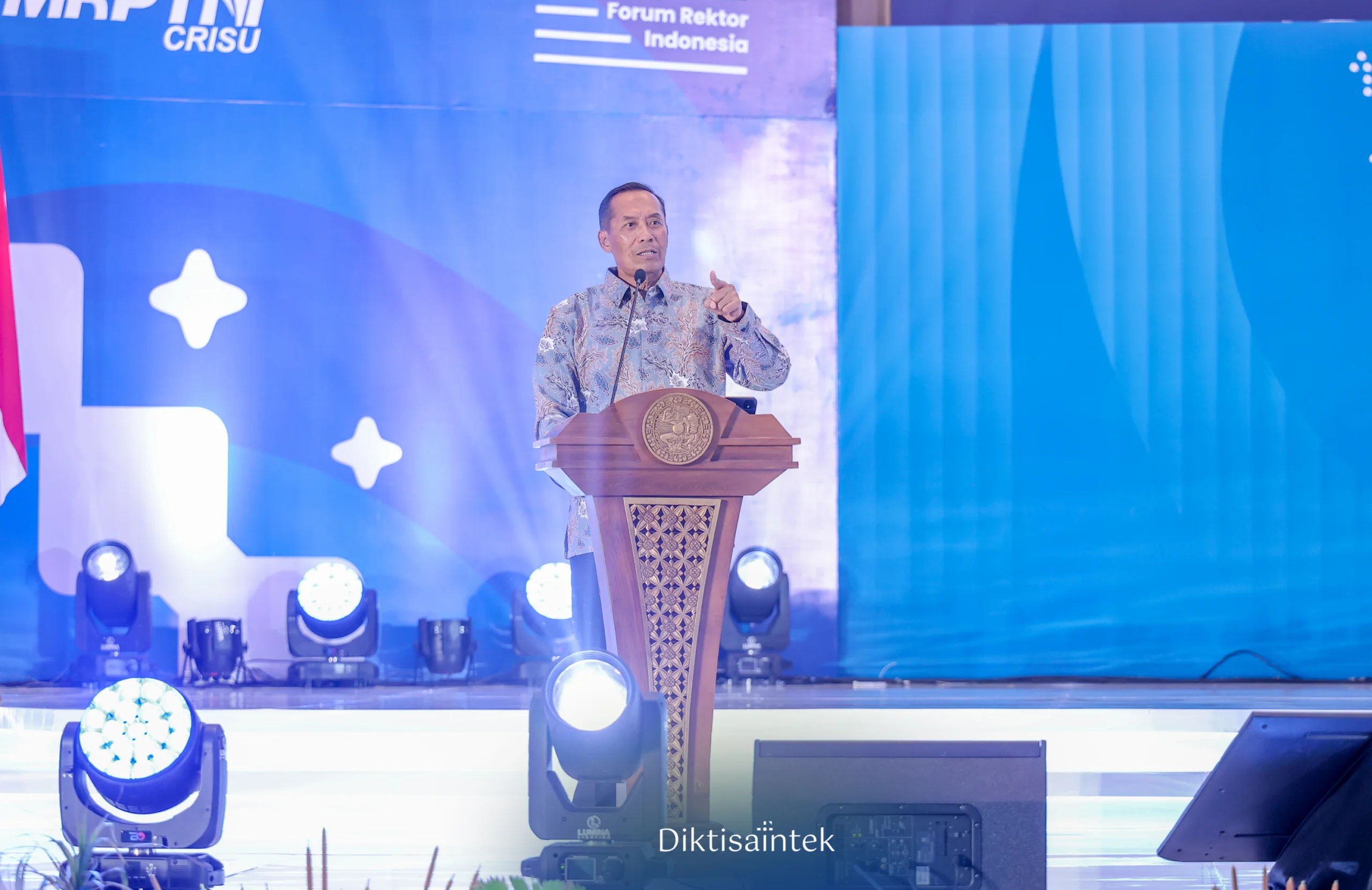
Vice Minister of Higher Education, Science, and Technology Fauzan delivered the idea at the Indonesian Higher Education Summit Conference (KPPTI) at Airlangga Convention Center (ACC), MERR-C Campus Universitas Airlangga (UNAIR), Surabaya, on Thursday (November 12, 2026), with a presentation titled Strengthening the Role of Universities Through Consortium.
“Education is not enough if interpreted merely as buildings where learning activities take place. There is a big mission within it, namely how universities are present amid the pillars of life and make real contributions to advance and prosper society,” Vice Minister Fauzan said.
According to the Vice Minister, campus social sensitivity must become the main benchmark of institutional progress. The quality of universities going forward will not be judged merely by accreditation status on paper, but by how far their presence can answer real problems in their surroundings, such as extreme poverty and stunting.
“Going forward, the quality of universities will not be measured merely by the accreditation they hold, but by how much they contribute to the society around them. Universities must not stand magnificent while the community around the campus still struggles with extreme poverty and stunting,” Vice Minister Fauzan stressed.
Vice Minister Fauzan emphasized the need for a mindset transformation in managing universities. Changes made by campuses must not be merely cosmetic or imitate other institutions (one to n), but must be a complete metamorphosis that changes character and values and gives rise to new breakthroughs (zero to one) in line with the demands of the times.
“We cannot manage universities the same way as in previous years. We want to prepare the current generation to live in their own time, not live in yesterday’s world. Therefore, universities must dare to undergo a character metamorphosis and always present new breakthroughs that give value to society,” Vice Minister explained.
To accelerate this impact, Prof Fauzan urged universities in every region to let go of sectoral egos and build a cooperation ecosystem through cross-institution consortium schemes.
“It is no longer time for universities to work separately. Large, medium, and small universities must unite in consortium in their respective regions to conduct joint research, exchange lecturers, and produce academic solutions that answer real problems of local governments and communities,” he added.
As a concrete example of the consortium approach’s success, Fauzan highlighted the collaboration initiative of Nusa Cendana University (Undana) with private universities, local governments, and industry in East Nusa Tenggara (NTT) through the Stunting and Poverty Alleviation Movement (GENTASKIN) program.
In addition, he appreciated synergy among local governments, such as in Central Sulawesi, that directs postgraduate research to answer region-specific problems, and encouraged universities to help drive the economy of poverty-pocket areas in their respective regions.
At the governance level, Kemdiktisaintek is also finalizing a clustering scheme for more than 4,300 universities in Indonesia with diverse accreditation levels. The clustering scheme is designed as an effective and proportionate mentoring instrument so that all layers of universities can grow and move up according to their capacity.
This strengthening of the role of universities through consortium is in line with the six mandates of the President of the Republic of Indonesia, from producing superior human resources, mastery of science and technology, and industry downstreaming, to solving community problems and strengthening national integrity, as well as the Impactful Higher Education, Science, and Technology policy. Kemdiktisaintek is committed to continuing to oversee synergy among universities, local governments, and industry partners so that academic innovation does not stop in classrooms but appears as real solutions for national progress.
Author: Muhammad Yasir
Editor: Khefti Al Mawalia