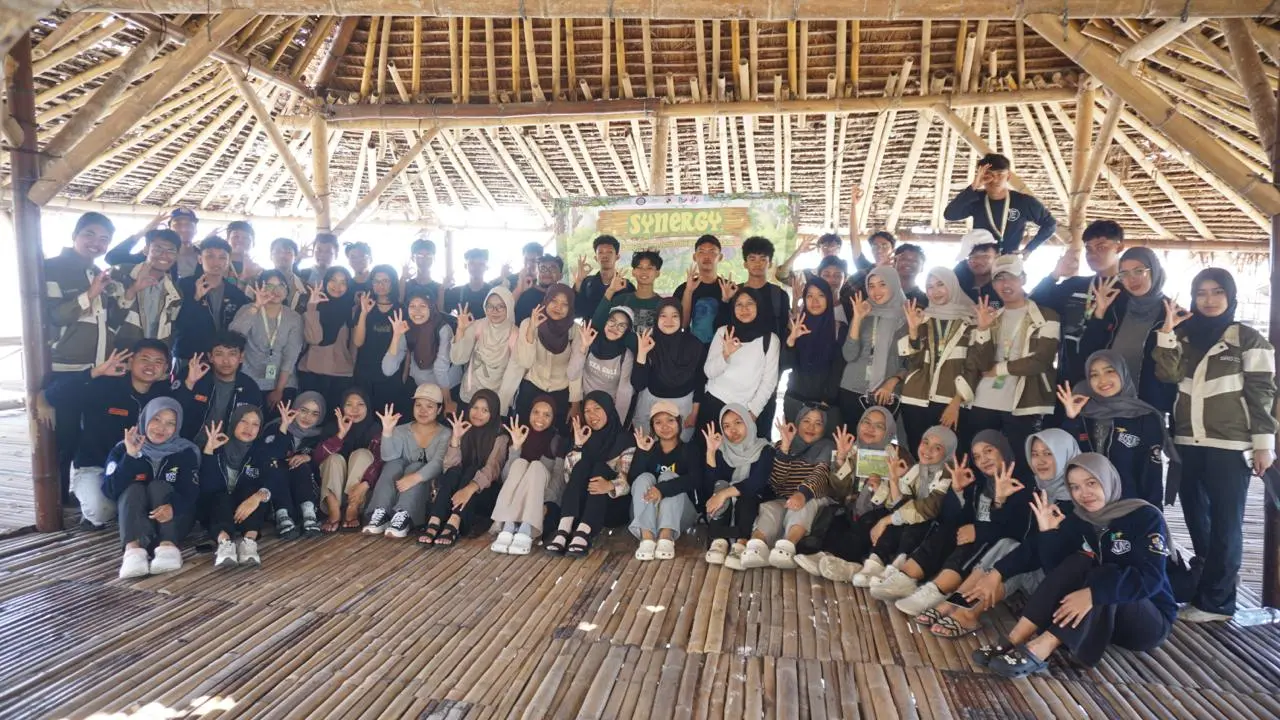
UNAIR NEWS – Universitas Airlangga (UNAIR) students succeeded in collecting 573 kg of trash in 40 minutes through coastal clean-up action at the Mangrove Wonorejo Ecotourism, Surabaya, on Sunday, September 13, 2026. This action was a part of SYNERGY: Synergizing Eco-Restoration & Green Youth which brought together Herogreen by the Student Executive Board (BEM) of Faculty of Science and Technology (FST) and Green Action, one of the pre-event series of Catalyst Summit by the Society of Renewable Energy (SRE) UNAIR.
The organizer head of SYNERGY, Kimora and Agung, said that this action is not merely aimed to clean up the coastal area. Participants were also encouraged to understand the environmental conditions before involving in the restoration activity. “We do not want to be only talking about vegetation restoration, but also look at the overall environmental conditions where the mangroves grow,” they said.
Looking directly on the coastal issues
The series of the event began with a sharing session on coastal ecosystem, types of mangrove, also its functions and benefits for the environment. This material became the foundation for the participants before they carried out the field activities.
After the education session, the participants participated directly in coastal clean-up. In about 40 minutes, they successfully collected 573 kilograms of trash. Kimora noted that this amount of trash indicates that the trash problem in coastal areas remains quite significant. Even after the activity ended, some trash could still be seen around the site.
“573 kg does not mean that all of the site area is all clean. After the clean-up session ended, there are still many trash left,” she explained.
According to her, this condition became a real experience for the participants to look at the environmental issues that could not be solved by a single action. Trash carried by water currents and ocean tides can accumulate again in coastal areas.
Planting and maintaining mangrove sustainability
Action continued by the planting of 60 Rhizophora mucronata seedlings, also known as Bakau Kurap. This species was chosen for its role in preserving the coastal ecosystem, providing habitat for various organisms, also absorbing and saving carbon.
Kimora said that the mangroves planting does not automatically guarantee that the seedlings will grow to trees. The coastal conditions such as water currents, trash, and other environmental factors can affect its growth.
“We can not guarantee that all of the 60 seedlings will survive. That’s why we plan to return to the site around the end of the year to see the seedlings’ conditions and its survival rate,” she explained.
This monitoring plan was implemented to track the seedlings’ growth after several months and to support efforts to ensure the sustainability of the action. According to her, the action’s success can not be judged solely by the number of seedlings planted, but also by the ability of its survival and growth in the coastal environment.
“No matter how small the result may be, we want this initiative to leave a positive impact and continue to give benefits even after the action is over,” she concluded.
Author: Vaneza Ika Artamevia
Editor: Yulia Rohmawati