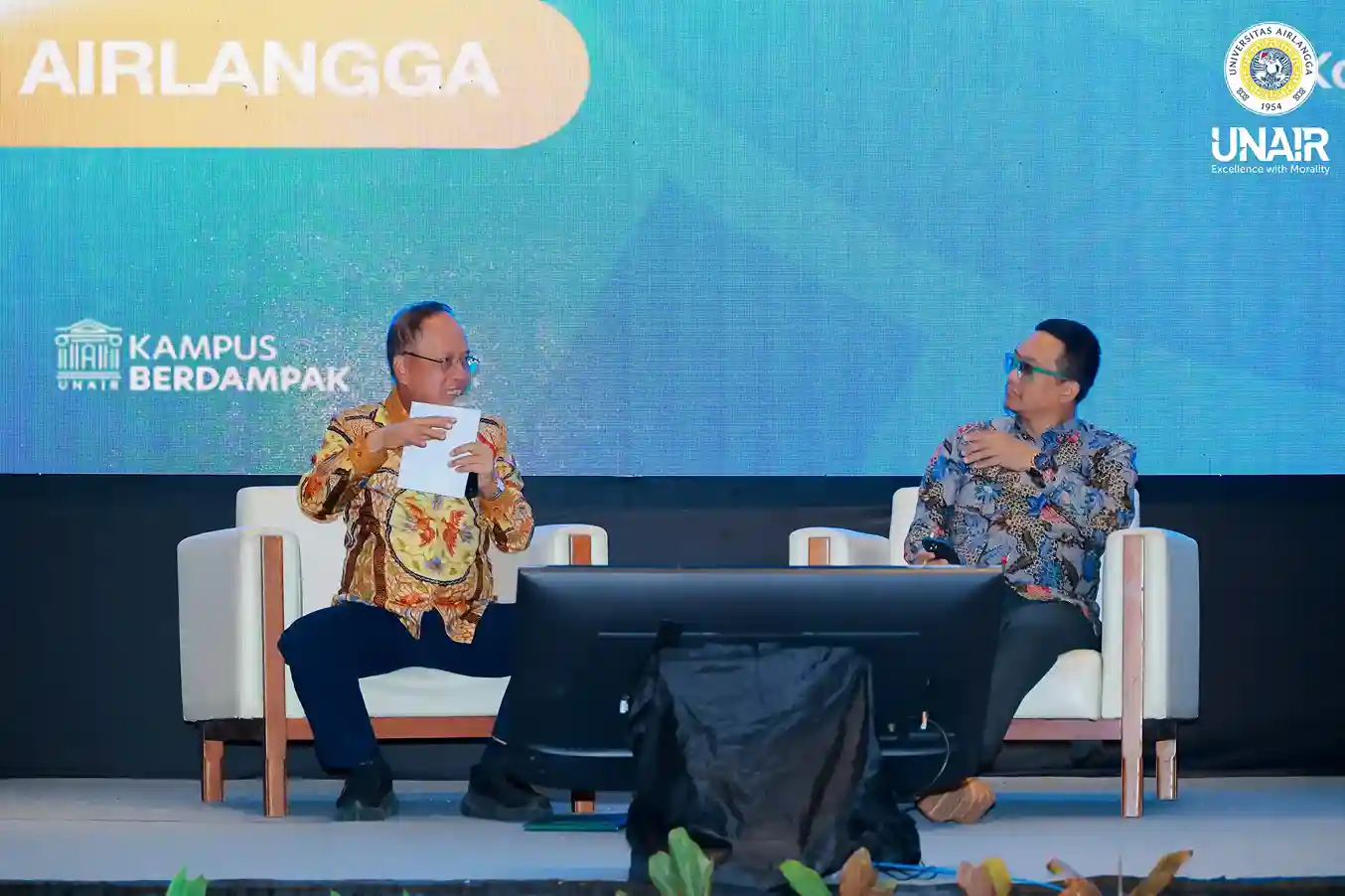
UNAIR NEWS – Universitas Airlangga (UNAIR) continues to strengthen its commitment to accelerating the transformation of higher education toward a global scale. To formulate strategic next steps following its World Class University (WCU) achievement, UNAIR hosted a two-day Sharing Session on Friday and Saturday, September 18–19, 2026. The event featured two national experts: Prof Mohamad Nasir PhD and Prof Dr Ainun Na’im PhD.
Transformation toward entrepreneurial university and AI-enabled impact university
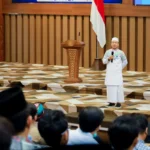
The first session, held on Friday, September 18, 2026, featured Prof Nasir, Minister of Research, Technology, and Higher Education of the Republic of Indonesia for 2014–2019 and Independent Commissioner of Bank Syariah, moderated by Prof Miftah.
In his presentation, Prof Nasir emphasized that achieving WCU status is not the ultimate goal, describing it as “beyond excellence.” Higher education institutions today face the challenge of evolving in the era of artificial intelligence, moving from Teaching University to Research University, Entrepreneurial University, and eventually to AI-Enabled Impact University.
Looking back at the journey since 2015, Indonesia was then still behind other countries in Southeast Asia in terms of research publications. The “speed up” policy and the Top 500 WCU target significantly boosted publication output among lecturers and professors.
“But what do we do after reaching this target? Academic excellence must not stop at paper. Research must be guided through the nine levels of Technology Readiness Level (TRL), shifting its focus from publication toward intellectual property (IP), prototypes, and ultimately commercialization,” Prof Nasir said.
He praised UNAIR’s stem cell research, which he considers to be on the right TRL track and which has drawn interest from international researchers and partners in the United States.
To become a World Class Entrepreneurial University (WCEU), Prof Nasir shared a key formula: Academic Excellence + Research Innovation + Entrepreneurship + Industry Partnership + Global Engagement. He encouraged a reverse engineering approach, starting from market needs, equipping students with future-proof skills such as data science and AI, and strengthening the role of graduates as job creators.

University business models and global innovation ecosystem
The discussion continued on the second day, Saturday, September 19, 2026, with Prof Ainun Na’im PhD, who explored the harmonization between academic strategy and the effectiveness of the university business model.
Prof Na’im opened his presentation by praising UNAIR’s remarkable progress toward WCU status, which he described as outstanding among universities in Indonesia. He emphasized that in order to bring the benefits of research to society, universities must clearly distinguish between innovation and entrepreneurship.
“Innovation is the process of creation, while entrepreneurship is the vehicle that carries the results of that innovation to society. Innovation alone is not enough; it takes an entrepreneurial spirit for its impact to be truly felt,” Prof Na’im explained.
He outlined the ideal innovation process chain: identifying societal needs, research and ideation, prototyping, pilot testing, learning, and public dissemination. To support this, he said, universities need a solid ecosystem, including a Technology Transfer Unit, a unit for building entrepreneurial mindsets, and institutions that connect innovators with venture capital.
Prof Na’im also compared the business models and strengths of several renowned universities worldwide:
- LMU Munich (Germany): Focuses specifically on biotech/pharma, medtech, and AI/software. Its funding is dominated by state funding (71 percent) and research grants (21 percent), without relying on tuition fees, and it maintains a Promotion of Junior Academics policy supporting young professors.
- Harvard University (US): Leads in endowment fund management and patent ownership, with philanthropic contributions accounting for 46 percent of total funding.
- UC Berkeley (US): Ranks first globally in entrepreneurship, followed by Stanford and Harvard. UC Berkeley is home to the Sutardja Center for Entrepreneurship & Technology, founded by an Indonesian figure, the IPIRA unit for licensing and intellectual property rights, and SkyDeck, a startup accelerator connecting ventures to industry.
In his closing remarks, Prof Na’im noted that the research commercialization process carries high risk. At Harvard University, of roughly 30,000 new products developed, about 95 percent have not succeeded.
“These failures usually happen due to a lack of careful understanding of the real solutions society needs. That’s why cross-disciplinary research that addresses tangible needs must continue to be optimized,” he said.
The shared perspectives of Prof Nasir and Prof Na’im underscore that the World Class University milestone is not an endpoint, but a starting point for universities to transform their academic excellence into an Entrepreneurial University and an AI-Enabled Impact University. Through structured research tracking (TRL), strengthening the commercialization and technology transfer ecosystem, cross-disciplinary collaboration, and close industry partnerships, universities are expected not only to produce graduates with entrepreneurial talent, but also to turn knowledge into concrete innovation that continuously addresses society’s real needs.
Author: Ahmad Suhail Alhazimi
Editor: Ragil Kukuh Imanto