
Scientific Article

Analysis of Factors Affecting of Using Sharia Mobile Banking among Indonesian Muslim Students

The sharia-based economy in Indonesia is predicted to grow rapidly and has the potential to become the largest in the world. With 85% of its population being Muslim, Indonesia has strong demographic support. However, its strategic plan to lead the sharia economy is not easy, as global achievements remain limited. Reports show Indonesia ranked only

Prediction of Average Temperature in Banyuwangi Regency Using SARIMA

Climate change due to human activity has significantly impacted increasing global average temperatures,Β  includingΒ  inΒ  BanyuwangiΒ  Regency,Β  EastΒ  Java.Β  TheΒ  impactΒ  isΒ  feltΒ  inΒ  several sectors, such as agriculture, tourism, and health. As a preventive measure to minimize the adverseΒ  effectsΒ  thatΒ  willΒ  occurΒ  inΒ  theΒ  future,Β  anΒ  accurateΒ  predictionΒ  ofΒ  the average temperature of

Elaboration of the Concept of Serious Human Rights Violations in Indonesia

Corporations are considered to have limited status as subjects of international law. This status differs from other international legal subjects, such as countries or international organizations. Based on this proposition and the fact that individuals (natural persons) are also legal subjects, with the existence of rights and obligations based on international human rights law, corporations

Modeling and Forecasting the Total Volume of Goods Transported by Rail in Indonesia Using Seasonal Autoregressive Integrated Moving Average (SARIMA)

Transportation is vital for daily activities, including the movement of goods, services, and labor. In Indonesia, rail transport has been important since 1864, with Kereta Api Indonesia (Persero) providing services that help reduce congestion. Trains efficiently carry large volumes of goods at relatively low costs and with high time efficiency, making them crucial for economic

Climate Change Challenge: Coastal Community Adaptation Towards Achieving Sustainable Community Resilience in Central Java, Indonesia

Climate change poses significant challenges for coastal communities in northern Central Java, Indonesia, particularly in the cities of Semarang and Demak. These regions are increasingly vulnerable to a multitude of environmental threats, including rising sea levels, land subsidence, coastal erosion, tidal flooding, and extreme weather events. Such phenomena not only jeopardize the livelihoods of local

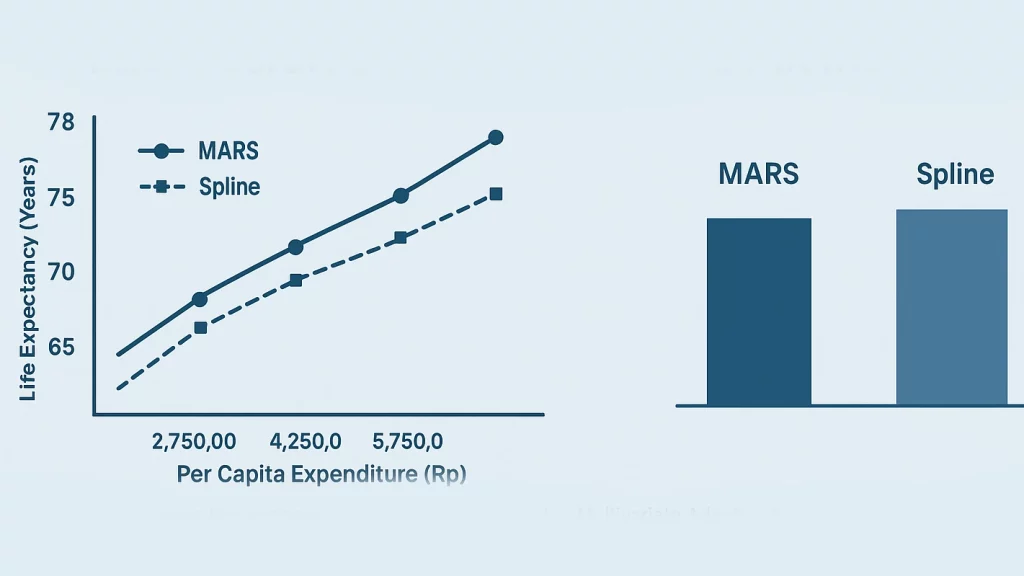
Comparison of Multivariate Adaptive Regression Spline and Spline Nonparametric Regression on Life Expectancy in Indonesia

This study investigates life expectancy in Indonesia by comparing two nonparametric regression methods: Multivariate Adaptive Regression Spline (MARS) and Spline Nonparametric Regression, using 2023 data from 34 provinces provided by the Indonesian Central Bureau of Statistics (BPS). Life expectancy serves as a critical indicator of public health and overall welfare, influenced by various socioeconomic factors.

Modeling Youth Development Index in Indonesia Using Panel Data Regression for Binary Response with Random Effect

This study explores youth development in Indonesia through the Youth Development Index (YDI), a key indicator designed to assess youth progress across five domains: education, health, employment, participation, and gender equality. Despite having the largest youth population in Southeast Asia, Indonesia ranks only fifth in the region’s YDI. Using panel data from 34 provinces over

Modeling prevalence of hypertension in Indonesia with Multivariate Adaptive Regression Splines method

Hypertension is one of the important public health problems in Indonesia, which contributes to the high prevalence of non-communicable diseases. This study aims to model the prevalence of hypertension in Indonesia using the Multivariate Adaptive Regression Splines (MARS) method to identify significant predictors and their interactions. The data used was secondary data from the 2023

Illustrationof passion fruit (Photo: andr)

Potential of cell-free fermentation supernatant from yellow passion fruit microspheres as a novel antibacterial agent against multi-drug resistant organisms

Antibiotic resistance is a significant health issue in the world. These bacteria, which mutate and adapt to antibiotics and make inadequate therapy. These bacteria are classified as Multi-drug Resistant Organisms (MDRO), by which the organisms are no longer vulnerable at least to one type of antibiotic. Extended Spectrum Beta Lactamase (ESBL) Escherichia coli and Methicillin

Bahasa Indonesia Bahasa Indonesia English English
Universitas Airlangga
Excellence with Morality
Accessibility βœ•
Scroll to Top