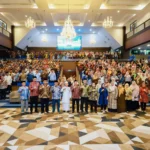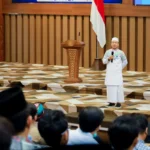
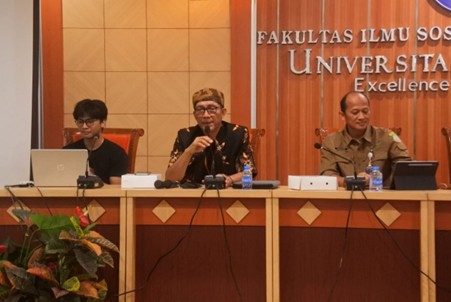
UNAIR NEWS – The Department of Anthropology and the Human, Culture, and Body Laboratory (MaBuRag Lab) at the Faculty of Social and Political Sciences (FISIP), Universitas Airlangga (UNAIR), held another guest lecture on Tuesday (May 26, 2026). The lecture, titled “The Culture of Social Innovation: Transforming the Corporate Mindset in Managing the Bromo Ecosystem as a Shared Asset,” took place at the Adi Sukadana Hall of FISIP UNAIR.
The event featured Ir Suratno SHut MM IPU, Deputy Head of Perhutani’s East Java Regional Division, as the keynote speaker. The session was moderated by Prof Dr H Mohammad Adib Drs MA, Coordinator of the MaBuRag Lab at FISIP UNAIR.
Transforming corporate culture
The discussion highlighted the importance of transforming corporate culture in achieving sustainable natural resource management, particularly in the Bromo region, which is regarded as a shared asset with ecological, social, and cultural significance.
Prof. Adib explained that research on ecosystem and carbon management is driven by a broader vision of transforming spring and carbon ecosystems into a sustainable village scholarship endowment fund. The concept positions nature as a form of social capital capable of supporting educational empowerment in rural communities.
Meanwhile, Ir Suratno emphasized that forest management cannot be driven solely by economic interests. It must also prioritize environmental sustainability and the well-being of communities living around forest areas.
“Forests should not be viewed and utilized merely as sources of timber. Beyond that, they help safeguard food security, provide clean water sources, mitigate the impacts of climate change through carbon absorption, and support national energy resilience,” he said.
Perhutani’s responsibility
Ir. Suratno explained that Perhutani, Indonesia’s only state-owned forestry enterprise, is responsible for maintaining a balance between people, planet, and profit in managing forest areas. “As a state-owned corporate entity, Perhutani is not only responsible for ecological preservation. It is also expected to remain financially self-sufficient while improving the welfare of communities surrounding forest areas,” he said.
In his presentation, Ir. Suratno also addressed the growing pressure on forest ecosystems caused by population growth and increasing demand for food, energy, and clean water. According to him, contemporary forest management challenges include food security, renewable energy development, clean air, water availability, and climate change mitigation.
To address these challenges, Perhutani has developed a range of collaborative strategies, including agroforestry, intercropping systems, sugarcane cultivation, and forest honey production. The company also collaborates with local communities through Forest Village Community Institutions (LMDH) and profit-sharing schemes to enhance livelihoods while maintaining forest sustainability. “Perhutani remains committed to protecting approximately 1,385 spring water sources located within forest areas,” he said.
Environmental, social, and governance
In addition to discussing forest management, the guest lecture explored carbon trading and the implementation of Environmental, Social, and Governance (ESG) principles in corporate governance. Ir Suratno noted that carbon trading holds significant potential to support sustainable forest management, although Indonesia’s regulatory framework continues to evolve.
“Perhutani encourages the planting of tree species with high carbon sequestration capacity, such as rain trees, banyan trees, and mahogany,” he explained.
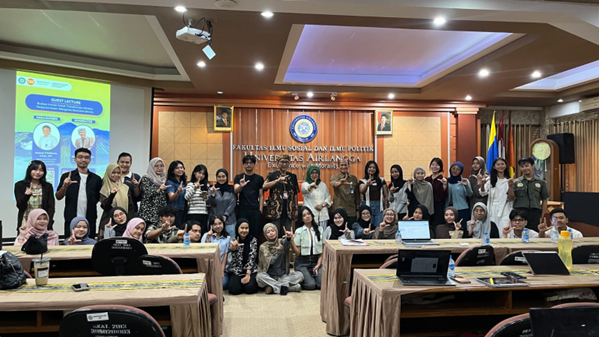
Through the guest lecture, FISIP UNAIR underscored the importance of collaboration among government institutions, corporations, academics, and local communities in safeguarding Indonesia’s natural resources. Students demonstrated strong enthusiasm throughout the discussion session.
Author: Nasywa Kaffa and Michael Anggi Hutauruk
Editor: Yulia Rohmawati