
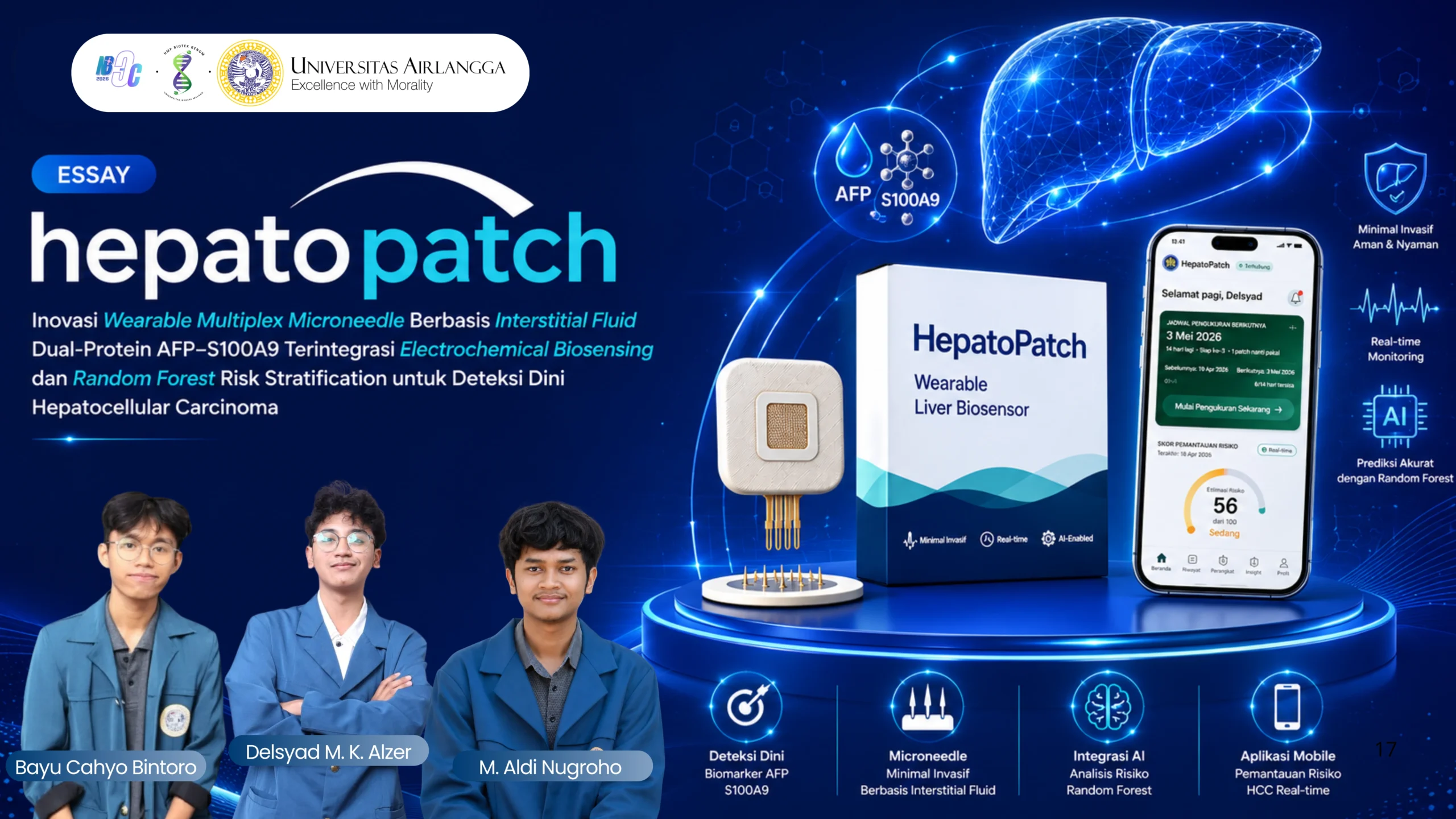
UNAIR NEWS – Students from Universitas Airlangga (UNAIR) have once again earned national recognition in an academic competition. The HepatoPatch team secured first place at the National Biotechnology Essay Competition 2026, held on Saturday (May 23, 2026) at Universitas Negeri Malang. The competition encourages students to develop innovative biotechnology-based solutions, including those in biopharmaceuticals and health technology.
The HepatoPatch team consisted of Bayu Cahyo Bintoro from the Faculty of Dental Medicine, Delsyad Muhammad Koosha Alzer from the Faculty of Pharmacy, and Mohammad Aldi Nugroho from the Faculty of Science and Technology. The team claimed the top prize with an innovation called HepatoPatch, a health patch designed to enable early detection of primary liver cancer.
HepatoPatch: Early detection solution for liver cancer
Bintoro, the team leader, said the idea for HepatoPatch emerged from the high mortality rate associated with liver cancer, largely because many patients are diagnosed only after the disease has reached an advanced stage. He noted that current screening methods still face significant limitations.
“Conventional liver cancer screening methods currently have limitations, particularly in detecting cases at an early stage. Therefore, we designed a more accessible, minimally invasive approach that utilizes a combination of biomarkers, allowing early screening to become more widely available to the public,” he said.
HepatoPatch is a wearable health patch developed to support the early detection of primary liver cancer. Nugroho explained that the device works by attaching directly to the skin, eliminating the need for venous blood collection.
“The device is applied to the skin to collect interstitial fluid located between the body’s cells through a minimally invasive process. The detected biomarkers are then analyzed, and the data are processed through a biosensor system and mobile application to generate a hepatocellular carcinoma (HCC) risk score,” he said.
From concept to implementation
Alzer said the team encountered several challenges during the competition, particularly in developing a comprehensive framework for the innovation’s integrated system. “We had to ensure that every component of the innovation could function as an integrated whole, from sample collection and biomarker detection to data analysis. The primary challenge was designing a solution that is not only technologically advanced but also realistic to implement and supported by a strong scientific foundation,” he said.
Bintoro added that HepatoPatch has the potential for broader application following further testing and validation. “This innovation must undergo analytical validation, clinical trials, and regulatory approval before it can be implemented in the community. The device is not intended to replace a physician’s diagnosis but rather to serve as an initial screening tool for individuals at high risk of developing liver cancer,” he said.
The HepatoPatch team encouraged fellow students to participate in scientific competitions despite the challenges they may face. “The most important aspect of participating in scientific competitions is understanding the problem and building a solution step by step. Competitions are not solely about winning; they are also opportunities to learn how to think systematically and develop solutions to real-world healthcare challenges,” the team concluded.
Author: Maulya Afifah Zahra
Editor : Khefti Al Mawalia