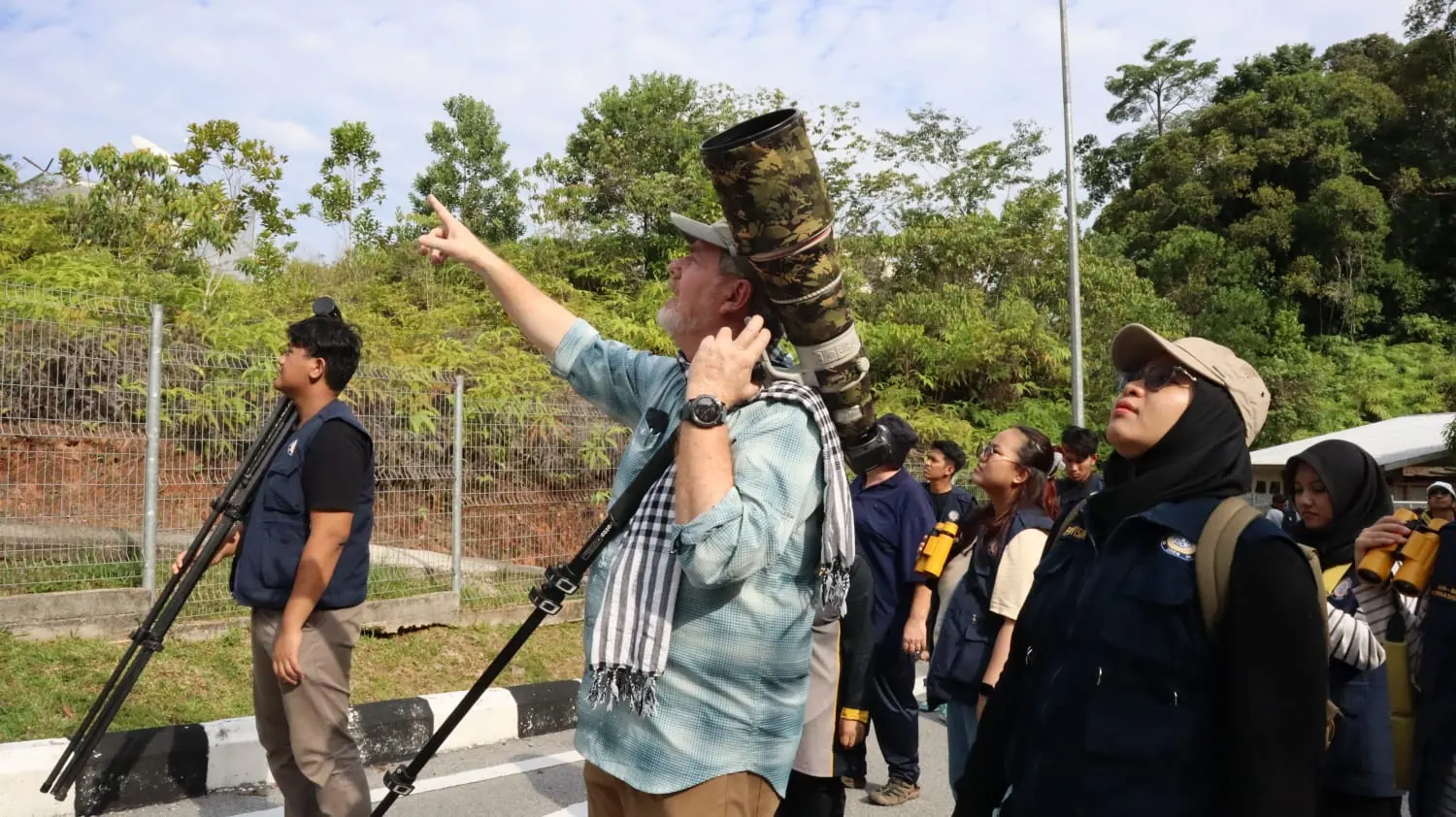
| UNAIR NEWS – Twelve Universitas Airlangga (UNAIR) students participating in the International Belajar Bersama Komunitas (BBK) Program in Kuala Terengganu gained hands-on experience in birdwatching and citizen science at the SPAK Research Station, Universiti Malaysia Terengganu (UMT), on Tuesday (28/7/2026). The activity introduced a biodiversity conservation approach that involves active community participation in collecting scientific data. |
One of the participants, Kamila Mahfudza A P from the Faculty of Public Health (FKM) UNAIR, said the activity provided a new perspective on the connection between environmental conservation and public health. She added that hands-on learning in the field helped students better understand the importance of protecting biodiversity.
“This activity broadened our understanding that conservation is not limited to researchers. Communities can also contribute through simple observations that support scientific research while raising environmental awareness,” Mahfudza said.
Learning conservation through birdwatching
The activity was led by Anuar McAfee, who explained birdwatching as an activity that supports scientific research and ecotourism development while also providing physical and mental health benefits. Participants were also introduced to the eBird platform, which allows the public to record bird observations and contribute to biodiversity databases.
The activity was led by Anuar McAfee, who explained birdwatching as an activity that supports scientific research and ecotourism development while also providing physical and mental health benefits. Participants were also introduced to the eBird platform, which allows the public to record bird observations and contribute to biodiversity databases.
“Seeing various species firsthand in their natural habitats was a truly memorable experience. We learned that simple data collected by the community can make a significant contribution to conservation efforts,” Mahfudza added.
Strengthening international collaboration
Through the activity, students not only gained knowledge about citizen science-based conservation but also learned the importance of collaboration between universities and communities in protecting biodiversity.
International BBK Program provides a platform for students to learn best practices that can be adapted in Indonesia, including the development of community-based conservation and ecotourism through simple and participatory scientific approaches.
“We hope this experience can inspire the development of community-based conservation activities in Indonesia while strengthening international collaboration in education and environmental conservation,” Mahfudza concluded.
The activity also contributed to the achievement of the Sustainable Development Goals (SDGs), particularly SDG 4 (Quality Education), SDG 15 (Life on Land), and SDG 17 (Partnerships for the Goals).
Author: Dheva Yudistira Maulana, M. Ammar Putra Ramadhani
Editor: Yulia Rohmawati