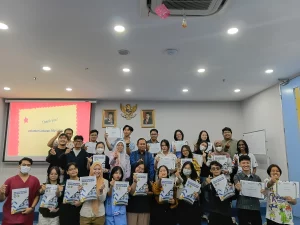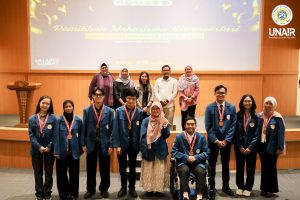


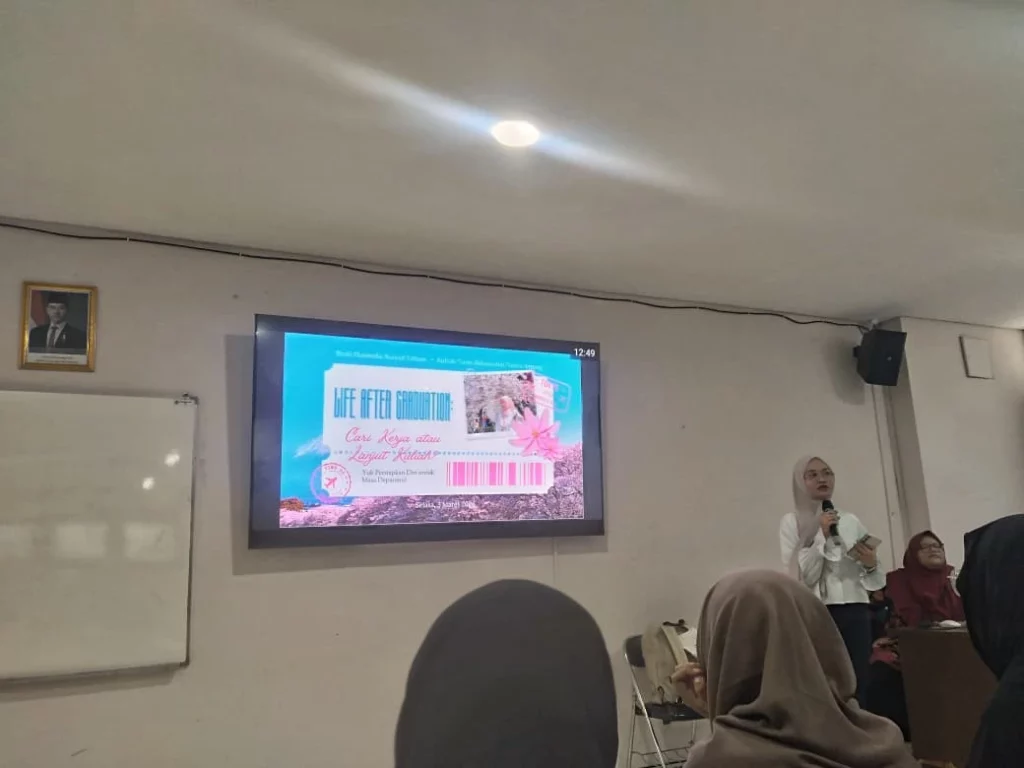
UNAIR NEWS – The Department of Japanese Language and Literature, Faculty of Humanities Universitas Airlangga (UNAIR), held a guest lecture titled “Choices After Bachelor’s Degree: Career or Master’s Study” on March 3, 2026, at Room 302, Faculty of Humanities UNAIR. The session featured Rizki Hanindia Rasyid SHum, a 2024 graduate of the Japanese Language and Literature Study Program.
Hanindia currently works as a translator and human resources officer in a Japanese-Indonesian multinational manufacturing company. She began her professional career after completing a student exchange program at Kansai University and graduating from her undergraduate program. “I am proud that students can better understand their future aspirations,” said Nunuk Endah Srimulyani SS MA PhD, Head of the Department of Japanese Language and Literature, in her opening remarks.
Achievement and professional journey
Before completing her undergraduate study, Hanindia was awarded the prestigious Bank Indonesia Scholarship and participated in a one-year student exchange program at Kansai University. After returning to Indonesia, she completed her undergraduate thesis and graduated in 2024. After graduation, she received an offer from a recruitment agent to work as a translator at a multinational company. However, due to differences in professional culture, she was assigned dual roles as both translator and HRD training staff. “In Japanese professional culture, translator roles are often considered irregular positions, which may result in holding multiple responsibilities,” Hanindia said.
She admitted that the position was quite challenging, as it required a strong understanding of Japanese manufacturing terminology. Limited academic preparation in specialized translation also contributed to the difficulty. Nevertheless, she remained committed and continued to develop her skills. Currently, Hanindia is pursuing her master’s degree at Kyoto University as a research student under the MEXT Scholarship.
Tips on choosing between further study and work
Choosing between continuing studies and entering the workforce requires sufficient preparation in terms of both time and finances. “Taking translation courses alone is not enough, students need to practice outside the classroom,” Hanindia said. She explained that those who want to become translators cannot rely solely on classroom materials. They need to study additional resources and practice for at least two hours a day due to the large amount of vocabulary involved. Artificial Intelligence technology can also support the learning process.
Hanindia also stated that students who plan to pursue further studies need to prepare for language proficiency tests such as the JLPT or TOEFL as part of the scholarship selection process. Financial preparation is also necessary as an emergency fund while living in Japan. “My scholarship was only disbursed at the end of April, while the academic term began in early April. Therefore, I had to work part-time to prepare my finances,” Hanindia said.
Concluding the public lecture session, she emphasized that both pursuing further studies and entering the workforce have their own advantages and disadvantages. Therefore, focus and determination are required to pursue either path.
Author: Yongki Eka Cahya
Editor: Ragil Kukuh Imanto