UNAIR NEWS – Jamu is not only part of Indonesian traditional medicine but also has a history as a health product in the Dutch East Indies. Prof Hans Pols PhD, a professor of history and philosophy of science at the University of Sydney, said this at the Masterclass and International Conference on the History of Medicine in Indonesia (HOMI).
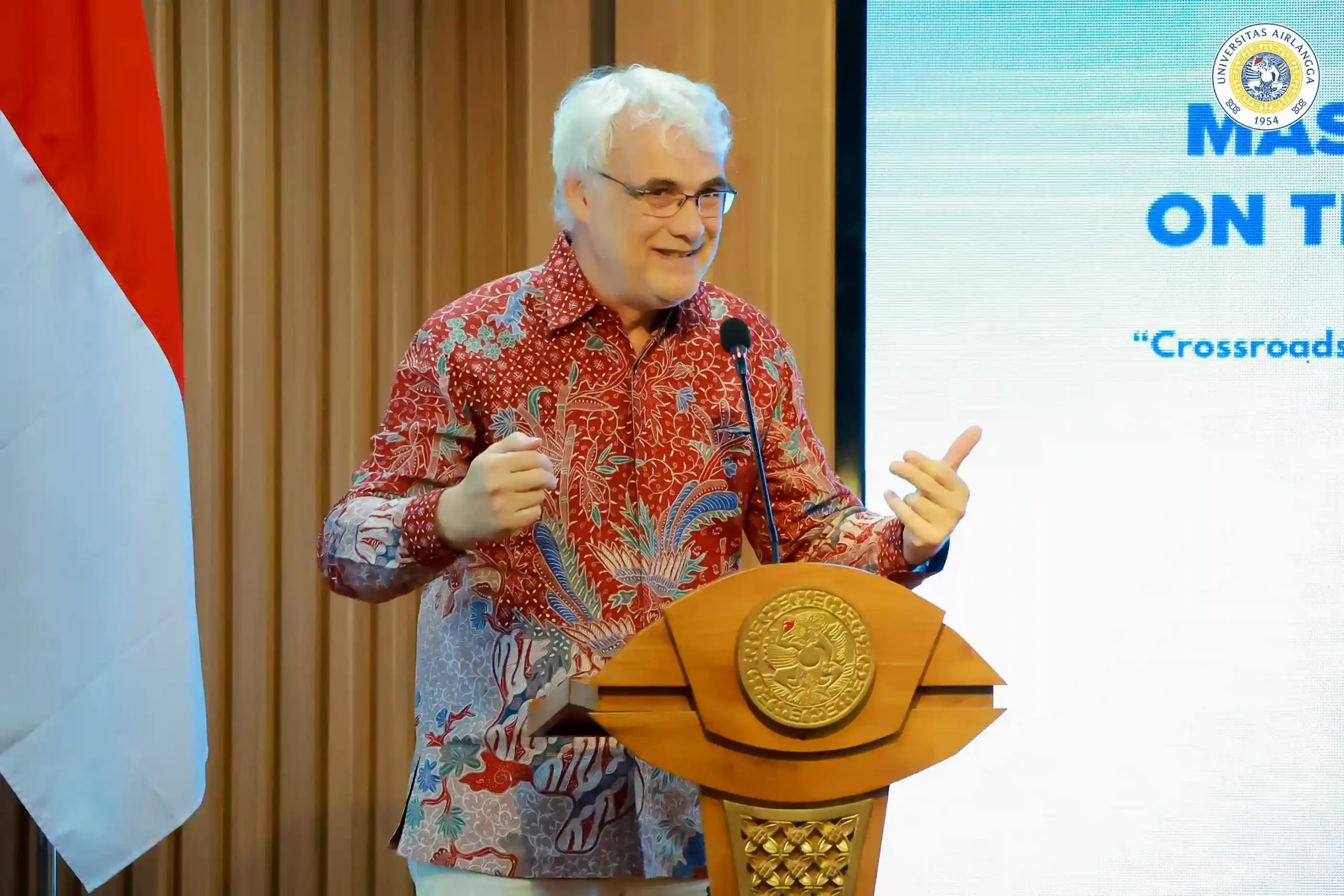
The international conference was organized by the Faculty of Humanities (FIB) and the Faculty of Medicine (FK) at Universitas Airlangga (UNAIR) on Thursday, September 24, 2026. The event, held in the Majapahit Hall at ASEEC Tower, UNAIR, featured the theme “Crossroads of Healing: Indonesia in Global Medical Networks.”
In a presentation, “Introduction to Medicine without Physicians: Health, Disease, and Self-Care in the Dutch East Indies,” Prof. Pols discussed public health practices in the Dutch East Indies. He explained how traditional medicinal products, such as jamu, were introduced and marketed to the public.
Health products and knowledge
Prof. Pols explained that the growth of jamu is not limited to traditional medical practices. Jamu has also grown as a health product marketed to the public. At that time, these medicinal products were introduced through various promotional materials, such as booklets containing product information and prices.
“Through the booklet, the public can use this information to select and order the products they need,” Prof. Pols said.
In addition to product information, the booklet also contains details about various illnesses and advice on use. This shows that the marketing of health products went hand in hand with spreading information about treatments to the public.
He also shows Jamu Cap Jago as an example. The product has been well known since 1918. Its booklet lists various illnesses that the public can use as a reference when choosing a product.
“The presence of catalogs and promotional materials shows that jamu has a history that extends beyond its role as a medical heritage. Jamu was also part of how people obtained information and chose health products at that time,” he said.
Jamu during Modernization
Prof. Pols explained that the development of modern medicine has also influenced the role of jamu in society. Jamu then emerged as one of several treatment options amid the growth of the modern medical system. According to him, the public response is an important part of understanding.
He explained that when a traditional treatment is considered beneficial, the related knowledge can be studied and developed within modern medicine. At the same time, traditional medicine remains an alternative for the public.
“I couldn’t say for sure whether jamu actually works. However, people enjoy it and continue to buy the product. Maybe jamu does provide benefits for them, but maybe it doesn’t,” he concluded.
Author: Vaneza Ika Artamevia
Editor: Yulia Rohmawati