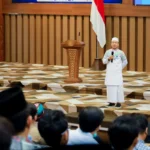
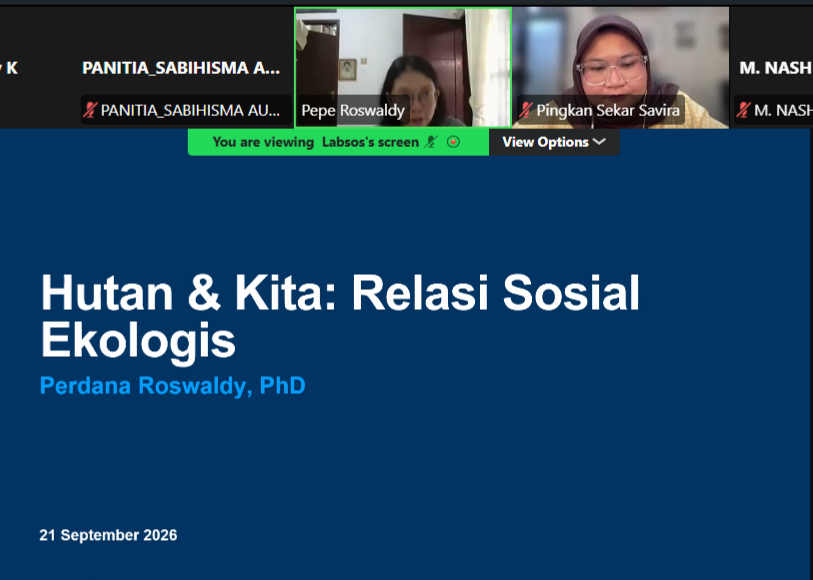
UNAIR NEWS – The Sociology Department of Faculty of Social and Political Sciences (FISIP) Universitas Airlangga (UNAIR) organized a guest lecture titled “Who owns the Forest? Power, Land, and Inequality Behind Indonesia’s Forest Fires” on Monday, September 21, 2026 via Zoom. This guest lecture featured Perdana Roswaldy PhD, a Professor Assistant in the Master of Sustainability Program at Monash University Indonesia, as a speaker. Through the perspective of environmental sociology, Roswaldy discussed forest and land fires and linked them to policy, forest ownership, and society’s relation with the environment.
Disasters are not only a matter of nature
Roswaldy encouraged participants to view disasters as a phenomenon shaped by various factors, rather than merely the result of natural conditions. He explained that policies and preparedness measures also determine the extent to which an environmental phenomenon impacts society.
“What caused an environmental phenomenon is one thing, but how it reached the point of ‘disaster’ involves a combination of several other variables that made it worse,” he said.
Forest and land fires served as one of the examples of how environmental impacts can spread when prevention and mitigation systems are not functioning optimally. For this reason, Roswaldy encouraged the shift of perspective towards disaster so that Indonesia will not merely react after a disaster has occurred.
“There’s nothing natural about natural disasters. There’s no such thing as a natural disaster,” he said. “We can mitigate the effects of disasters with better disaster management policies.”
Forest ownership and indigenous people
The issue of forest and land fires also raises the question of who owns and controls the forests. Roswaldy explained that when a county designates forests as state property, that decision shapes the social relationships between the state, the community, and the various parties who have claims to those resources.
“When a state has classified something as property, in this case forests, it means there is a social relationship based on property rights involved,” he explained.
In forest management, Roswaldy believes that the government also needs to take into account the knowledge and ecological relationships of indigenous communities. He pointed out that forest degradation can affect the lives of communities who depend on their surrounding ecosystems, including those who do not have direct claims to forest areas.
“Nature is also considered as a social actor, and humans are also actors of nature in this context,” he said. “We’re talking about how, for example, indigenous communities have a different cosmology, in an economic sense, when it comes to viewing the forest,” he concluded.
Through this discussion, Roswaldy emphasized that forest issues go beyond the legality of ownership. Social relations, ecological value, and how the communities understand the environment also determine how forests are managed and the impact of their destruction.
Author: Katara Joy Kurniawan
Editor: Ragil Kukuh Imanto