
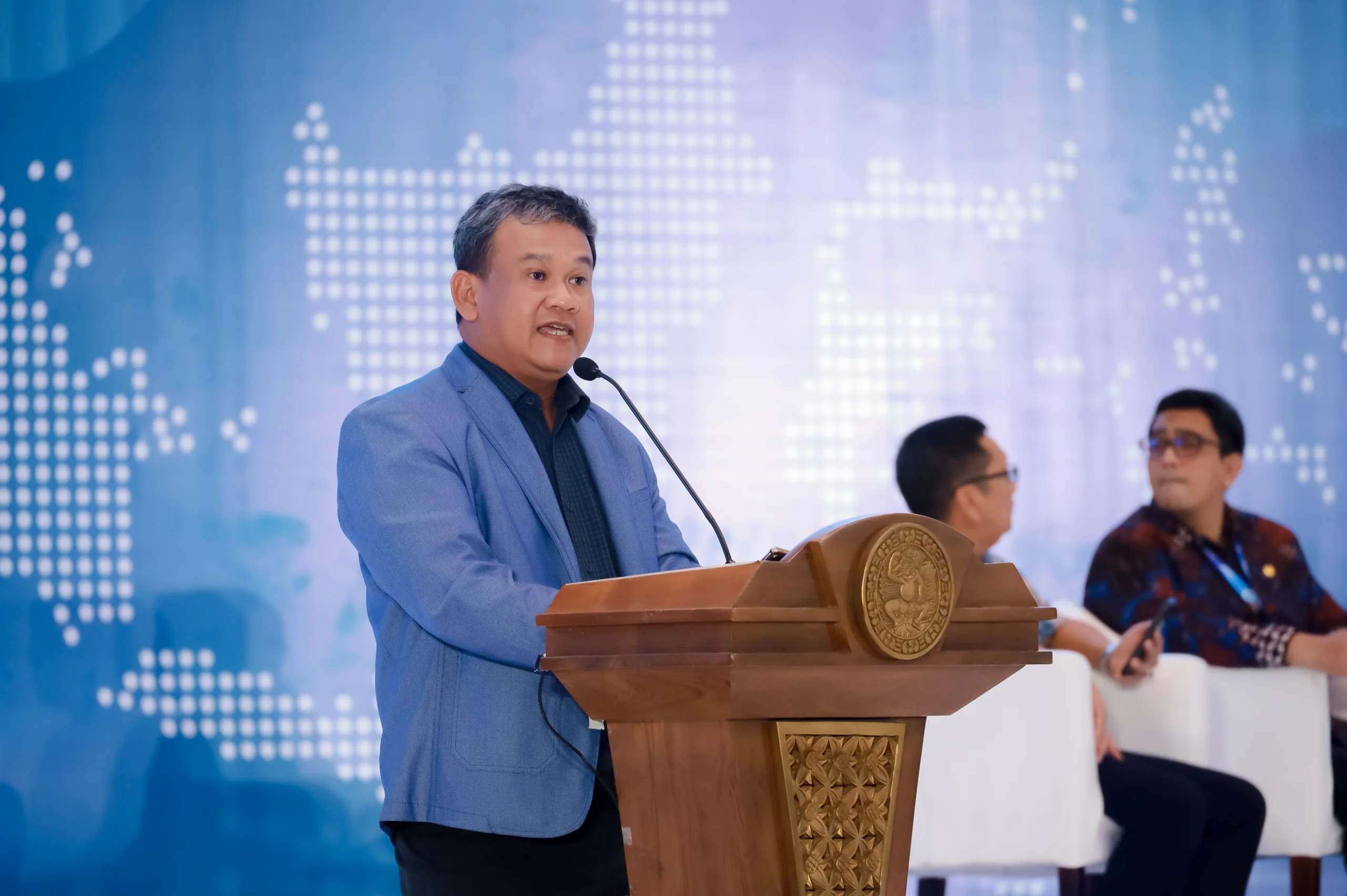
KPPTI NEWS – Universities are encouraged to strengthen partnerships with various stakeholders to accelerate the downstreaming of innovations and address community issues in local areas. These efforts need to be carried out through the implementation of the Tridharma of Higher Education that involves the community and takes into account local potential and wisdom.
This was one of the recommendations from Cluster 3, themed “Partnerships and Tridharma with Regional Impact,” presented by Cluster 3 Coordinator Uuf Brajawidagda during the plenary session summarizing the discussions of the 2026 Indonesian Higher Education Summit (KPPTI) at the Airlangga Convention Center (ACC), UNAIR MERR-C Campus, on Friday, November 13, 2026.
In his presentation, Brajawidagda outlined three strategic perspectives: strengthening collaboration to accelerate the downstreaming of innovations; increasing the contribution of universities in solving community issues; and developing programs in harmony with local cultural roots.
Collaboration to accelerate innovation downstreaming
The first strategic perspective emphasizes the importance of universities being open to building collaborations with various stakeholders to drive the downstreaming of innovations.
“Universities are opening up and collaborating with various parties to carry out the downstreaming of innovations,” Brajawidagda explained.
Referring to the first strategic perspective from the plenary findings, collaboration involving communities, local governments, other universities, cooperatives, or large corporations can accelerate the downstreaming process. Although this collaboration has successfully generated economic, social, and environmental impacts, universities and their partners still face real challenges, including technology transfer, institutional capacity, legal issues, and funding.
Addressing Community Challenges Through Education, Research, and Community Engagement
Beyond conducting laboratory research, today’s academic community must work directly with communities to deliver practical solutions.
“Universities actively engage with communities through initiatives such as community service programs (KKN), village development programs, partner village initiatives, and other activities that directly address local challenges,” Brajawidagda explained.
These initiatives are expected to increase community incomes, strengthen village self-reliance, empower residents, and improve nutrition. Universities’ contributions can also support their performance in the Times Higher Education Impact Rankings. However, universities must still address challenges related to changing community mindsets and ensuring program sustainability.
Strengthening Local Wisdom in Regional Development
The third strategic perspective emphasizes the importance of developing universities in harmony with local cultural roots and regional potential.
“Universities grow in harmony with the cultural roots that have shaped them,” he said.
In practice, universities can draw on local wisdom to help prevent disasters, as illustrated by a case in Lamongan. They also help strengthen the capacity of Indigenous communities in Keling Kumang, Sekadau, West Kalimantan, and support cultural preservation through initiatives in Malang.
Concluding his presentation, Brajawidagda emphasized that universities must become more open and focus their efforts on accelerating the translation of research into practical applications. This process is essential to supporting commercialization and community empowerment so that people can directly benefit from research outcomes.
“Universities grow from communities, work alongside them, and create impact for them,” Brajawidagda concluded.
By strengthening partnerships and aligning education, research, and community engagement with regional needs, universities are expected to deliver useful innovations and support sustainable community development.
Author: Nabila Afifah Abida
Editor: Ragil Kukuh Imanto