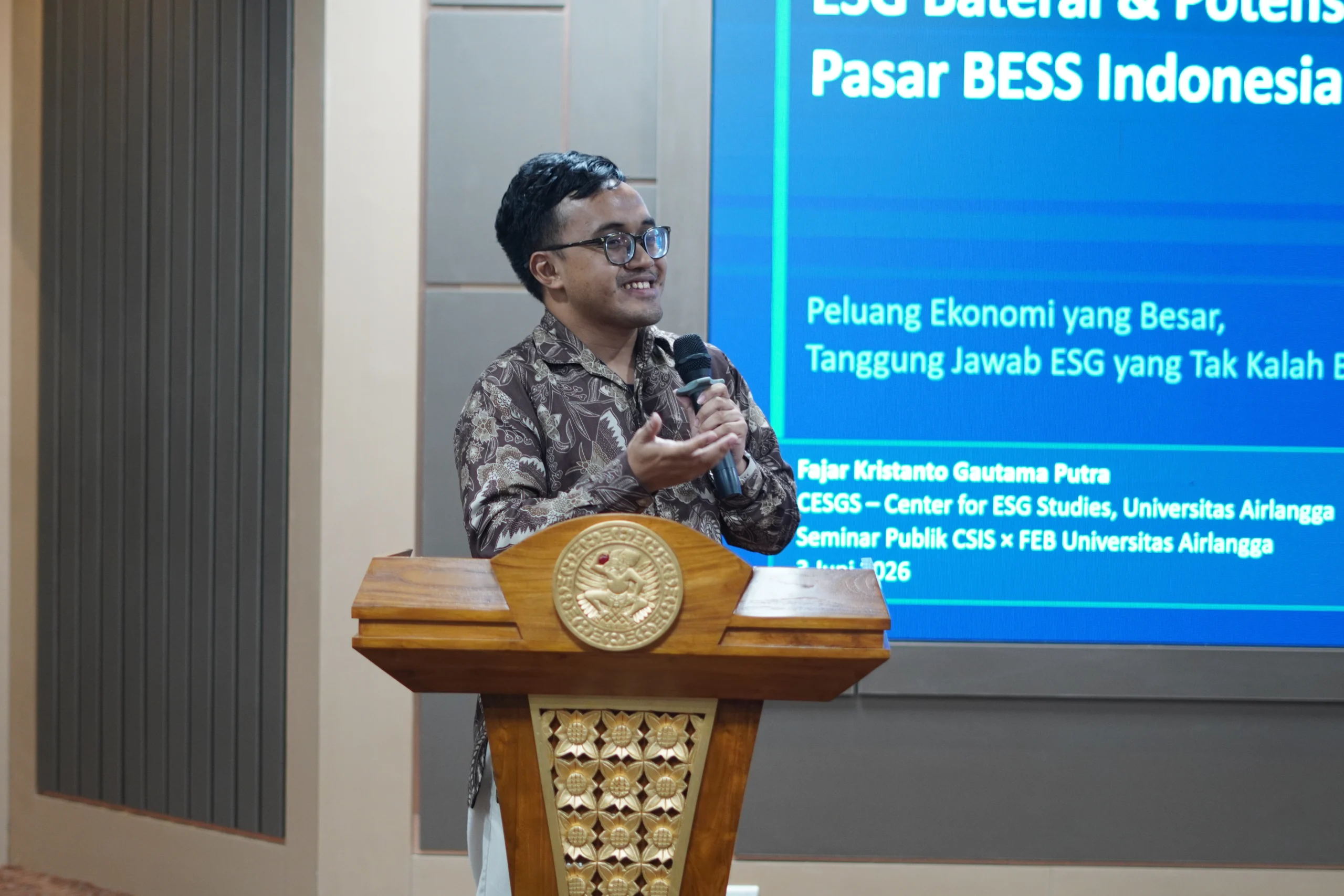
UNAIR NEWS – Indonesia’s Battery Energy Storage System (BESS) sector holds significant growth potential, according to Fajar Kristanto Gautama Putra, Managing Director of Research Innovation at the Center for Environmental, Social, and Governance Studies (CESGS) of Universitas Airlangga. Speaking during a session titled Battery ESG and Indonesia’s BESS Market Potential: Major Economic Opportunities, Equally Significant ESG Responsibilities, Putra outlined both the economic promise and sustainability challenges facing the industry. The session was part of the CSIS–CESGS Universitas Airlangga Public Seminar, Building Decarbonization in the Battery and EV Industry Supply Chain to Safeguard Indonesia’s Competitiveness and Environmental Commitments, held on Tuesday (June 3, 2026) at Tarumanegara Hall on the 10th floor of ASEEC Tower, Campus B, Universitas Airlangga.
Expanding economic potential of BESS
During his presentation, Putra emphasized that battery applications in Indonesia extend well beyond electric vehicles (EVs). He noted that batteries play an increasingly important role in supporting renewable energy development, particularly solar power generation. As Indonesia accelerates its transition toward cleaner energy sources, demand for energy storage systems is expected to rise steadily.
He pointed to projections outlined in the government’s 2025–2034 Electricity Supply Business Plan (RUPTL), which forecasts substantial demand for energy storage capacity. Under those projections, battery storage requirements are expected to reach between 2.46 and 6.01 gigawatts (GW) by 2034.
“The economic potential is tremendous, but the ESG responsibilities are just as significant,” he said.
According to Putra, declining global battery prices have become a key catalyst for BESS growth. As production costs continue to fall, energy storage technologies are becoming more affordable and accessible, increasing their adoption across both industrial and residential markets.
Based on the estimates presented during the seminar, battery demand associated with Indonesia’s energy storage targets could generate a market worth billions of U.S. dollars. The projection does not yet account for growing demand from households, electric vehicles, and other industrial sectors, all of which are expected to expand in the years ahead.
Battery industry confronts major ESG challenges
Despite the sector’s strong economic outlook, Putra cautioned that the battery industry faces considerable environmental, social, and governance (ESG) risks. Data from global ESG ratings firm Sustainalytics show that the nickel mining industry, one of the primary suppliers of battery raw materials, continues to face elevated ESG risk levels.
He identified emissions, waste management, community engagement, resource consumption, and workplace safety as some of the most pressing issues requiring attention from industry stakeholders.
“While electric vehicles operate with relatively low emissions, battery manufacturing itself presents substantial sustainability challenges,” he said.
Putra also highlighted increasing international scrutiny of ESG performance throughout the battery supply chain. Global regulations, including the European Union’s battery passport initiative, now require companies to provide greater transparency regarding production processes and the sourcing of raw materials used in battery products.
He argued that Indonesia should move quickly to develop a more comprehensive and sector-specific ESG framework for the battery industry. Such measures, he said, would help the country meet international standards while strengthening the competitiveness of domestic manufacturers.
“ESG is no longer simply a matter of ethical responsibility or regulatory compliance. It has become a decisive factor in securing investment, financing, and access to global markets,” he said.
In his closing remarks, Putra stressed that the growth of Indonesia’s battery industry must be accompanied by a strong commitment to sustainability. By integrating ESG principles into industry development, Indonesia can maximize the economic benefits of the battery sector while building a more responsible and resilient supply chain for the future.
Author: Nikita Aulia
Editor: Ragil Kukuh Imanto