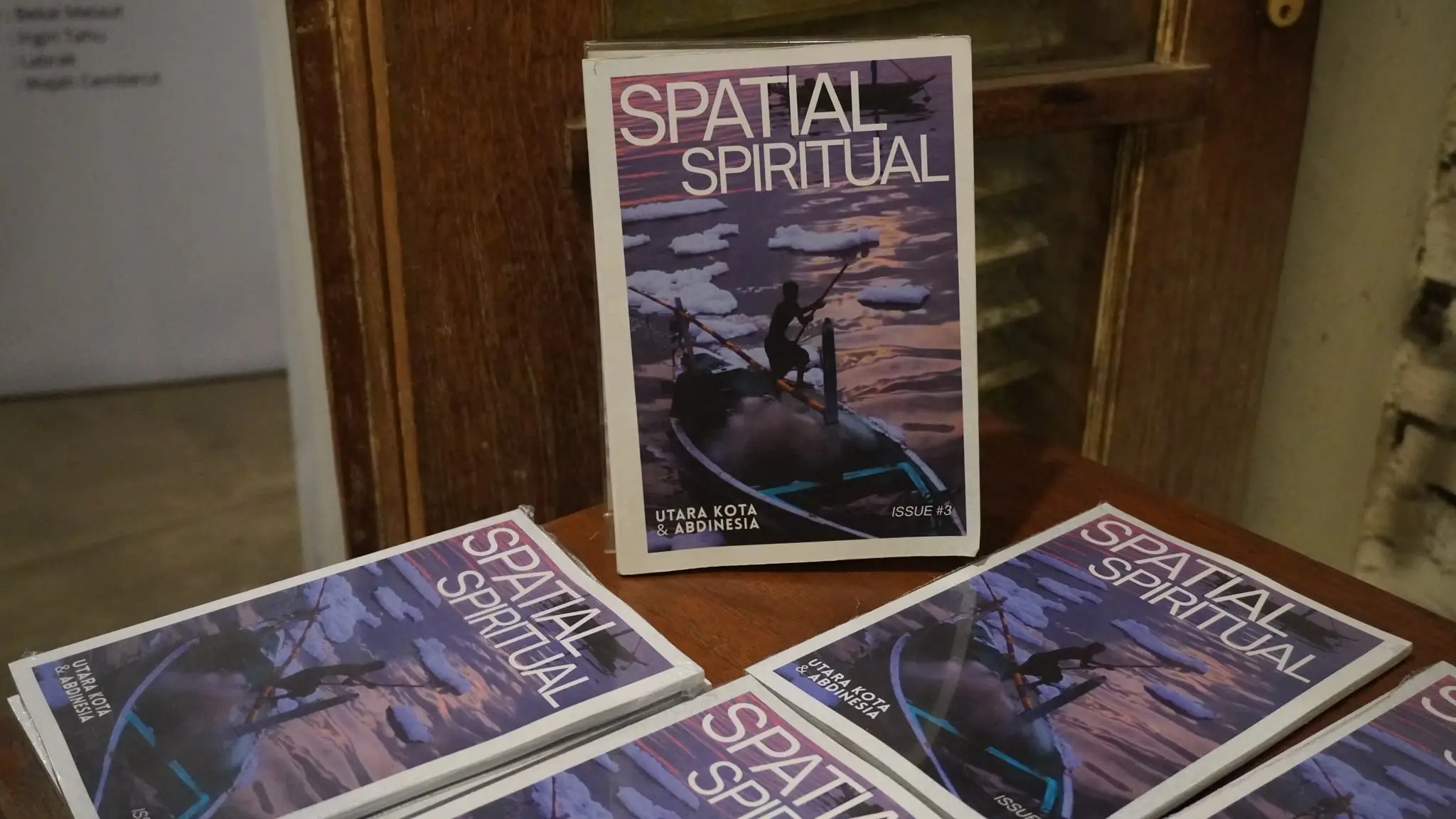
UNAIR NEWS – Understanding social reality does not always begin with field research. For Rusydan Hadid, literary works serve as the gateway to exploring various issues, which he then captures in a zine titled Spatial Spiritual. Drawing on his experience studying in the Indonesian Literature Program at the Faculty of Humanities (FIB), Universitas Airlangga (UNAIR), he highlights the dynamics of life in the Kenjeran coastal community through a blend of writing and visual documentation.
Understanding reality through literature
For the zine’s author, who is currently pursuing postgraduate studies at the University of Edinburgh, Spatial Spiritual emerged from more than a simple desire to create. The zine originated from his habit of reading and analyzing literary works, which gradually led him to understand the social realities around him. In his view, literature opens up space to question issues in society while also prompting a closer look at realities on the ground.
“When it comes to reality, I actually encountered literary works first. When those works are unpacked, that’s where the main bridge lies, and it’s what makes work like Spatial Spiritual possible. Literature sparks curiosity about issues on the ground and opens up opportunities to understand the reality around us,” the UNAIR alumnus said.
It was that perspective that led him to highlight the lives of the Kenjeran coastal community in Spatial Spiritual. The zine brings forward the voices of coastal children as a reflection on the direction of development in the area where they grew up.

When literature becomes a way of seeing
He shared that one of the most memorable experiences while pursuing his undergraduate degree in Indonesian Literature at FIB UNAIR was the Ecocriticism course, which introduced him to ways of reading the relationship between humans, the environment, and literary works. For him, the creative process is a way to bring the knowledge gained in class back to life.
Through his work, he not only applies the theories he learned during his studies but also deepens his understanding of the issues he encounters in the field. For that reason, he added, Indonesian Literature graduates have a wide space in which to create, especially when the work grows out of genuine concern for an issue.
“Whatever you make is a work. Through creating, I come to better understand what I’m learning. And when we create, we also need something we truly care about. For the zine, I chose to focus on the Kenjeran coastal community because it’s an issue I wanted to understand more deeply,” he said.
Through Spatial Spiritual, Hadid hopes his work serves not only as a storytelling medium, but also as an invitation for readers to revisit social realities that often go unnoticed. He hopes Indonesian Literature students will make the most of the wide space available for creative work, without limiting that work to literary forms alone. For him, the academic foundation gained during his studies serves as a way to read reality while producing work that speaks to the issues people face.
Author: Marissa Farikha Siti Fatimatuzzahra Editor: Khefti Al Mawalia