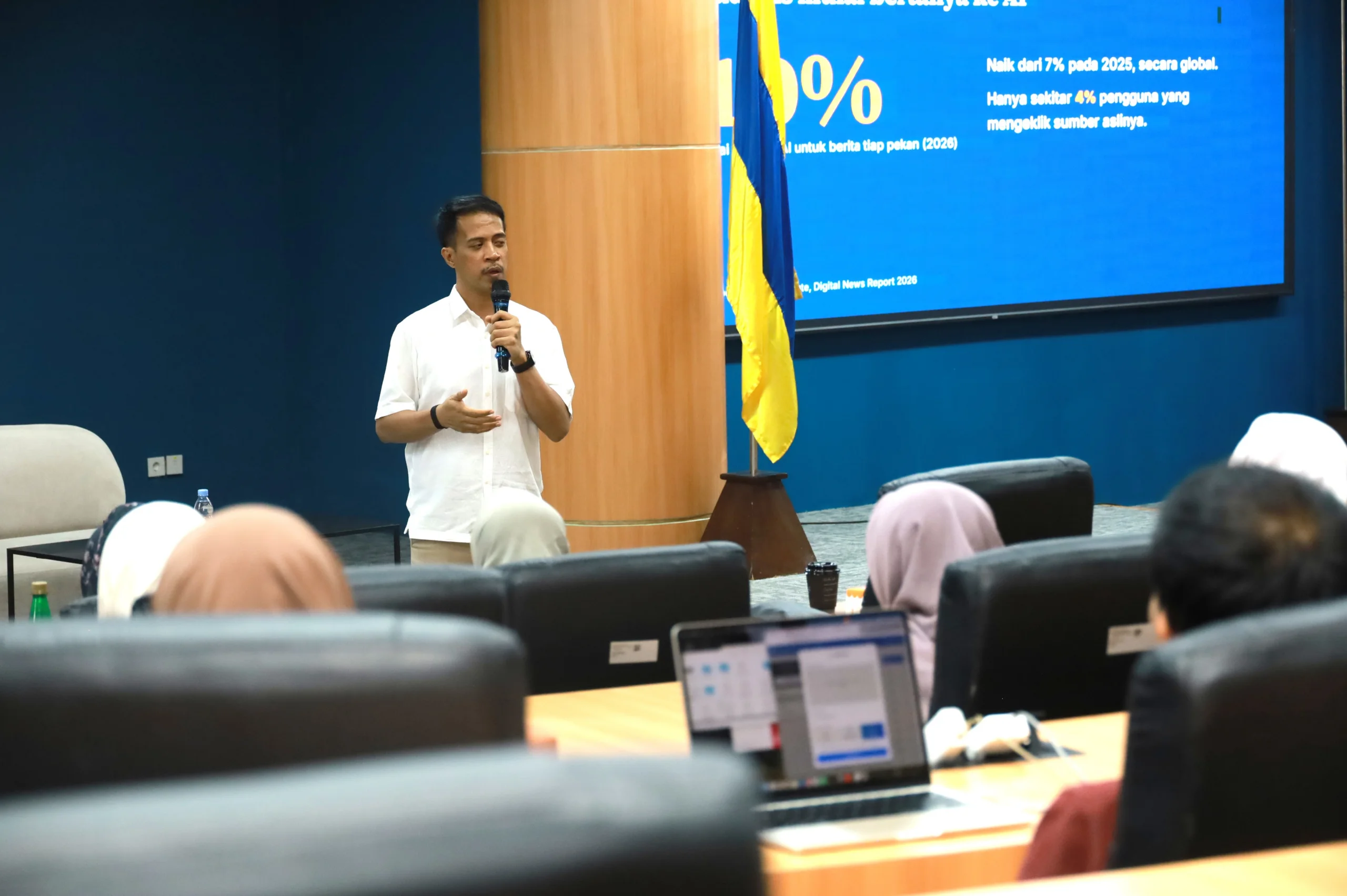
UNAIR NEWS – Use of artificial intelligence (AI) without ethical safeguards in public relations publications risks triggering a reputational crisis for the institution. This warning was emphasized by Indozone Editor-in-Chief Dr Fahmy Fotaleno SIP MIKom during a journalism training session titled “Smart PR & Smart Content” held at the Airlangga Convention Center (ACC) UNAIR MERR-C Campus, on Tuesday, October 20, 2026.
Fotaleno said that about 79 percent of public relations professionals now rely on generative AI to streamline their workflows. However, he emphasized that speed must not come at the expense of accuracy, given that AI-generated content remains prone to factual hallucinations, narrative biases, and errors in the presentation of confidential data.
Upholding journalistic principles
To maintain public trust, Fotaleno urged UNAIR public relations practitioners to consistently adhere to the five core principles of journalism: truth, verification, independence, minimizing harm, and transparency.
“Artificial intelligence is merely a tool to complement our work, not to replace our role. Accuracy and full accountability for information remain in human hands,” Fotaleno emphasized.
While drafting press releases, public relations professionals are expected to consistently maintain the authenticity of the narrative and the integrity of the data. One ethical boundary that must not be crossed is fabricating quotes from sources using AI generators.
“Creating artificial quotes with AI is strictly prohibited in journalism and public relations. Quotes must come purely from the original source direct statements to maintain the integrity of the information,” Fotaleno emphasized.
Applying the S.M.A.R.T governance framework
Additionally, the senior journalist17 years experience,introduced the S.M.A.R.T. governance framework, an acronym of the Indonesian terms for clear sources (Sumber jelas), humans in control (Manusia pegang kendali), accurate (Akurat), confidentiality protected (Rahasia dijaga), and transparent (Transparan). The use of AI is permitted to spark ideas (brainstorming), refine language, and format texts.
However, there is a strict prohibition on entering confidential institutional data and publishing content without re-verification. Ideally, the workflow places humans at the beginning and end of the production process, while AI serves only as a rough draft generator in the middle.
“Speed in sharing information is indeed important for public relations professionals, but factual accuracy is non-negotiable. We must not allow institutional confidentiality to be compromised simply because we are overconfident in feeding sensitive and important data into public AI systems,” he explained.
In closing his presentation, Fotaleno emphasized that AI must not replace the human role, in accordance with Press Council Regulation No. 1 of 2025. “Comprehensive human oversight is the key. This disciplinary measure is crucial to ensure that public relations professionals avoid reputation crises and the loss of public trust in the future,” he asserted.
Author: M Yasir Dharmawan Diniy
Editor: Khefti Al Mawalia