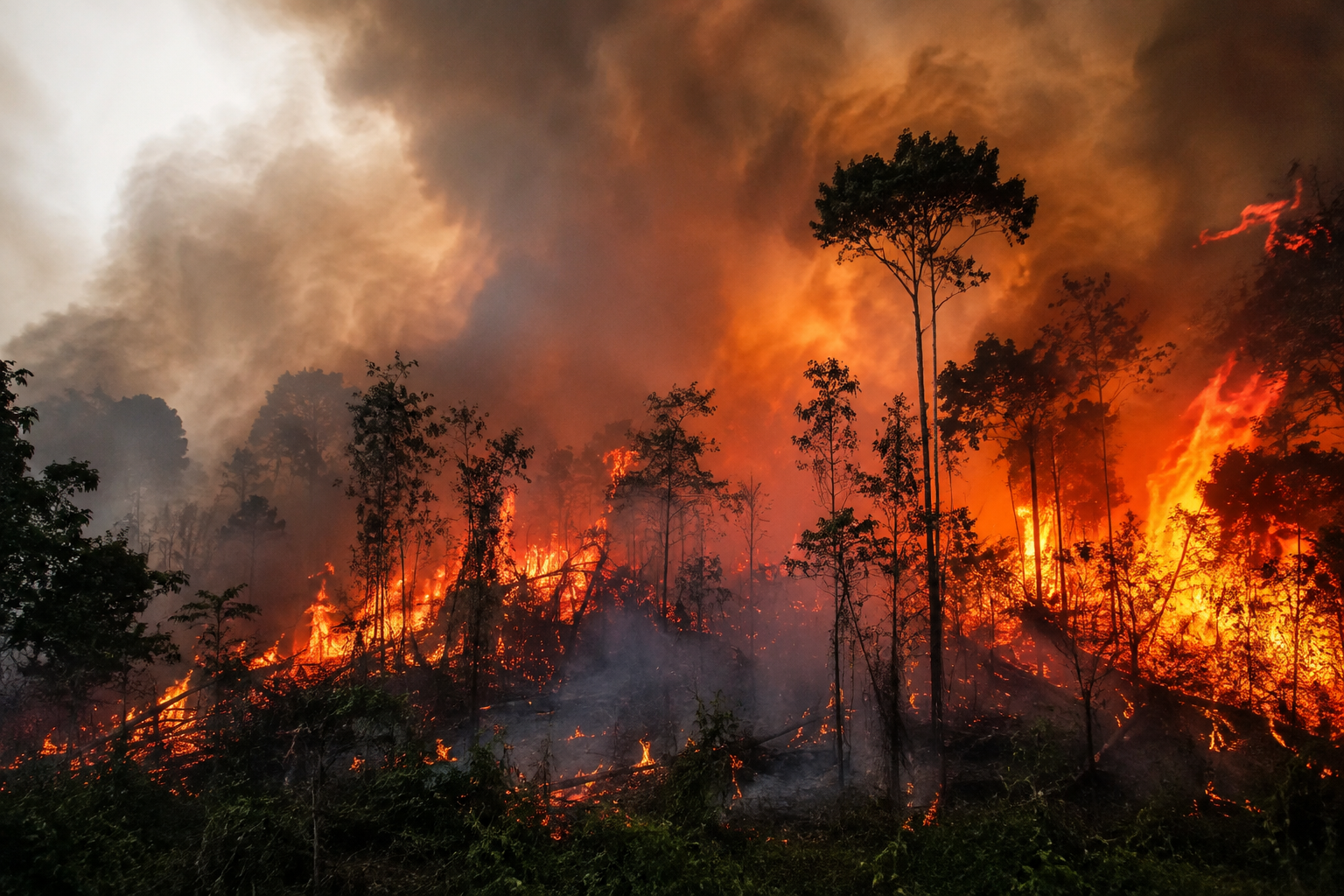
UNAIR NEWS – August should be a moment full of joy for Indonesian people. However, amid the festive atmosphere of Independence Day celebrations, various environmental issues remain a challenge. One of these is forest fires in Kalimantan, which have yet to fully resolve. These forests, which serve as one of the pillars of the global ecosystem, are once again facing the threat of fires that cause harm to both the environment and local communities.
Based on NOAA-20 satellite data cited in the material, there were approximately 1.487 hotspots, with the highest concentration in the area of Central Kalimantan. A lecturer from Master Program in Disaster Management, Postgraduate School (SPs), Universitas Airlangga (UNAIR), Dr Hijrah Saputra ST MSc, shared his thoughts.
“These fires were caused by three factors, weather conditions which are currently in the El Nino dry season. This condition makes the weather drier and increases the risk of fires. And the fact that the land in Kalimantan’s forests consist of peatlands, which are highly flammable and allow fires to spread rapidly,” he explained. Saputra also added, another major factor is caused by human activity, specifically the indiscriminate clearing of land by industry and illegal logging.
Government’s response considered inadequate
The effect caused by these massive fires, which also spread as far as neighboring countries, has damaged many aspects. However, Dr. Saputra considered the government’s preparedness and response time were less than optimal.
“Although the government has already taken steps to provide assistance through government agencies, such as National Disaster Management Agency (BNPB), the Meteorology, Climatology, and Geophysics Agency (BMKG), local governments, the Indonesian National Armed Forces (TNI), and the Indonesian National Police (Polri) which are already on the ground handling the situation, I deeply regret that the MInistry of Forestry has not yet issued an official statement or hel a press conference regarding the current situation. Even though the impact has already spread across national borders, such as Malaysia and Brunei,” said Dr Saputra on Saturday, August 22, 2026.

Losses in various sectors
Furthermore, these fires also caused various health risks. “For now, the public must be vigilant about the smoke caused by the fires. Health issues such as Acute Respiratory Infections (ISPA) have increased rapidly. Especially children, teenagers, pregnant women, and the elders who are breathing air that is classified as hazardous,” he said.
The Ministry of Health reports that the Acute Respiratory Infections (ISPA) cases in Indonesia have surpassed more than 400 thousand per week. These ISPA cases mark as one of the highest weekly trends in these past years, especially when compared with the early dry season period last year.
From the environmental side, Indonesia lost the world’s ‘lungs’, vegetation, and ecological functions that store carbon which produce oxygen and maintain ecosystem balance. “Once the land has been burned like this, it will take decades or even centuries to restore the forests to its former state,” Dr Saputra said.
In addition, there have been equally significant socioeconomic impacts. “This means there are many schools that have been forced to close. Not only in Indonesia, but also in neighboring countries. The limited visibility has hampered economic activity in the region, bringing it to a standstill,” he added.
Urgent fire mitigation
The public, particularly those in Kalimantan, must be cautious about smoke exposure. Dr Saputra urged people to minimize direct exposure by reducing outdoor activities. If it is absolutely necessary, he urged people to wear masks outdoors.
“The government and academia can also educate the local community and large companies about the importance of not clearing land indiscriminately,” he said.
Urgent mitigation steps that can be taken right now is, first, to quickly extinguish the fire hotspots. “The government and local communities can take immediate action as quickly as possible by extinguishing the fire hotspots,” he said.
Second, expanding health services such as distributing free masks to the public and deploying medical workers evenly to areas that have not yet been reached. “Furthermore, the government can also enforce the law against this land clearing by burning, and conduct rigorous audits of corporations that have violated regulations. This is to ensure that this disaster will not recur in the coming years and the government can anticipate it quickly,” he said.
Moreover, the government can also implement wild-life mitigation there. Animals including elephants, orangutans, and others should be relocated to residential areas or evacuated/translocated to safer forest areas. Post-relocation monitoring is also needed which could involve the Natural Resources Conservation Agency (BKSDA).
Dr Saputra noted that everyone should always consider the long-term impacts of whatever they do. “The government and the public truly need to work together to preserve the forest. Because at the end of the day, these forests will be enjoyed and passed down to the future generations,” he concluded.
Author: Fauziah Kandela
Editor: Khefti Al Mawalia