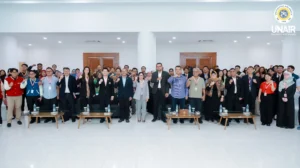


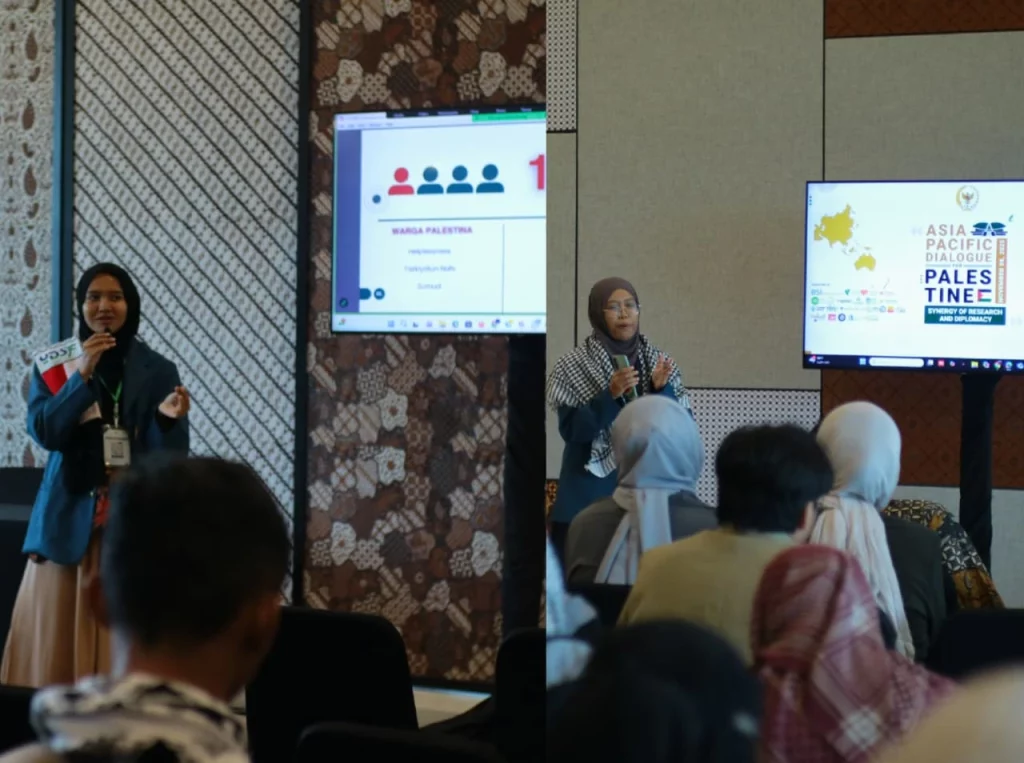
UNAIR NEWS – Four teams from Universitas Airlangga contributed substantial perspectives at an international forum titled “Asia Pacific Dialogue for Palestine: Synergy of Research and Diplomacy,” held at the Indonesian House of Representatives (DPR RI) Complex in Senayan, Jakarta, on Saturday (Nov 8, 2025).
The strategic gathering was organized through a collaboration among three key institutions: the Inter-Parliamentary Cooperation Body (BKSAP) of the DPR RI, the Indonesian Ulema Council (MUI), and the Palestine Research Center. The event followed a stringent selection and paper review process conducted from August 17 to November 4, 2025.
Examining genocide and narrative warfare
The UNAIR teams presented rigorous, interdisciplinary analyses. Two papers fell under the Law and Humanity cluster. The first, submitted by Anindhito Gading Rasunajati (Undergraduate Law) and Dhia Jinan Naura Nidaulhaq (Traditional Medicine Applied Bachelor), carried paper ID 257 and explored “Engineered Genocide in Gaza: An Examination of the Systemic Failures of International Law and the Urgency of Global Collective Action.”
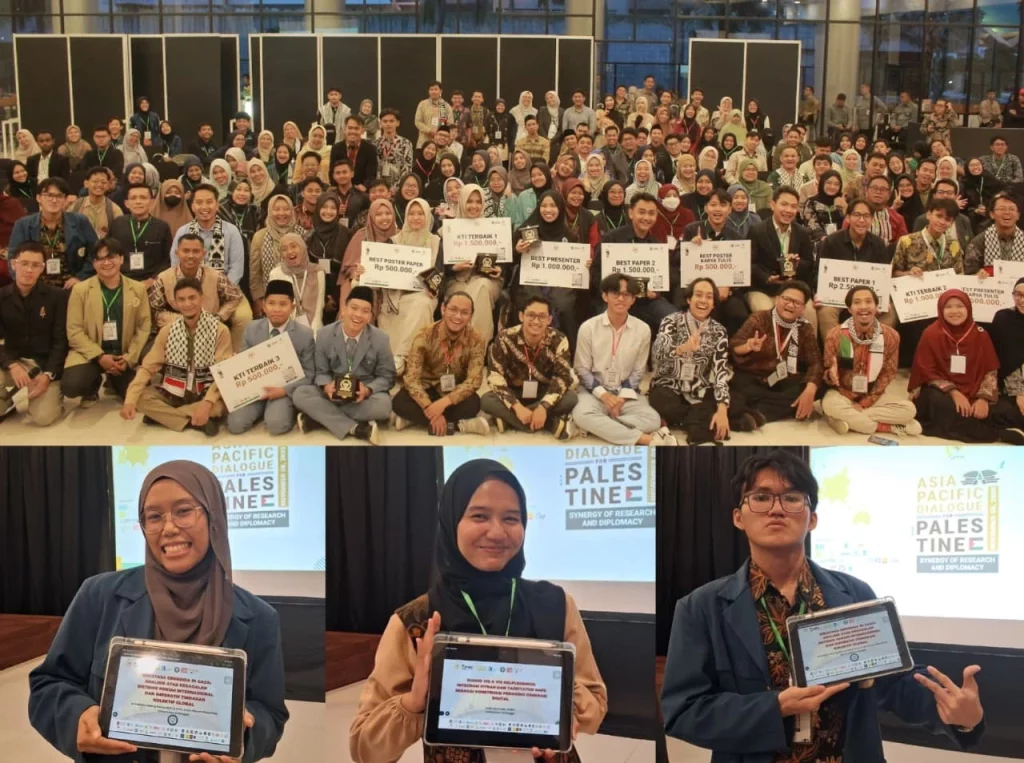
Also within the same cluster, Alfhen Rhedo Putra (Master’s in International Relations) presented his study (paper ID 223), titled “The UN’s Limitations as Mediator in the Post–October 7, 2023 Hamas–Israel Conflict: A Review of General Assembly and Security Council Resolutions.”
In the Culture and Social cluster, Sayyidah Ilman Nisa (Master’s in International Relations) assessed narrative framing through paper ID 228: “Representation of Palestinian Identity: An Analysis of BBC Coverage of the 2023–2024 Palestinian–Israeli Conflict.”
Rounding out the analyses, Aulia Rachmah Andini (Undergraduate Psychology) contributed to the Education cluster with paper ID 241, “Sumud Vis-à-Vis Helplessness: Integrating Fitrah and Tazkiyatun Nafs as a Pedagogical Model for the Digital Generation,” offering approaches to strengthening psychological resilience.
Intellectual arena for advocacy
The UNAIR delegates expressed that their participation was driven by a strong sense of purpose. For them, the forum represented a meaningful opportunity for scholars to champion Palestinian issues through academic research and diplomatic engagement at both national and international levels.
“This is not simply an academic conference. It is an intellectual battleground,” one team member noted. “Our work on ‘Engineered Genocide’ and the ‘Systemic Failure of International Law’ provides evidence-based support. We aim to give diplomats at BKSAP a solid legal and political foundation to advocate more forcefully on the world stage.”
Aulia Rachmah Andini added that the struggle also unfolds in the psychological sphere. “Our research introduces ‘sumud’, steadfastness, as a response to helplessness. We want our findings to move beyond academic halls and contribute to diplomacy that speaks for the younger generation.”
The participation of these four UNAIR teams reflects the real, active role of young scholars. Their involvement demonstrates that defending Palestine can be pursued across multiple domains, through sharp analysis, reliable data, and the academic conviction needed to influence global diplomatic conversations.
Editor: Yulia Rohmawati