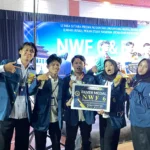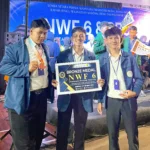
UNAIR NEWS – Students from the Faculty of Advanced Technology and Multidiscipline (FTMM) Universitas Airlangga (UNAIR) have added another achievement to the university’s growing list of international accolades. A multidisciplinary team comprising Raka Argha Ahsantya, Reizo Nararya Alinandito, and Muhammad Daffa Tristan from the Robotics and Artificial Intelligence Engineering program, alongside Alifah Rahmah, Dyah Ajeng Kencana Putri, Nabiel Faiz Rusdinar, and Bonifasius Christian Alfandhika from the Nanotechnology Engineering program, won both a Gold Medal and a Special Award at the World Young Inventors Exhibition (WYIE) 2026 in Kuala Lumpur, Malaysia, held from May 17–20, 2026. Their winning innovation, “WhisPr,” is a food quality monitoring system that combines Cloud AI, Internet of Things (IoT) technology, and silver nanoprism sensor technology.
Faster approach to food poisoning prevention
The WhisPr project was developed in response to concerns about food safety risks in school nutrition programs, where contamination can undermine efforts to improve children’s health. Unlike traditional food quality assessment methods that rely on pH or temperature measurements and often require more time, WhisPr provides rapid and highly sensitive spoilage detection. The device uses specially engineered triangular silver nanoparticles to identify Volatile Organic Compounds (VOCs) emitted by bacteria as food begins to spoil.

When VOCs are present, the sensor changes color from blue to yellow or black. If the color variation is too subtle to be detected visually, an integrated spectral sensor analyzes the change and determines whether the food remains safe or has become unsafe. The system also incorporates an AI-powered feature that uses a smartphone camera to estimate nutritional content.
“The main objective of school meal programs is to improve children’s nutrition, yet food poisoning incidents continue to occur. We wanted to address that issue by creating an innovation capable of identifying food spoilage quickly,” said Ian, a member of the team.
Bringing different disciplines together
Developing WhisPr required close collaboration between students from different academic backgrounds. The team had only two to three months to integrate expertise from nanotechnology and robotics into a single working system. While the Nanotechnology Engineering students focused on chemical synthesis, the Robotics and Artificial Intelligence Engineering students were responsible for developing the IoT infrastructure and application platform.
Reizo, one of the Robotics and Artificial Intelligence Engineering students, said coordinating across disciplines presented its own challenges. “The timeline was extremely tight. At first, it was difficult because we were not fully familiar with the Nanotechnology team’s area of expertise, but eventually we were able to bring everything together and make it work,” he said.
Pursuing intellectual property protection and commercial growth
Following its success at the competition, WhisPr attracted interest from international investors and academics in Malaysia who expressed a willingness to support the project’s development. The team is now working to strengthen the AI dataset used for nutritional analysis while preparing an application for intellectual property rights protection. Encouraged by the positive feedback, the students are refining their funding proposals and incorporating recommendations from experts they met during the exhibition.
“In the next few weeks, we plan to apply for intellectual property protection for our project and then move forward with fundraising efforts. The device is highly affordable and has strong potential for large-scale implementation,” Ian said.
Author: Fauziah Laili Romadhon
Editor: Ragil Kukuh Imanto