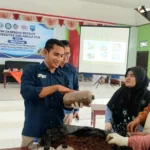
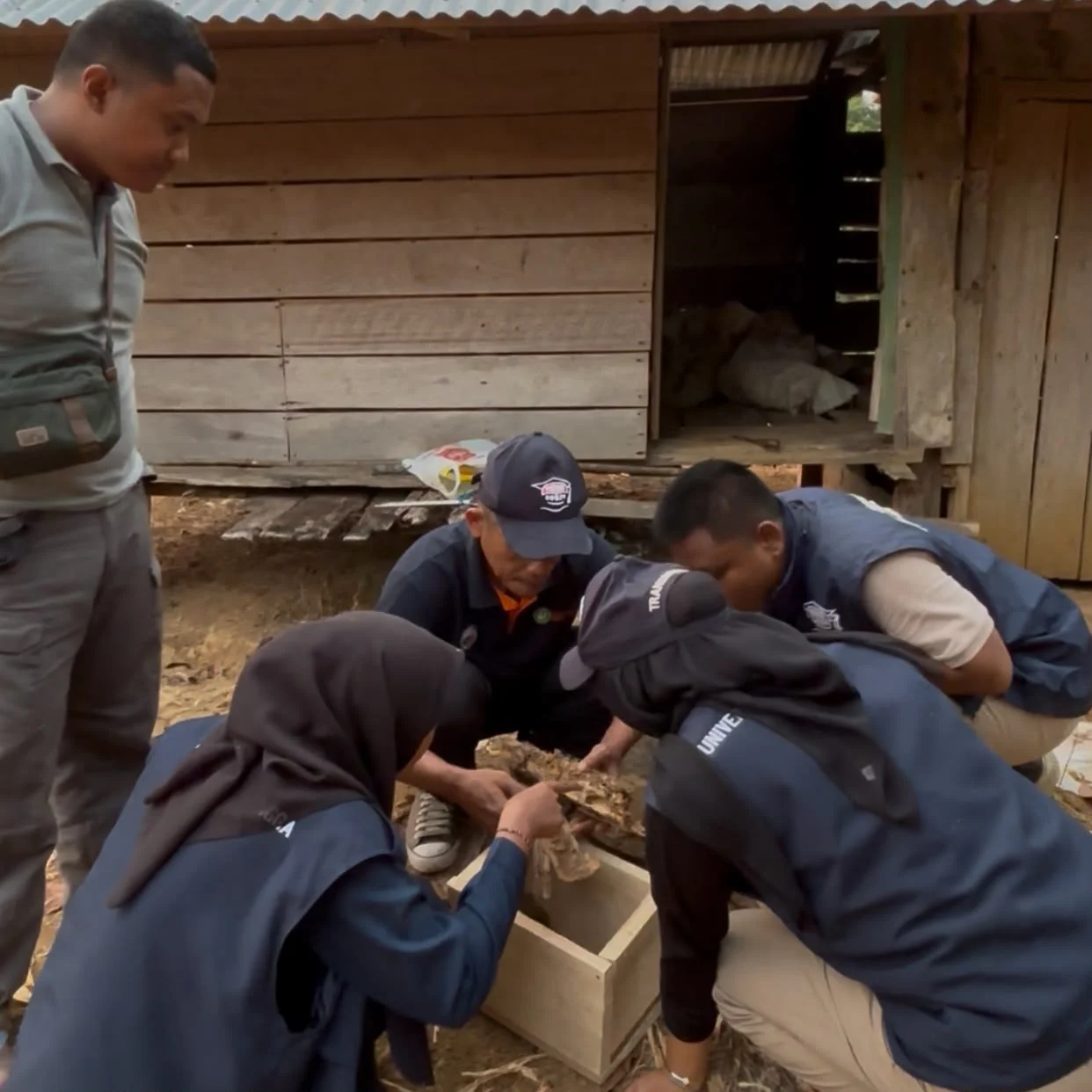
The Universitas Airlangga (UNAIR) Patriot Expedition Team at the Sumalata locus and local residents harvest Trigona bee honey “Tahudu” on Tuesday (October 6, 2026) (Photo: By courtesy)
The harvest took place on land owned by Rasmin Idrus, the former head of Pulohenti Village, specifically at a hut in the Pulohenti plantation area. The presence of Trigona bee colonies around the garden hut is a unique feature, and it shows how the surrounding space and environmental potential can be used for productive economic activities.
The plantation environment, with vegetation serving as natural food sources, also supports the growth of Trigona bee colonies. This potential is expected to develop into a local honey product with added value through packaging, branding, and marketing.
Knowledge transfer to the community
During the harvest, residents worked directly with the Patriot Expedition Team at the Sumalata locus, from checking the condition of the colonies and preparing to harvesting the honey. This involvement is part of knowledge transfer and community capacity building so that the cultivation can be managed independently and sustainably.
The UNAIR Patriot Expedition Team provided technical assistance while keeping the colonies’ sustainability in mind. This approach is expected to make Trigona bee cultivation a productive source of income for the community while supporting sustainable use of the environment.
Head of the UNAIR Patriot Expedition Team Dr Dr Johny Alfian Khusyairi SSos MSi MA expressed appreciation and gratitude to the North Gorontalo Regency Government and the community for supporting the development of Trigona bee cultivation in the Sumalata Transmigration Area.
“What is interesting about this activity is how simple potential in the garden environment can be developed into a productive activity. The community is directly involved in the process, so the knowledge and skills they gain can serve as provisions for independent management,” he said.
Realizing the SDGs
The activity supports SDG 8 (Decent Work and Economic Growth) through developing productive businesses based on local potential, SDG 15 (Life on Land) through cultivation that supports pollinators and the plantation environment, and SDG 17 (Partnerships for the Goals) through collaboration among the government, universities, the Patriot Expedition Team, and the community.
Dr Khusyairi hopes the collaboration will continue to be strengthened to develop the community’s economic potential and support the vision of the North Gorontalo Regency Government through the 2030 North Gorontalo Producer Movement (G-30 PB).
The harvest of Trigona honey “Tahudu” is a tangible form of community empowerment based on local potential that combines economic, environmental, capacity-building, and partnership aspects in the Sumalata Transmigration Area.
Author: Arif Yahya
Editor: Yulia Rohmawati