UNAIR NEWS – Dependence on coal poses challenges for East Kalimantan in achieving a just energy transition. This transition needs not only to promote the use of renewable energy but also to take into consideration the region’s economic sustainability and the future of workers in the mining sector. In response to these issues, students at Universitas Airlangga (UNAIR) have developed the JUST-5 Framework as a solution for a just energy transition.
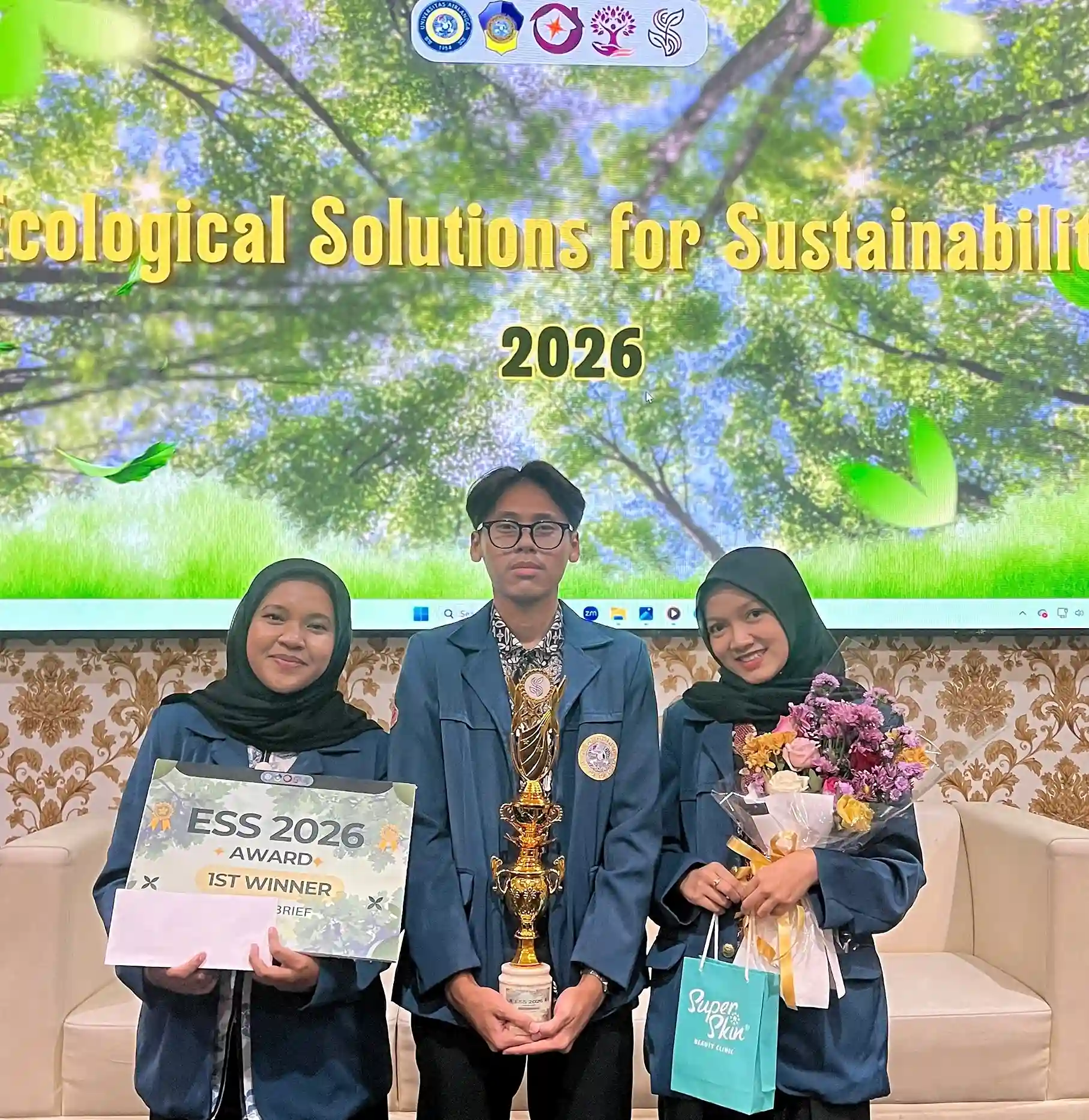
That idea brought the UNAIR team the first place prize in the “Ecological Solutions for Sustainability (ESS)” Policy Brief competition, organized by the UNAIR Student Executive Board (BEM) in collaboration with the Environment Ministry on Saturday, September 26, 2026.
The team consisted of Mifdah Nur Syahbaniyah as leader, along with Maia Chaerunnisa and Muhammad Daksha Hisahito. They presented a work titled “Breaking the Coal Trap: The JUST-5 Framework as a Manifestation of Net-Zero Emissions in East Kalimantan.”
JUST-5 Framework as Solution
Syahbaniyah explained that East Kalimantan economic dependence on coal, despite its vast potential for renewable energy, became the team’s main focus. “The JUST-5 Framework was developed so that East Kalimantan can begin to move away from its dependence on coal without neglecting its economy and communities,” she explained.
In order to develop a solution, the team conducted a problem analysis using the “Ask Why 5 Times” method. The results showed that the energy transition must be accompanied by regional economic transformation.
The team formulated the JUST-5 Framework based on five pillars: the rule of law, human capital transition, green financing, renewable energy, and economic diversification. Those five pillars integrate policy, the workforce, financing, renewable energy, and economic diversification into a single framework.
Opening economic opportunities beyond coal
During implementation, the team suggested mapping workforce needs as part of a skills-building program. It is expected to give workers in the mining sector the opportunity to transition to new economic sectors.
The team also proposed developing renewable energy according to the region’s potential. Their recommendations included the use of post-mining land for solar power plants, hydropower in suitable areas, and biomass and biogas from plantation and forestry waste.
Through JUST-5, the team hoped that the energy transition wouldopen up new opportunities for economic growth. The use of renewable energy can also help reduce dependence on coal.
According to Syahbaniyah, the concept of energy transition is not only focused on the environment but also takes into consideration other sectors, such as workers and the local economy. “We hope this concept can serve as a basis for further discussion among the government, academics, and other stakeholders concerned with the future of East Kalimantan,” she concluded.
Author: Vaneza Ika Artamevia
Editor: Yulia Rohmawati