


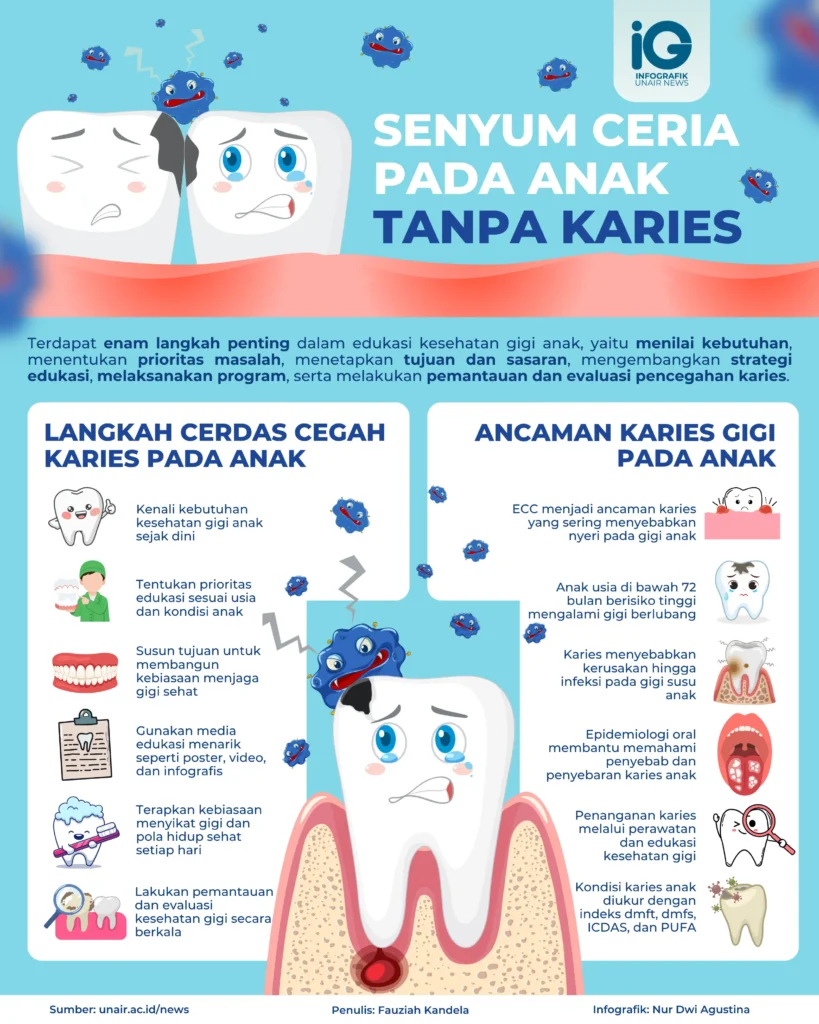
UNAIR NEWS – There are six key steps in
children oral health education: assessing
needs, identifying priority issues, setting
goals and objectives, developing educational
strategies, implementing the program, and
monitoring and evaluating caries prevention.
Smart steps to prevent childhood caries
Preventing childhood caries begins with
identifying children oral health needs from
an early age and tailoring oral health
education to their age and condition. The
next step is to establish clear goals for
developing good oral hygiene habits,
supported by engaging educational materials
such as posters, videos, or infographics. The
habit of brushing teeth and adopting a
healthy lifestyle must be practised
consistently, alongside regular monitoring
and assessment of dental health, to ensure
that children’s dental health is maintained.
The threat of childhood dental caries
Childhood dental caries, particularly Early Childhood Caries (ECC), is a common oral
health problem that often causes pain and
primarily affects children under 72 months.
This condition can lead to damage and
infection of the primary teeth, requiring both
dental treatment and oral health education. In
addition oral epidemiology plays an important
role in understanding the causes and
distribution of dental caries, while the severity
of children's oral health conditions can be
assessed using the dmft, dmfs, ICDAS, and
PUFA indices.
Also read: