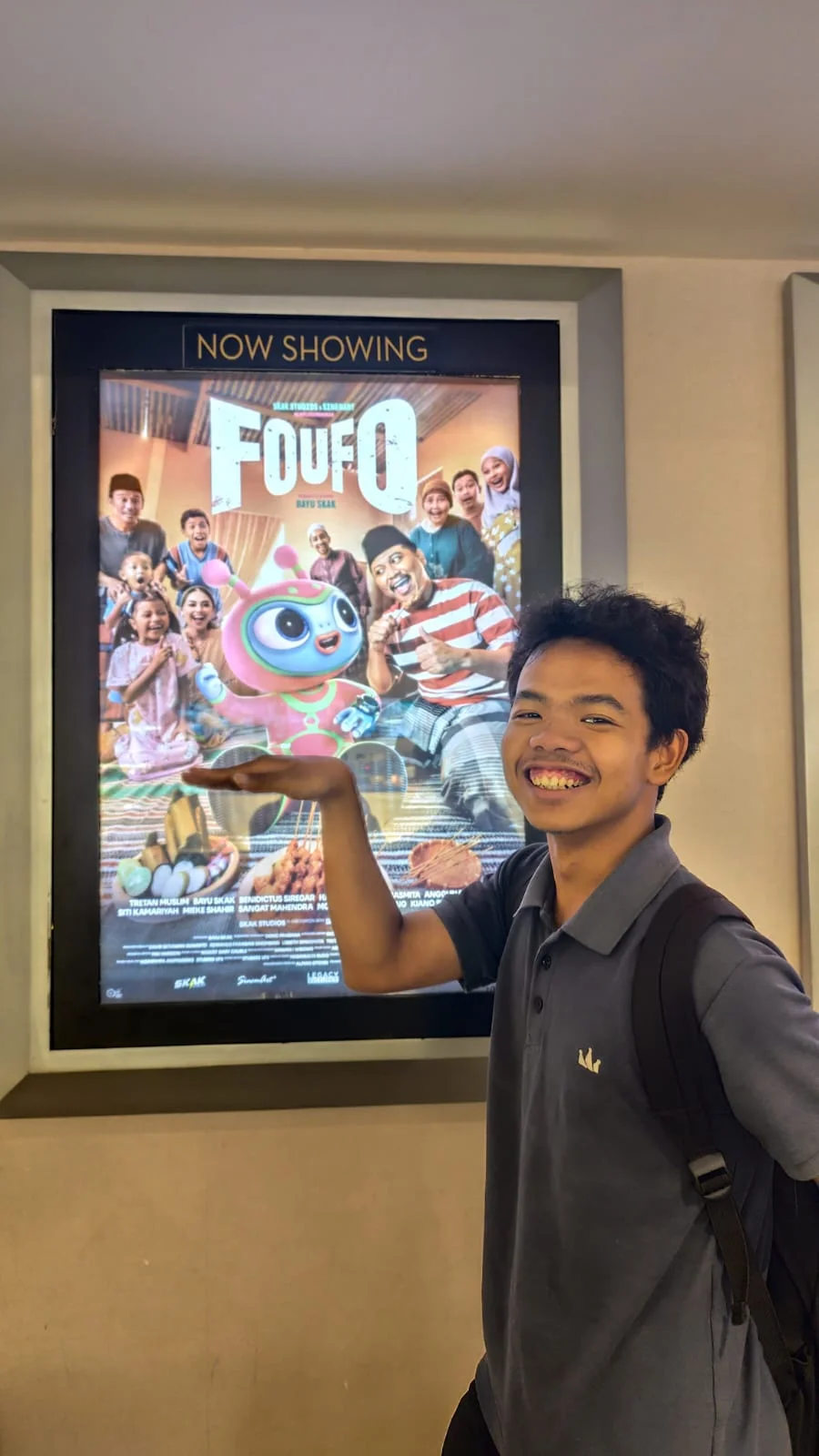
UNAIR NEWS – Driven by uneasiness about Indonesian mainstream cinema, which often features formal uniformity in both language and storytelling styles, Abdullah Muhammad Irsyad Syaifudin, a student at the Faculty of Humanities (FIB) Universitas Airlangga (UNAIR), won first place in UI Film Festival 2026 Film Essay Competition. This competition, organized by Universitas Indonesia (UI), took place from Sunday, August 23, through Monday, October 12, 2026. In his essay, Syaifudin not only analyzed the film FOUFO through the theme of Sandiwara Anuraga but also highlighted how the film exposes social realities regarding the stigma and stereotypes attached to the Madurese community.
“Mainstream Indonesian cinema is usually in the national language, and even when local languages are used, they’re merely for filler. However, in FOUFO, 90 percent of the dialogue is in the Madurese language. This is especially significant when we consider that stigma and stereotypes against the Madurese people remain widespread today,” he said.
Challenging the exploitation of poverty
In his essay, the deconstruction of how poverty is visualized in FOUFO is a crucial point. While mainstream cinema attracts audiences by exploiting and dramatizing the suffering of marginalized groups solely to elicit pity, FOUFO takes the opposite approach. “It is true that in mainstream cinema, poverty is often used as a tool for exploitation. At the same time, it is dramatized to make the audience feel sad and pity the subjects,” he said.
Social expectations and family affection form the core of the film’s conflict. Through the interactions between the characters, Syaifudin seeks to encourage readers to re-examine standards of true humanity. He also encourages readers to view poverty from a structural perspective.
“Poverty should not be understood solely as a result of a lack of individual effort. This is because issues of access, economic inequality, and job insecurity also shape a person’s life,” he added.
Emphasizing academic community responsibility
Not merely focusing on film aesthetics, Syaifudin writings serve as a framework for sharp social criticism while also reflecting the important role of the academic community. The structural perspective inherent in his work serves as a bridge, ensuring that the academic community does not lose touch with social reality.
In line with the spirit of the Tridharma of higher education, particularly the pillar of community service, this work serves as a call for academics to always keep their eyes open to social realities and to side with the benefit of society at large. “As academics, our focus and what we strive for is, of course, the welfare of society,” he concluded.
Author: Amelia Farah Putri Iswara
Editor: Ragil Kukuh Imanto