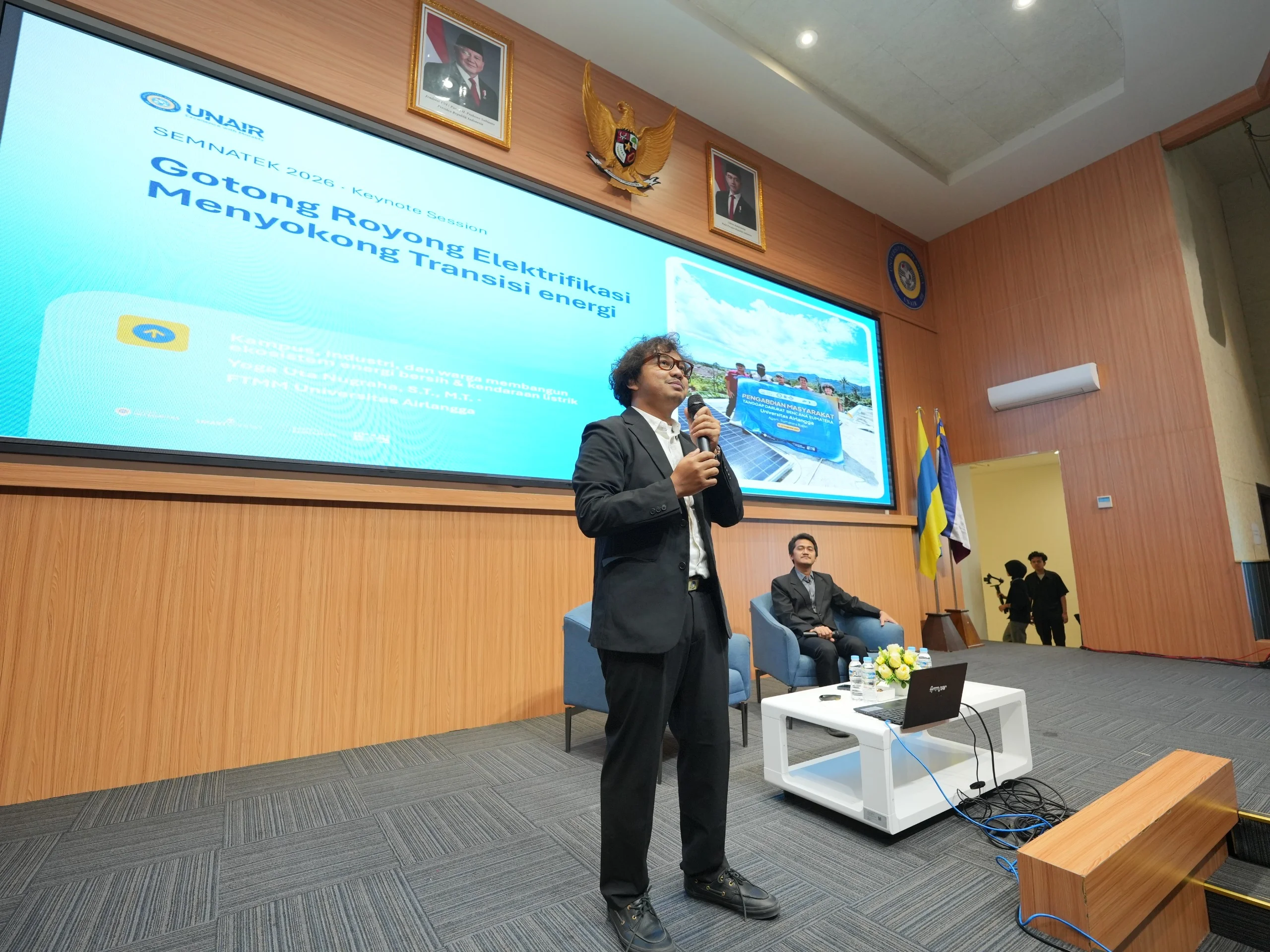
UNAIR NEWS – Energy transition requires collaboration among universities, partners, the government, and the public to ensure that technology can be used sustainably. Dr Yoga Uta Nugraha ST MT, a lecturer in Electrical Engineering at Universitas Airlangga (UNAIR), emphasized the importance of involving these various parties during a presentation titled “Mutual Cooperation (Gotong Royong) in Electrification to Support the Energy Transition” at the National Technology Seminar (SEMNATEK) 2026 on Thursday, October 15, 2026, at Candradimuka Auditorium, 9th Floor, Nano Building, UNAIR MERR-C Campus.
Collaboration to ensure sustainability of technology
According to Dr Nugraha, technology development needs to begin with research that takes into account local energy potential, technical design, economic aspects, and the ability of communities to use and maintain the devices. In this way, the implementation of technology does not end with installing equipment but also considers its sustainability.
Airlangga Solar Shelter on Gili Iyang is one example of a solar energy application that involves the community. The sustainability of this charging facility demonstrates the importance of support from parties outside the technology developers.
“Without contributions from the community, these things certainly wouldn’t be possible,” he said.
Furthermore, he explained that implementing technology is not just a matter of installing devices and handing them over to the community. Developers also need to provide education so that communities can use and maintain the technology, allowing them to enjoy its benefits in the long term.
Introducing solar energy from school age
Beyond implementing technology, universities can contribute through education. During a community service activity on Gili Iyang, UNAIR’s Faculty of Advanced Technology and Multidiscipline (FTMM) team introduced solar energy to elementary and middle school students through a demonstration of a solar-powered mini car.
Through this activity, students learned how solar panels work and gained exposure to the field of engineering. The hope is that this experience will broaden students’ perspectives on their opportunities to become engineers and develop technology, including electric vehicles, in the future.
For Dr Nugraha, efforts to support the energy transition can begin with small-scale activities that involve the community. He stressed that opportunities for collaboration to implement technology and provide direct benefits to the community remain wide open. “Piloting, however small, can be done,” he said.
Author: Katara Joy Kurniawan
Editor: Ragil Kukuh Imanto