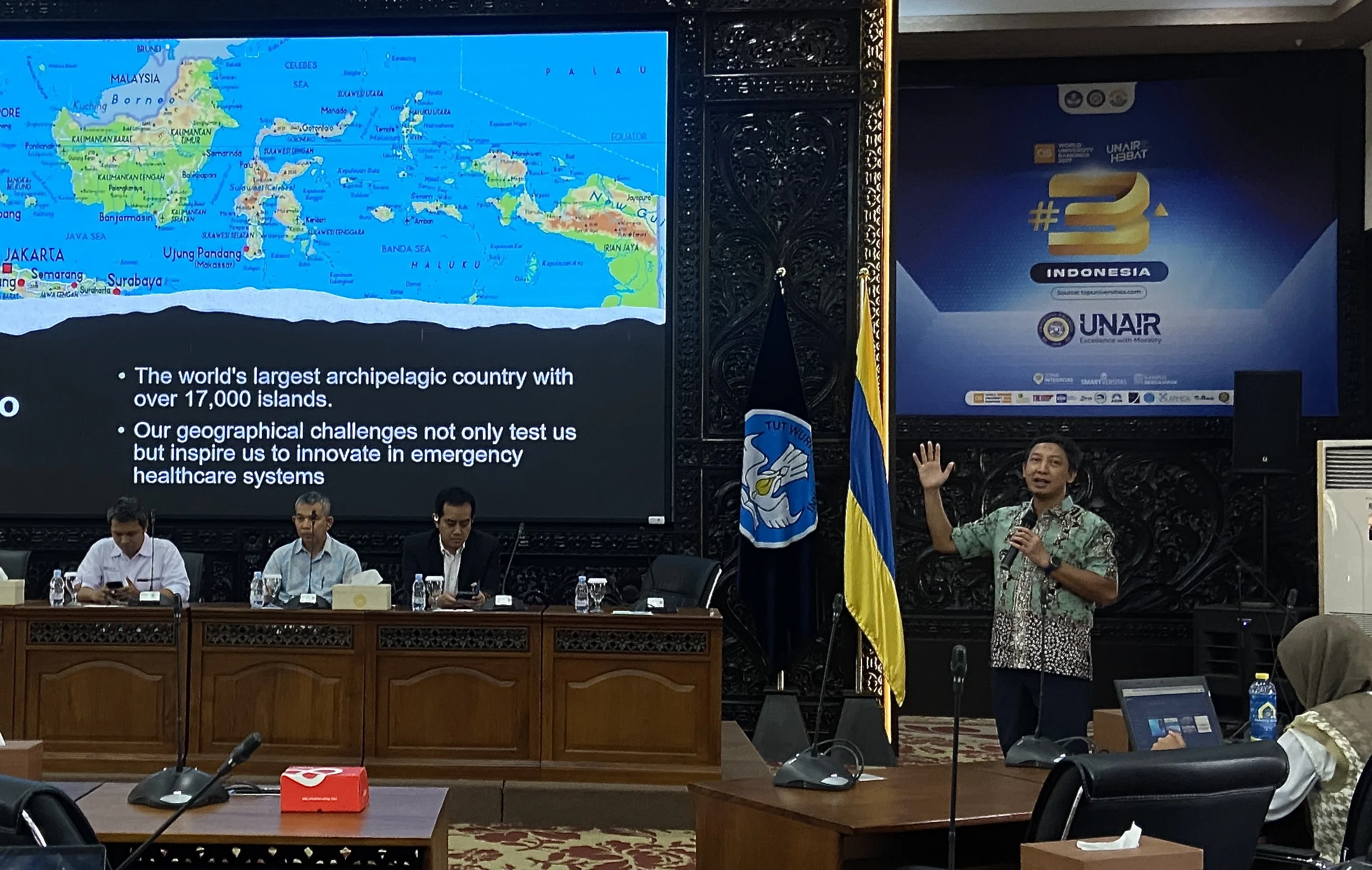
UNAIR NEWS – Closing the SDGs CONNECT 2026 international conference series, Universitas Airlangga (UNAIR) held the Garda Ksatria Airlangga Mahagana IKA Airlangga satellite parallel session on Friday, October 16, 2026. The session, themed on disaster management, took place at Amerta Hall, 4th Floor, Rectorate Building, UNAIR MERR-C Campus.
Speaking at the event, Garda Ksatria Airlangga Head Dr Bambang Pujo Semedi dr SpAn-TI SubspTI(K) delivered a presentation titled “Disaster emergency response: What it is and how it works.” In his presentation, he highlighted Indonesia’s geography as an archipelago of more than 10,000 islands, which makes it vulnerable to highly complex disasters throughout the year.
Integrated response and cluster system
According to Dr Semedi, disaster emergency response in Indonesia cannot be addressed through conventional means but must be based on a comprehensively coordinated health system. In addition, humanitarian operations must adhere to four core principles: humanity, impartiality, neutrality, and independence.
”Essentially, disaster emergency management is a coordinated response by the health system. We must uphold the principles of humanity and neutrality, ensuring that the groups most in need are given top priority, regardless of their background,” Dr Semedi stated.
He added that Indonesia has implemented a national cluster system for disaster management. These clusters range from search and rescue, evacuation and protection, and logistics to the health cluster, which covers medical services, sanitation, and data management.
Importance of field assessments
According to Dr. Semedi, one of the biggest obstacles in emergency response is often not the availability of expert personnel, but rather the management and distribution of resources. Inadequate coordination in the distribution of relief supplies at disaster sites frequently triggers new crises.
Because of this, he emphasized three crucial questions that volunteer teams must answer before deploying aid to a disaster site: what happened, what facilities are still functioning, and what the community actually needs.
“Having expert personnel is not enough if they are not supported by well-prepared equipment and precise resource allocation. Rescue teams must first conduct a rapid assessment before taking action to ensure that aid reaches the right people,” he explained.
In closing, he highlighted that, in addition to technical skills, disaster volunteers must master four core competencies: communication, decision-making, critical thinking, and problem-solving. He also called on all alumni and community members to strengthen cross-sector collaboration.
“Synergy between stakeholders through the pentahelix approach, including the active role of alumni in the community, is key to building a resilient and sustainable disaster response capacity,” concluded Dr Semedi.
Author: M Yasir Dharmawan Diniy
Editor: Khefti Al Mawalia