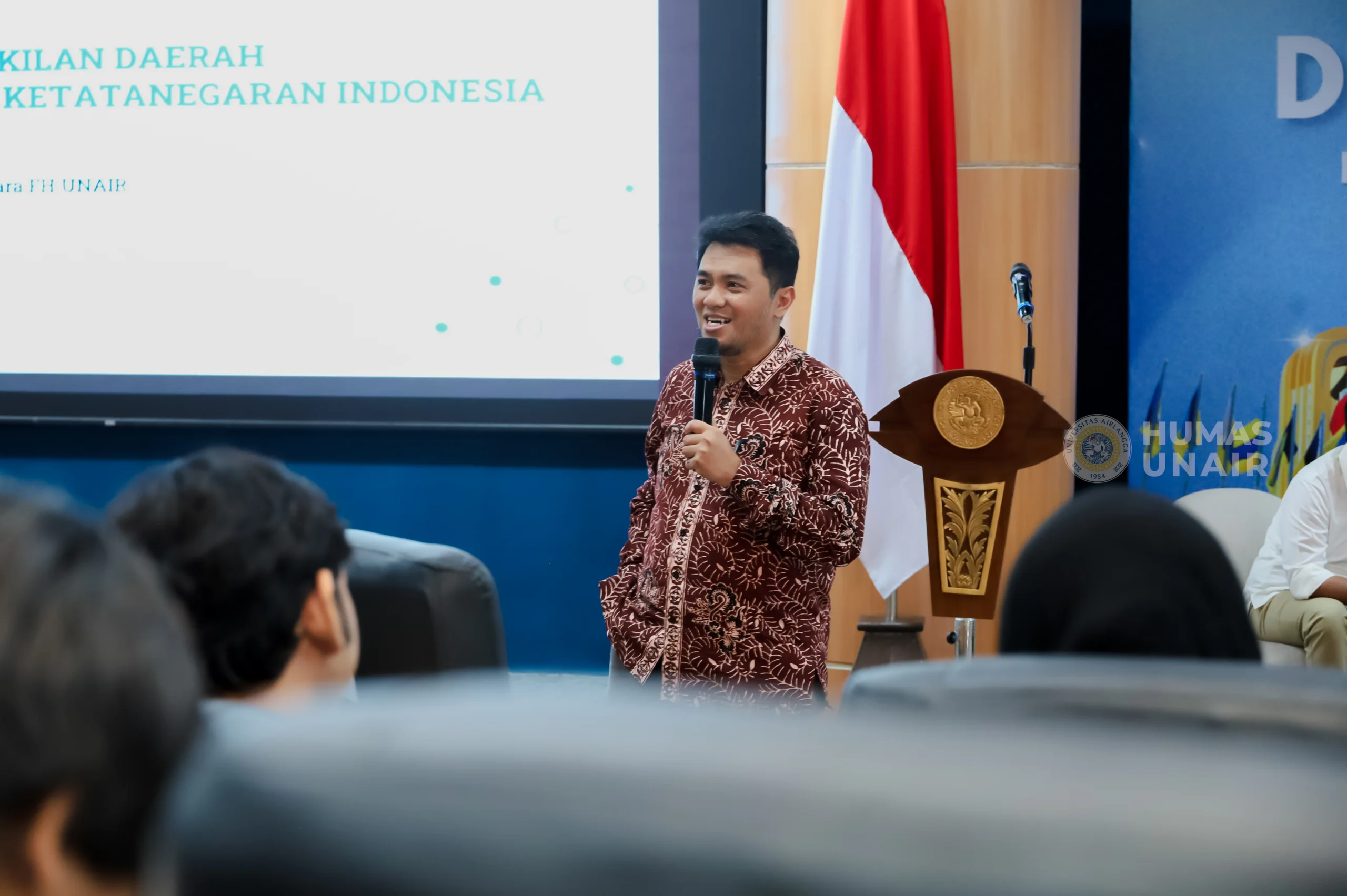
UNAIR NEWS – DPD Goes to Campus seminar at Universitas Airlangga (UNAIR) served not only as an opportunity to introduce the institution but also as a critical forum for examining the role of the Regional Representative Council (DPD RI). Constitutional law expert Prof Dr Radian Salman SH LLM and political communication expert Dr Suko Widodo Drs MSi joined the seminar to examine the constitutional dimension and social realities of the regional representative body.
Through an academic lens, both emphasized the importance of strengthening the legislative functions of the DPD RI while also urging improvements to political communication channels, so that the younger generation does not become apathetic toward the nation’s future.
Authority dilemma and bicameral system
Prof Salman emphasized that politics is, by nature, an inclusive issue and an extraordinary instrument for the common good when managed properly. “Politics is not an exclusive issue but an inclusive one. No matter which faculty you come from, you should engage with politics because it is an extraordinary tool for the common good,” said the professor at the Faculty of Law (FH) and Director of Human Resources at UNAIR.
He explained that, in Indonesia’s bicameral system, the House of Representatives (DPR) represents the population, while the DPD represents regions. However, current constitutional practice still shows an imbalance of authority (asymmetric bicameralism).
Limited legislative authority often makes the DPD seem like a mere supporting or advisory body. This prompts the need for a constitutional push through the restructuring of parliamentary functions.
“The DPD is, in reality, a council of advocacy due to its limited authority. Because its legislative authority is not yet symmetrical, the role of the DPD must continue to be fought for so that it can give full voice to regional aspirations,” Prof. Salman emphasized.

Bridging political communication gap
Meanwhile, UNAIR political communication analyst Dr Widodo highlighted the significant communication gap between political institutions and the younger generation. This situation has generated public skepticism toward political institutions.
“Many young people feel that politics is distant or dirty. In fact, politics is the process of managing shared interests and advocating for the people’s well-being,” explained Dr Widodo.
He believes the DPD RI has a major responsibility to build relaxed and context-sensitive two-way communication with students, rather than simply showing up right before elections. “The role of the DPD is not merely to seek voter support but to make the people’s aspirations the focus of its efforts. We must not let this political relationship become like unrequited love,” he said.
Closing his presentation, Dr. Widodo encouraged UNAIR students (Ksatria Airlangga) to turn personal anxiety into productive social concern for the betterment of society.
“Don’t be worried about yourself, but be a generation that feels restless when you see public issues around you. It is from that restlessness that real movements and change will emerge,” concluded Dr Widodo.
Author: M Yasir Dharmawan Diniy
Editor: Khefti Al Mawalia