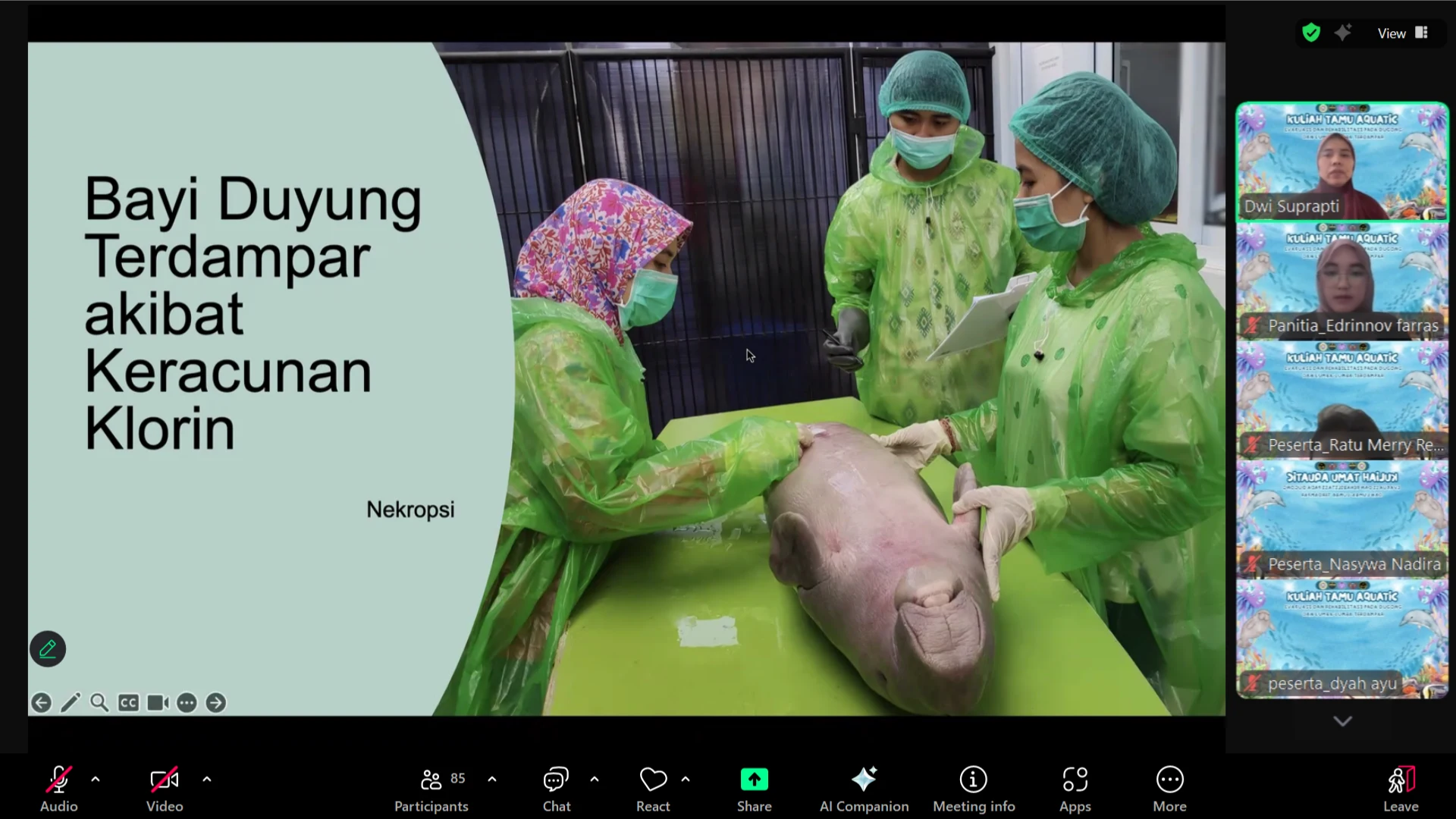
UNAIR NEWS – The Faculty of Health, Medicine, and Natural Sciences (FIKKIA) at Universitas Airlangga (UNAIR) hosted an Aquatic Guest Lecture titled Evacuation and Rehabilitation of Stranded Dugongs and Dolphins. The virtual event, held via Zoom on Saturday, June 28, 2025, was initiated by Wildlife Animal Care (WLAC), a division under the Veterinary Medicine Student Association (HMKH).
The featured speaker was Drh Dwi Suprapti, M.Si, a veterinarian with over 20 years of experience in marine megafauna conservation. She explained that marine mammals such as dugongs and dolphins differ significantly from fish in terms of anatomy and respiration.
“The main differences are in tail orientation and breathing. Marine mammals have horizontal tails, breathe through lungs, and possess blowholes on the tops of their heads. In contrast, fish have vertical tails and use gills to breathe,” she said.
Understanding causes of stranding
Drh Suprapti defined a stranding event as a situation in which a marine mammal becomes unable to return to its habitat on its own, often ending up in shallow waters or on land. She identified eleven key causes behind such events.
“These range from being caught in receding tides, illness, predators like cookiecutter sharks, underwater noise, fishing activities, boat strikes, seabed earthquakes, algal blooms, solar storms, extreme weather, to marine pollution,” she explained.
She shared her experience rescuing a baby dugong that had been separated from its mother due to low tides. “Unlike dolphins, young dugongs tend to approach humans. They sometimes hide under a diver’s arm, thinking it’s their mother,” she added.
Response protocols based on condition codes
Drh Suprapti outlined five response codes used to classify stranded marine mammals. Code 1 applies to live animals that need urgent rescue. “For dugongs, dolphins, or other marine mammals, it’s critical to keep their blowholes clear, prevent sand from getting into their eyes, and avoid damaging their pectoral fins due to body weight. All of this must be safeguarded,” she explained.
Code 2 refers to recently deceased animals that are still suitable for necropsy. Code 3 describes carcasses in early decomposition, where partial necropsy is still possible. Code 4 applies to severely decomposed bodies, where only external documentation can be done. Code 5 indicates only skeletal remains are left.
She emphasized the need to approach stranded animals calmly to reduce stress. For evacuation, a stretcher that is both sturdy and gentle is essential due to the animals’ sensitive skin. In mass stranding scenarios, group releases require coordinated handling.
“In mass strandings, like with dolphin pods, you can’t release them one by one. They need to be released simultaneously, ideally in a circle, so they can maintain visual contact. If one gets left behind, it’s likely to strand again,” she explained.
She closed by stressing the importance of reporting all stranding incidents to the appropriate authorities. “Don’t act alone. Always involve the Ministry of Marine Affairs and Fisheries (KKP), the Marine and Fisheries Department (DKP), or other relevant agencies. And make sure to document and study every case as a collective learning opportunity,” she concluded.
Author: Fania Tiara Berliana Marsyanda
Editor: Ragil Kukuh Imanto