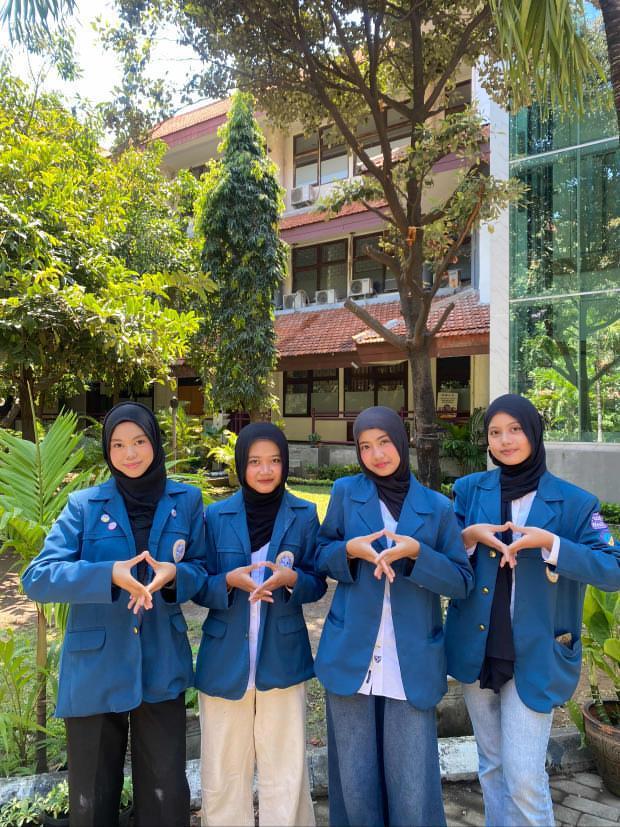
UNAIR NEWS – Four students from the Faculty of Public Health (FKM), Universitas Airlangga (UNAIR), successfully advanced to the national stage of the 2026 Student Digital Innovation Competition (LIDM) in the Reasoning and Poster Design (PDP) category, through a digital poster highlighting the dangers of microplastics to family health. Team Bisa Jadi, consisting of Ulfa Suci Ayuwijaya, Benita Alexandra Menajang, Hawa Syahirah Thifal, and Shinta Putri Maharani, used a visual storytelling approach to connect ocean pollution with the entry of microplastics into the human food chain.
Connecting ocean pollution and family health
The team developed the work out of concern over the dangers of microplastics, which remain poorly understood by the public. They highlighted how plastic waste polluting the water can break down into microparticles and enter the human body through food. This became the team’s main motivation for raising the issue through their work, aiming to shift public perception from a mere environmental issue into a tangible threat within the household.
In the process, the team traced the journey of microplastics from the aquatic environment to the consumer. They then packaged this journey into a single visual sequence, so the audience could better understand the connection between ocean pollution and everyday life.
“We developed a digital poster innovation based on persuasive visual storytelling, focusing on the flow of microplastic pollution from the sea to the dining table. This poster innovation aims to make the public aware that the pollution has already entered the food chain and poses a direct threat to everyday family health,” Menajang said.
Thifal further explained that the team developed the idea by tracing the cause-and-effect relationship between ocean pollution and its impact on society, rather than simply raising the issue of ocean waste in general. “The idea of linking global ocean pollution with family health threats at the dining table is the key point of novelty and the main appeal of our poster, and it’s what helped us advance to the national level,” she concluded.
Expanding microplastic education through #SebelumTersaji
After bringing the issue of microplastics into their poster, the team expanded their educational message through the social campaign #SebelumTersaji. The campaign serves as the team’s next step in bringing the issue of plastic waste management closer to society, particularly within the family sphere.
“We will continue our social campaign called #SebelumTersaji. Through this movement, we want to educate the wider public to shift their bad habits around plastic waste management,” Thifal explained.
They hope the campaign can raise public awareness about caring for the environment, as well as build habits of managing plastic waste starting at home. Ultimately, #SebelumTersaji is expected to serve as an invitation for society to consider the impact of plastic waste before it reaches the consumption stage.
Author: Katara Joy Kurniawan
Editor: Ragil Kukuh Imanto