UNAIR NEWS – The Bengawan Solo River, which flows through Ngawi Regency, is currently facing the threat of pollution caused by the discharge of industrial waste, which is contaminating the tributaries that form a part of the Bengawan Solo River basin. The murky, foul-smelling river water, which contains hazardous substances, inspired a team from Universitas Airlangga students who took part in Community Service Program – Learning with the Community (KKN-BBK) 8, to present a nature-based solution. A program titled GESANG (Gerakan Sawah Apung) introduced the use of Floating Treatment Wetlands (FTW) or floating gardens to residents of Ngawen and Waru hamlets, Kalang Village, Pitu Subdistrict, Ngawi Regency, on Wednesday, July 29, 2026.
Floating Treatment Wetlands (FTW) works by using the roots of aquatic plants which hang directly on the river’s surface to absorb pollutants such as fertilizer residues, soap waste, and hazardous heavy metals. Around these roots, millions of microbes of beneficial bacteria grow and break down pollutants naturally without the use of any chemicals. As a result, the polluted water will gradually be restored.
The plants used include water hyacinth, water spinach, water jasmine, and other plant species that have been shown to have dense root systems and high pollutant absorption capacity. Interestingly, water hyacinth that has been considered as a harmful weed, is actually the main component that is optimally utilized in the implementation of these floating gardens.
Direct practice with community
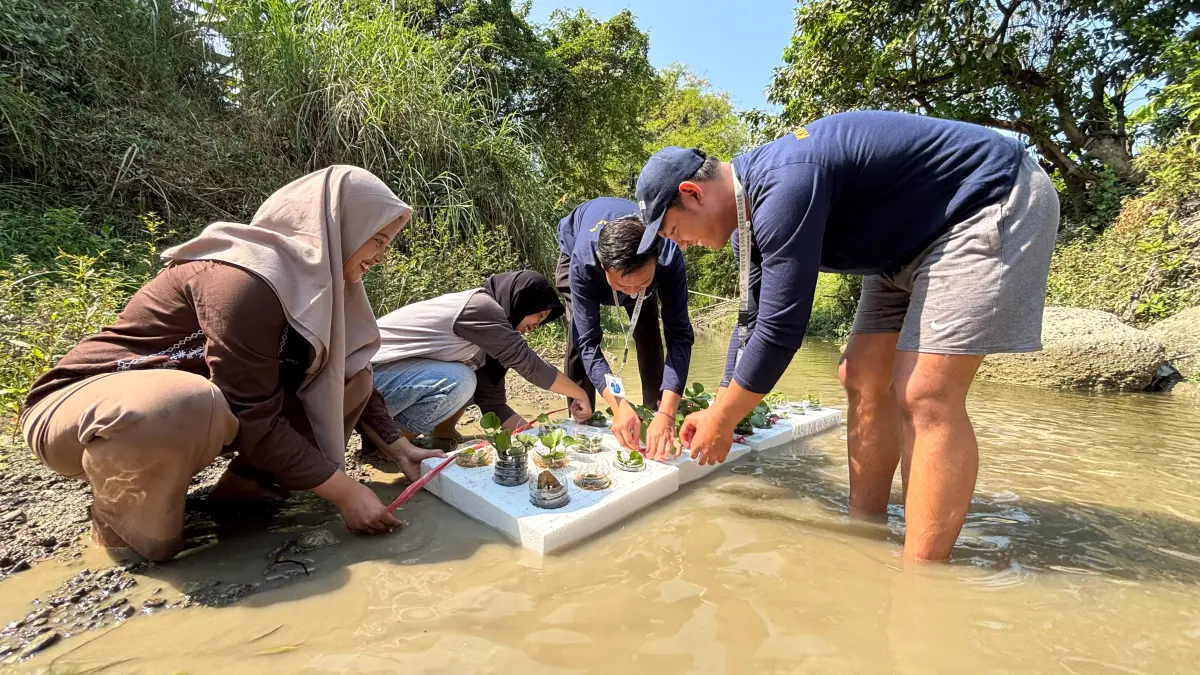
The program did not only stop at the presentation of material, function, and how Floating Treatment Wetlands works. BBK 8 UNAIR students also invited about 2 to 5 residents of Ngawen and Waru hamlets to practice building Floating Treatment Wetlands using simple and easily obtainable materials. The structures were made of 7-10 cm thick styrofoam and used plastic water bottles with holes drilled in them, which were then filled by layers of coconut fibers, pebbles, sand, and soil before being planted with water hyacinth, with the roots pointing downward to touch the water.
This direct practice approach was chosen so that the community would not only understand its function, how it works, and its concept, but they are able to implement Floating Treatment Wetlands independently in water bodies surrounding their village. Hoping that this direct practice can be carried out on a sustainable basis.
One of the residents who participated, Ilona, expressed her admiration towards the implementation of Floating Treatment Wetlands presented by BBK 8 UNAIR students. “It’s truly wonderful that the Community Service Program students from UNAIR were able to implement and teach us about these floating water hyacinths in the tributaries of the Bengawan Solo River, especially here in Kalang Village. I hope that the implementation of these floating water hyacinths can free rivers in Kalang Village from the waste,” she said.
Through this GESANG program, Community Service Program – Learning with the Community (KKN-BBK) 8 Universitas Airlangga students also contribute to support the achievement in Sustainable Development Goals (SDGs) point 6 (Clean Water and Sanitation), through the implementation of phytoremediation which directly reduces river contamination. Beside, this program also aligns with SDG 12 (Responsible Consumption and Production), through the reuse of water hyacinths and reusable materials responsibly. Lastly, this program aligns with SDG 15 (Life on Land), which is reflected by the effort to maintain the balance of the aquatic ecosystem and the vegetation surrounding the river.